


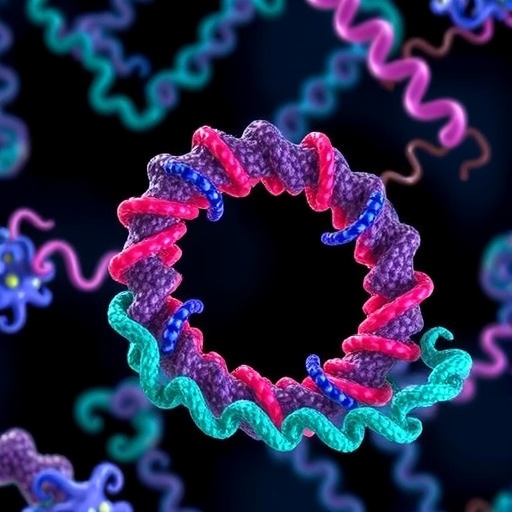
A newly published study in Molecular Cell unravels the intricate structural dynamics of the protein SPOP, shedding light on how cancer-associated mutations disrupt its delicate functional balance. Researchers at St. Jude Children’s Research Hospital reveal that SPOP exists in a finely tuned equilibrium between an active filamentous state and an inactive “double-donut” assembly—a discovery that resolves previous mysteries behind unexplained mutations impacting cancer progression.
SPOP acts as a substrate receptor within a larger E3 ubiquitin ligase complex, tasked with regulating cellular protein levels. This regulation controls critical gene regulators such as BRD2, BRD3, and BRD4, whose dysregulation is implicated in oncogenesis. While certain cancer-linked mutations impair substrate binding and are well understood, others located outside the substrate interaction sites had remained enigmatic—until now.
Using cryo-electron microscopy, the team characterized two distinct quaternary structural states of SPOP. The inactive form assembles into a large, ring-like double-donut structure composed of 22 to 30 SPOP molecules stacked as two rings. This conformation essentially “switches off” SPOP’s function. In contrast, the active conformation features linear filaments, a unique property among substrate receptors in ubiquitin ligase complexes, which facilitates the binding and turnover of target proteins.
The study further demonstrated that the cellular equilibrium between these states is governed by Cullin-3, a scaffolding protein that promotes filament formation and activates SPOP. Crucially, cancer mutations either shift this balance toward the inactive double-donut state—resulting in loss of function—or toward the active filaments, causing gain of function. This aberrant switching allows mutated SPOP to evade normal regulatory mechanisms that govern its activity.
Intriguingly, the inactive double-donut concentrates within nuclear speckles—membraneless compartments associated with RNA processing—while gain-of-function mutants disperse outside these domains. This spatial distribution highlights how structural shifts not only affect SPOP activity but also its subnuclear localization, further influencing cellular behavior in cancer.
These insights usher in a new framework for targeting SPOP in cancer therapy. Understanding the signaling pathways that regulate the transition between inactive and active states could permit pharmaceutical modulation of SPOP’s function. By manipulating this structural equilibrium, it may become feasible to restore proper protein homeostasis in cancer cells.
The discovery presented took several years and substantial access to advanced cryo-EM facilities, reflecting the complexity of SPOP’s higher-order assemblies. Despite these advances, some prevalent cancer mutations remain unexplained, signaling that SPOP’s role in oncogenesis is even more multifaceted than currently appreciated.
This pioneering research not only resolves longstanding structural puzzles but also underscores the sophisticated regulation of ubiquitin ligase receptors. As cancer mutations commandeer SPOP’s molecular switching mechanism, new therapeutic strategies targeting these transitions represent a promising frontier in combating malignancies.
Cite Scienmag News
Nathaniel Bowman. (July 14, 2026). SPOP Double-Donut Structure Reveals Cause of Cancer Mutations. Scienmag. https://scienmag.com/spop-double-donut-structure-reveals-cause-of-cancer-mutations/
Nathaniel Bowman. "SPOP Double-Donut Structure Reveals Cause of Cancer Mutations." Scienmag, 14 July 2026, https://scienmag.com/spop-double-donut-structure-reveals-cause-of-cancer-mutations/. Accessed 4 September 2026.
Nathaniel Bowman. "SPOP Double-Donut Structure Reveals Cause of Cancer Mutations." Scienmag. July 14, 2026. https://scienmag.com/spop-double-donut-structure-reveals-cause-of-cancer-mutations/


