

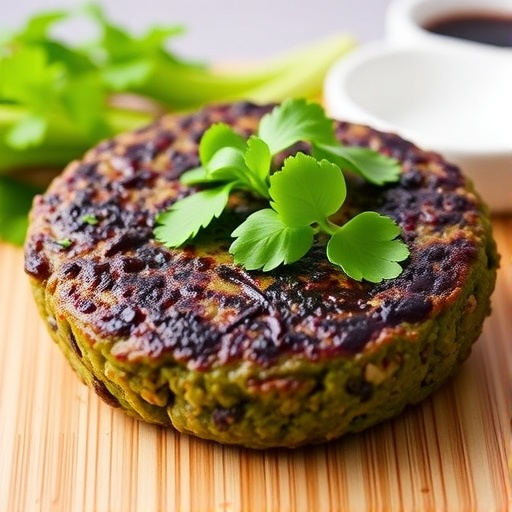
In the rapidly evolving landscape of food technology, a significant breakthrough has been reported by researchers investigating how plant-based patties—an increasingly popular alternative to traditional meat—can be improved both in taste and quality. A study published recently in Food Science and Biotechnology highlights the transformative potential of spirulina-derived Maillard reaction products (MRPs) in enhancing these vegetable-based protein substitutes. Given the surge in global demand for sustainable and nutritionally optimized meat alternatives, this work could herald a pivotal shift in the production of plant-based foods by leveraging novel chemical reactions and bioactive compounds from microalgae.
Spirulina, a blue-green microalga renowned for its exceptional nutritional profile and vibrant pigmentation, has long been lauded as a superfood. Its rich content of proteins, vitamins, and antioxidants makes it a promising candidate for incorporation into food products. What makes this new study particularly novel is the application of Maillard reaction products derived specifically from spirulina—a process that mimics natural browning reactions involved in cooking and roasting whereby proteins and sugars interact to produce complex flavor compounds. These MRPs are responsible for the desirable aroma, color, and taste in a variety of cooked foods, but their use in plant-based patty formulation marks a cutting-edge innovation.
Within the newly published research, the authors meticulously examined how spirulina-derived MRPs affected multiple quality attributes of plant-based patties, including texture, flavor profile, moisture retention, and volatile compound composition. Utilizing advanced chromatography and sensory analysis tools, the study delved into the molecular mechanisms by which these MRPs interact with the plant protein matrix and lipids to form a more appealing and palatable final product. The volatile profile, representing the ensemble of aroma-active molecules responsible for sensory perception, was notably enriched, leading to a taste experience closer to conventional meat patties.
This enhancement in flavor is critical because one of the main challenges facing plant-based meat alternatives is replicating the savory, umami-rich taste that consumers associate with traditional meats. By tapping into the biochemical reactions induced by spirulina MRPs, the study harnesses an effective, natural flavor enhancer that also contributes antioxidant benefits, potentially improving the shelf life and nutritional value of these patties. This addresses a dual challenge: satisfying consumer taste preferences while also offering health advantages through bioactive compounds.
The texture of plant-based patties is another domain where this research delivers promising results. Typically, vegetable proteins tend to lack the fibrous, juicy quality characteristic of animal meat, often leading to a less satisfying mouthfeel. The researchers observed that incorporating spirulina-derived MRPs improved the water-holding capacity and structural integrity of the patties. This chemical interaction likely stems from the modification of protein cross-linking and interactions with polysaccharides, culminating in a product that maintains moisture during cooking and delivers a juicier bite.
Beyond culinary properties, the color of plant-based patties is an equally vital dimension impacting consumer acceptance. The Maillard reaction is well recognized for contributing to the appealing browning of cooked foods, which signals flavor and freshness to the consumer. The study documented a marked improvement in the caramelized coloration of patties treated with spirulina MRPs. This color development is attributed to the melanoidin compounds formed during the Maillard process, which also contribute antioxidant activity—a dual benefit that synergizes visual appeal with nutritional enhancement.
Importantly, this work also interlinks with ongoing research aiming to minimize the reliance on synthetic additives or flavor enhancers in food products. By relying on naturally derived Maillard reaction products from a sustainable source like spirulina, producers can reduce the chemical footprint of their manufacturing process and align better with consumer demand for clean-label, minimally processed foods. This aspect resonates strongly in a marketplace where transparency and ingredient origin wield increasing influence on purchasing decisions.
Moreover, spirulina’s cultivation boasts environmental advantages compared to many plant protein sources, requiring less land, water, and energy while fixing atmospheric carbon dioxide. Capitalizing on spirulina MRPs not only elevates the sensory profile of plant-based meats but also advances the environmental sustainability narrative—positioning such food innovations at the crossroads of ecological responsibility and consumer satisfaction.
The volatile profiles analyzed in the study reveal a complex spectrum of aroma compounds including pyrazines, furans, and aldehydes—generally associated with roasted, nutty, and savory aroma notes that are highly valued in meat products. Through gas chromatography-mass spectrometry (GC-MS), the researchers characterized these compounds forming as a direct consequence of heat-driven Maillard reactions on spirulina protein and carbohydrate constituents. Such molecular insights provide crucial guidance for formulating flavors tailored to consumer expectations.
What makes the application of spirulina-derived MRPs technologically robust is the adaptability of the Maillard reaction conditions—temperature, pH, and reactant concentrations can be precisely tuned to optimize outcomes. This flexibility permits customized flavor and texture profiles without detrimental nutritional losses, a constraint often encountered in food processing. The study also rigorously evaluated the safety profile of these MRPs, confirming the absence of harmful by-products that frequently complicate Maillard chemistry in processed foods.
Industry stakeholders aiming to scale these findings face the exciting prospect of integrating spirulina MRPs production into existing protein ingredient supply chains. Spirulina cultivation and processing infrastructure is already expanding due to demand in supplements, and utilizing by-products or fractions for MRP generation could enhance economic viability. This is aligned with circular economy principles and valorization of food-grade microalgal biomass in multi-product platforms.
From a consumer perspective, the improved organoleptic properties of these plant-based patties could significantly impact market adoption rates. Participants of taste panels included meat-eaters and vegetarians alike, with many reporting a closer approximation to traditional beef patties in terms of juiciness, flavor complexity, and overall satisfaction. This sensory upgrade promises to reduce barriers for flexitarians transitioning towards plant-forward diets.
While this study sets a promising foundation, the authors acknowledge the necessity of further research to fully translate lab-scale findings into commercial production. Future work will likely explore integration with other plant proteins such as pea, soy, or wheat gluten, and delve deeper into nutritional bioavailability and digestive impacts of spirulina MRPs. Multidisciplinary collaboration involving food chemists, nutritionists, and sensory scientists will be pivotal in advancing this technology from concept to supermarket shelves.
In essence, the employment of spirulina-derived Maillard reaction products in plant-based patties embodies a powerful convergence of food science innovation, sustainability, and consumer-centric product enhancement. It exemplifies how leveraging natural biochemical processes and bioactive sources can unlock novel avenues to overcome longstanding challenges in plant-based meat analog design. As more consumers pivot towards environmentally responsible and health-oriented food choices, such advancements could redefine the sensory expectations of alternative proteins and elevate their role in global diets.
This pioneering research also underscores the untapped potential of microalgae as functional food ingredients far beyond their traditional scope. By marrying cutting-edge analytical techniques with creative food chemistry, the study contributes valuable knowledge that can stimulate further exploration into algae-derived MRPs and their applications across a broad spectrum of food products. The ripple effects of these innovations could revolutionize how flavors and textures are engineered in the foreseeable future.
Ultimately, this enriching interplay between microbiology, chemistry, and culinary science signals a new frontier where sustainability and sensory delight coexist harmoniously. The emergence of spirulina-derived Maillard reaction products as enhancers in plant-based patties is a testament to how targeted scientific inquiry can catalyze transformative progress in food innovation—offering promising solutions to nourish a growing and environmentally conscious global population.
Subject of Research: The study investigates the impact of spirulina-derived Maillard reaction products on the quality and volatile flavor profiles of plant-based patties.
Article Title: Effect of spirulina-derived Maillard reaction products on quality and volatile profiles of plant-based patties.
Article References:
Kim, Y.E., Hwang, Y.J., Nam, JK. et al. Effect of spirulina-derived Maillard reaction products on quality and volatile profiles of plant-based patties. Food Sci Biotechnol (2026). https://doi.org/10.1007/s10068-025-02082-9
Image Credits: AI Generated
DOI: 02 February 2026


