

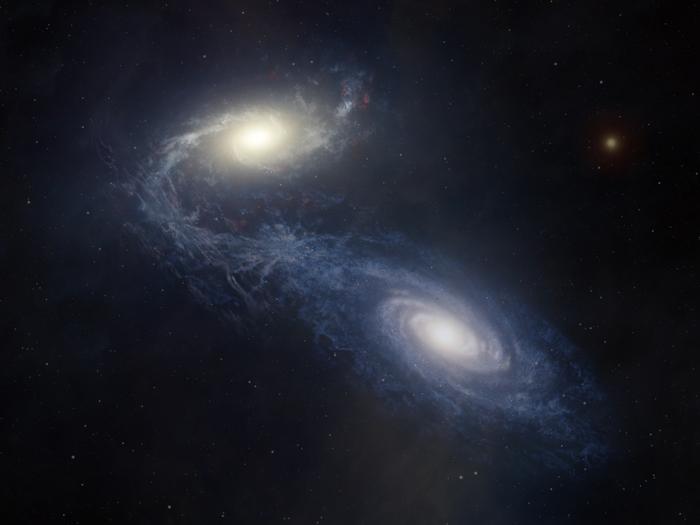
In a groundbreaking astronomical study published in Nature Astronomy on March 23, 2026, a team led by researchers at the Center for Astrophysics | Harvard and Smithsonian has pioneered a novel method to unravel the complex assembly history of galaxies beyond our Milky Way. Utilizing detailed chemical fingerprinting, what scientists call “extragalactic archaeology,” the study unlocks a new dimension in our understanding of galactic evolution by reconstructing the past 12 billion years of growth for the giant spiral galaxy NGC 1365.
This innovative approach leverages the intricate distribution of heavy elements such as oxygen within the galaxy’s gas clouds to decode its formative processes. Heavy elements are produced in stars and dispersed through supernova explosions, effectively embedding a chemical record across a galaxy’s structure. By analyzing these chemical patterns and comparing them to high-resolution simulation data, astronomers can draw a timeline of star formation, gas dynamics, and mergers that shaped a galaxy’s current form.
NGC 1365’s face-on orientation was key to this study, allowing the researchers to resolve and study star-forming regions individually across its expansive spiral arms. Data gleaned from the TYPHOON survey, conducted with the Irénée du Pont telescope at Las Campanas Observatory, provided unprecedented spectral detail. Young, hot stars emit intense ultraviolet light that excites the surrounding gas, causing elements like oxygen to shine in characteristic emission lines. These luminous markers expose variations in chemical abundance that are critical to tracing the galaxy’s past.
A central insight from the study is the radial gradient of oxygen abundance typically observed in spiral galaxies, where heavier elements concentrate more densely in the core and diminish toward the outer disk. Such gradients are shaped by a galaxy’s star formation rate, gas inflows and outflows, and the integration of smaller galaxies through mergers. By comparing observed oxygen distributions with the output of advanced simulations from the Illustris Project—which model galaxy formation from shortly after the Big Bang through cosmic time—researchers could reverse-engineer the evolutionary trajectory of NGC 1365.
Out of the approximately 20,000 virtual galaxies simulated, one emerged as a close analog to NGC 1365, paralleling its star formation patterns, gas flows, and chemical composition. From this, the team inferred a dynamic history wherein NGC 1365’s dense central core formed early and rapidly enriched with oxygen, while its extensive outer spiral arms accreted material through continual interactions with smaller dwarf galaxies over billions of years.
These results underscore how massive spiral galaxies evolve not in isolation but through hierarchical growth, repeatedly cannibalizing smaller companions that introduce fresh gas and stars. This ongoing assembly process shapes their chemical and physical properties, leading to the complex morphologies seen today. According to Lars Hernquist, a senior astrophysicist involved in the study, the remarkable concordance between simulation and observation validates the realism of current galaxy evolution models.
The concept of “chemical archaeology” thus emerges as a transformative tool to probe cosmic history, enabling astronomers to extract detailed evolutionary narratives from gas-phase element abundances. Extragalactic archaeology provides a powerful complement to spatial and kinematic studies, adding a chemical dimension to the story of galaxy formation and growth. As Lisa Kewley, the study’s lead author, emphasizes, this marriage of cutting-edge observations with sophisticated simulations exemplifies the synergy essential for advancing extragalactic astronomy.
By examining galaxies structurally akin to the Milky Way, this research yields comparative insights critical to understanding whether our galaxy’s evolutionary pathway is typical or exceptional. Questions about the universality of spiral galaxy formation, radial oxygen distribution, and diversity of assembly histories find fertile ground in this emerging field. Does every spiral galaxy pass through similar phases of growth and merger-driven chemical enrichment? Are their elemental fingerprints signatures of unique pasts or shared cosmological principles?
As technological advancements continue to sharpen our view of distant galaxies and quantify their chemical makeups, extragalactic archaeology is poised to revolutionize our grasp of galactic evolution on cosmic timescales. This study of NGC 1365 not only unlocks the secrets of a single giant spiral but heralds a new era of chemical cartography across the universe. Through such endeavors, we inch closer to comprehending the cosmic alchemy that eventually fertilized the elements making life and breathing possible on Earth.
Understanding the complex interplay of star formation, supernova enrichment, gas accretion, and galactic mergers refines our broader cosmological models. These insights bear directly on the grand questions of how baryonic matter evolves within dark matter halos and how galaxies attain the diverse morphologies observed at the present epoch. Future research expanding the extragalactic archaeology approach across larger samples promises to chart the chemical histories of many galaxies, enriching our cosmic narrative and illuminating our place among the stars.
Subject of Research: Not applicable
Article Title: The assembly history of NGC 1365 through chemical archaeology
News Publication Date: 23-Mar-2026
Web References:
http://dx.doi.org/10.1038/s41550-026-02808-7
Image Credits: Melissa Weiss/CfA
Keywords: Galaxy formation, Cosmology


