

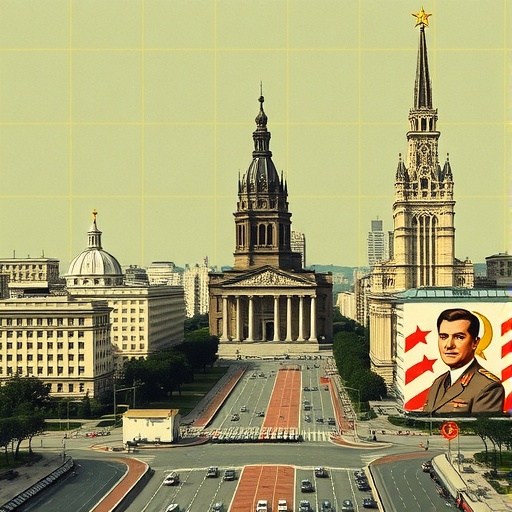
In the realm of cultural data and media, geographical representation carries far more significance than mere cartographic placement. It frames public perception, influences policy decisions, and shapes the collective memory of societies. A pioneering new study shines a spotlight on these dynamics within Soviet-era media, revealing an intricate web of biases in city portrayal that reflects both demographic realities and ideological priorities. By examining the Soviet newsreels from the mid-20th century, researchers have uncovered how urban representation transcended simple population metrics and was inflected by economic specialization and geographical strategic importance.
The study hinges on a corpus of “Novosti Dnya” (News of the Day), short newsreels shown in cinemas as political and cultural primers before feature films. These news segments, ubiquitous in Soviet life, acted as a daily lens on the country’s evolving urban landscape, extolling progress in industrial hubs and celebrating triumphs aligned with the state’s socialist agenda. By dissecting this archival footage quantitatively and qualitatively, scholars have tracked patterns revealing which cities gained disproportionate attention and which remained on the margins of imagined Soviet space.
At the heart of this analysis lies the concept of superlinear scaling, a phenomenon well documented in urban science where certain metrics increase disproportionately relative to city size. Here, the representation of cities in Soviet propaganda was found to scale superlinearly with population: larger cities did not just appear more frequently by virtue of their size; they dominated the media landscape in a far greater measure than population alone would predict. This suggests an intentional amplification of key urban centers in line with ideological goals.
Yet, city size alone does not fully explain the uneven media focus. The researchers noted significant biases linked to each city’s industrial specialization. Cities known for hydroelectric power generation and steel manufacturing were disproportionately celebrated, reflecting Soviet emphasis on heavy industry and technological prowess. This specialization served as a marker of ideological and economic importance, dictating media coverage that reinforced narratives of progress and socialist achievement.
Conversely, entire regions suffered systematic underrepresentation. The Soviet industrial heartland, despite its population and economic weight, found itself somewhat neglected in media terms. Similarly, cities located in the non-European socialist republics received markedly lower visibility, indicating a layered hierarchy of geographical significance. This illustrates how media portrayal served not only to highlight centers of power but to marginalize peripheral regions within the multinational Soviet state.
This research stands at the intersection of urban science, cultural geography, and digital humanities, blending data-driven methodology with critical interpretative frameworks. By quantifying media mentions of cities and correlating these with demographic and economic data, the study provides a robust statistical foundation. Qualitative interpretation further enriches this foundation, allowing the research team to contextualize their findings within Soviet ideological discourse and cultural policy.
The iterative feedback methodology employed by the researchers is particularly noteworthy. Starting with quantitative bias measurements, they refined their analytical categories through repeated qualitative assessments—creating a dynamic cycle of discovery that allowed the nuanced political and cultural dimensions of media representation to emerge clearly from the raw data. This holistic approach enables a deeper understanding of how propaganda shaped and reflected Soviet spatial imaginaries.
An unexpected insight from this work is the revelation that media representation operated not simply as a mirror of urban hierarchy but as a tool actively shaping perceptions of regional and industrial importance. The amplification of hydroelectric and steel cities, for instance, was as much about signaling Soviet technological triumph as it was about reporting on urban facts. This conscious media strategy reveals how propaganda functioned at the nexus of communication and urban development.
Beyond Soviet contexts, the findings speak to broader phenomena in cultural data analytics, emphasizing the crucial role of representational bias in shaping collective cultural memory. Geographical distortions in media help explain how societies construct particular narratives of place and progress—often privileging certain regions or industries to advance political agendas or cultural myths. The study exemplifies the potential for interdisciplinary approaches to unravel these embedded patterns.
This research also challenges the assumption that media representation naturally aligns with objective data like population size or economic output. Instead, it highlights a deliberate mediation process where socio-political priorities dictate which cities become emblematic or invisible. Such insights have profound implications for urban historians, media scholars, and policymakers attempting to understand how historical and contemporary cultural outputs construct urban imaginaries.
From a methodological standpoint, leveraging Soviet newsreels as a data source provides a rich, albeit complex, archive for studying ideological media bias. The filmic nature of the corpus, combined with its national circulation and temporal consistency, creates ideal conditions for longitudinal studies. The use of computational techniques to track city mentions quantitatively enhances traditional archival methods, unearthing trends not readily visible through manual analysis.
This pioneering combination of urban metrics with cultural analysis opens fruitful avenues for future research across different temporal and geographical contexts. How do contemporary media ecosystems replicate or diverge from Soviet-era dynamics? To what extent do technological shifts reshape media biases? By applying similar methods to global media corpora, scholars can gain comparative insights into the geography of cultural representation and propaganda.
Moreover, the findings resonate with global urban policy discussions about visibility and equity. Cities omitted from national or international media flows risk marginalization in resources and recognition, exacerbating regional disparities. Understanding historical biases offers a critical lens for addressing the representational justice of contemporary urban narratives and ensuring more inclusive portrayals of diverse urban futures.
This study ultimately reminds us that map-like representations in culture are never neutral. Whether in news media, film, literature, or digital platforms, portrayals of place carry the weight of power, ideology, and economic interest. By revealing the Soviet media’s selective amplification and silencing of urban centers, these findings illustrate how cultural data encapsulate and propagate geopolitical and socio-economic priorities under distinct political regimes.
As information cultures continue to evolve, awareness of representational biases remains vital. This research advocates for critical media literacy and the integration of quantitative and qualitative methods to dissect the layered politics embedded in cultural production. By bridging urban science with cultural geography and digital humanities, it provides a compelling blueprint for future scholarship tackling the geography of knowledge and memory in global media landscapes.
Through their innovative analysis of Soviet newsreels, the authors have restored complex urban geographies previously obscured by propaganda’s monolithic narratives. Their work enriches understanding of how spatial hierarchies functioned in socialist society and offers a methodological model for uncovering hidden geographies of representation elsewhere. In doing so, they have opened new dialogues about the intersections of space, power, and culture in the age of information.
Subject of Research: Geographical biases in city representation within Soviet propaganda media and the intersection of urban science, cultural geography, and digital humanities in analyzing cultural data.
Article Title: City representation in Soviet propaganda and geographical biases in cultural data.
Article References:
Tamm, M.V., Oiva, M., Mukhina, K.D. et al. City representation in Soviet propaganda and geographical biases in cultural data. Nat Cities (2026). https://doi.org/10.1038/s44284-025-00380-1
Image Credits: AI Generated


