


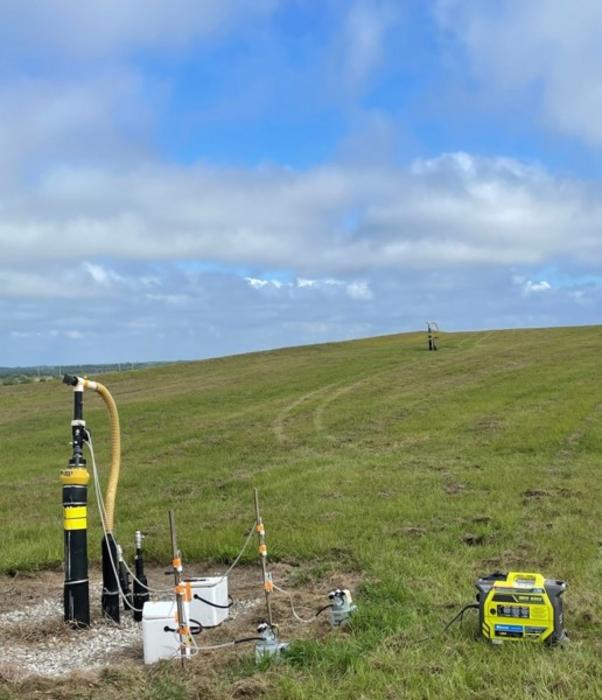
Many municipal landfills “burp” gas from decomposing organic matter rather than letting it build up. And burps from buried waste containing per- and polyfluoroalkyl substances (PFAS) can release these “forever chemicals” into the air, say researchers in ACS’ Environmental Science & Technology Letters. Their study reports unexpectedly high levels of airborne PFAS at three landfills and demonstrates that vented gases and liquid by-products called leachates could transport similar amounts of these contaminants to the environment.

Credit: Ashley Lin
Many municipal landfills “burp” gas from decomposing organic matter rather than letting it build up. And burps from buried waste containing per- and polyfluoroalkyl substances (PFAS) can release these “forever chemicals” into the air, say researchers in ACS’ Environmental Science & Technology Letters. Their study reports unexpectedly high levels of airborne PFAS at three landfills and demonstrates that vented gases and liquid by-products called leachates could transport similar amounts of these contaminants to the environment.
Some consumer products and commercial waste, such as children’s clothing, cosmetics and wastewater treatment sludge solids, contain PFAS — and they ultimately end up in landfills. Timothy Townsend and colleagues previously established that PFAS-containing waste can contaminate the water that seeps through landfills. This leachate is usually captured and treated before entering the environment. Landfills also produce gas that can be captured and controlled, but unlike leachate, it’s often released untreated. The burped gas is mostly made up of methane and carbon dioxide; however, two recent studies also discovered a subset of airborne PFAS called fluorotelomer alcohols, which have the potential to be toxic when inhaled and can be transported long distances. Since the prevalence of PFAS-contaminated landfill vapors isn’t yet widely known, Townsend, Ashley Lin and their team wanted to identify and measure them in vented gas at three sites in Florida.
The researchers pumped landfill gas from pipes through cartridges filled with resin that captured the airborne PFAS. They freed the compounds from the cartridges with organic solvents and analyzed the extracts for 27 neutrally charged PFAS, including fluorotelomer alcohols. Surprisingly, some of the fluorotelomer alcohol levels were up to two orders of magnitude higher than previous studies at other landfills. Three of these alcohols (abbreviated 6:2, 8:2 and 10:2) comprised most of the vaporized contaminants measured at each site. The researchers also collected leachate samples at the Florida sites and analyzed them for ionic PFAS commonly found in water samples. From this data, they estimated that the annual amount of fluorine (as a proxy for PFAS content) leaving the landfills through gas emissions could be similar to, or even greater than, the amount leaving through leachates.
Because landfills are repositories for PFAS, this work indicates that vented gas from these sites should be considered in future mitigation and management strategies to reduce potential inhalation exposure and release to the environment. Some landfills burn the vapors or trap them for energy production, and the team suggests that further research is needed to determine the degree of removal these treatments provide for airborne contaminants.
The authors acknowledge funding from the Florida Department of Environmental Protection and from the U.S. Environmental Protection Agency under the Science to Achieve Results grant program.
The paper’s abstract will be available on June 26 at 8 a.m. Eastern time here:
For more of the latest research news, register for our upcoming meeting, ACS Fall 2024. Journalists and public information officers are encouraged to apply for complimentary press registration by completing this form.
###
The American Chemical Society (ACS) is a nonprofit organization chartered by the U.S. Congress. ACS’ mission is to advance the broader chemistry enterprise and its practitioners for the benefit of Earth and all its people. The Society is a global leader in promoting excellence in science education and providing access to chemistry-related information and research through its multiple research solutions, peer-reviewed journals, scientific conferences, eBooks and weekly news periodical Chemical & Engineering News. ACS journals are among the most cited, most trusted and most read within the scientific literature; however, ACS itself does not conduct chemical research. As a leader in scientific information solutions, its CAS division partners with global innovators to accelerate breakthroughs by curating, connecting and analyzing the world’s scientific knowledge. ACS’ main offices are in Washington, D.C., and Columbus, Ohio.
To automatically receive news releases from the American Chemical Society, contact newsroom@acs.org.
Note: ACS does not conduct research, but publishes and publicizes peer-reviewed scientific studies.
Follow us: X, formerly Twitter | Facebook | LinkedIn | Instagram
Journal
Environmental Science & Technology Letters
Article Title
“Landfill Gas: A Major Pathway for Neutral Per- and Polyfluoroalkyl Substance (PFAS) Release”
Article Publication Date
26-Jun-2024
Cite Scienmag News
Bethany Barker. (June 26, 2024). Some landfill ‘burps’ contain airborne PFAS, study finds. Scienmag. https://scienmag.com/some-landfill-burps-contain-airborne-pfas-study-finds/
Bethany Barker. "Some landfill ‘burps’ contain airborne PFAS, study finds." Scienmag, 26 June 2024, https://scienmag.com/some-landfill-burps-contain-airborne-pfas-study-finds/. Accessed 12 September 2026.
Bethany Barker. "Some landfill ‘burps’ contain airborne PFAS, study finds." Scienmag. June 26, 2024. https://scienmag.com/some-landfill-burps-contain-airborne-pfas-study-finds/

