


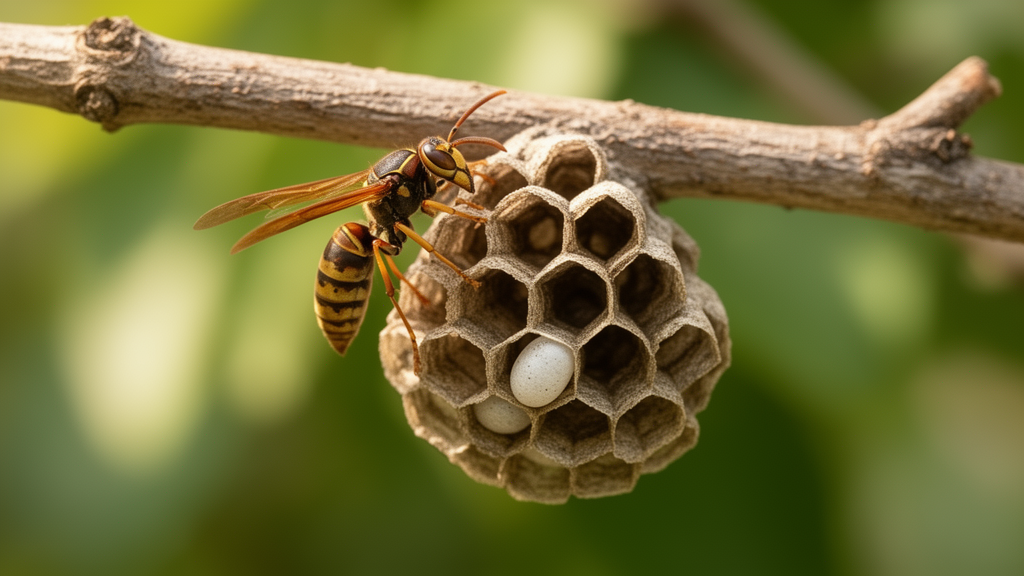
Researchers in southwestern China have uncovered a sophisticated architectural strategy employed by a solitary wasp to significantly enhance its reproductive success. The study, published in the Journal of Hymenoptera Research, focuses on Anterhynchium flavomarginatum, a species within the subfamily Eumeninae. While the nesting habits of social wasps have been extensively documented, the structural adaptations of solitary species remain a relatively underexplored area of entomological research. This new investigation provides critical insights into how specific physical dimensions of a nest directly influence the survival and development of the wasp’s offspring, challenging previous assumptions about the uniformity of cavity-nesting behaviors in Hymenoptera.
The study was conducted in the Chishui Alsophila spinulosa National Nature Reserve in Guizhou Province, a region characterized by a subtropical humid monsoon climate. The area features an average annual temperature of 17.7 degrees Celsius and high relative humidity, creating a stable environment for cavity-nesting insects. The research team deployed standardized trap nests consisting of PVC tubes filled with giant reed internodes of varying diameters. These artificial structures mimicked natural cavities, allowing the researchers to observe and measure the nesting behaviors of A. flavomarginatum in a controlled yet ecologically relevant setting over a two-year period from June 2022 to June 2024.
A total of 2,043 nests were collected during the study, with 1,227 being identified as belonging to A. flavomarginatum. This species accounted for approximately 60 percent of the total nests observed, highlighting its dominance in the local cavity-nesting community. The wasps provisioned their nests with paralyzed caterpillars from families such as Crambidae, Pyralidae, and Tortricidae, which serve as essential food sources for the developing larvae. By longitudinally splitting open the collected nests, researchers were able to meticulously measure the number of brood cells, the presence of intercalary cells, the overall nest diameter, and the length of the vestibule, a protective buffer zone preceding the first brood cell.
One of the most significant findings was the positive correlation between the number of intercalary cells and nesting success. Intercalary cells are structural units within the nest where no offspring are deposited, effectively acting as empty spaces between brood cells. The statistical analysis revealed a highly significant difference in nesting success between nests with and without these cells. The researchers hypothesize that these empty compartments provide a more independent and spacious environment for each larva, reducing the potential for interference or physical compression from adjacent cells. This spatial separation may also serve as a defensive mechanism, making it more difficult for parasites to infiltrate the nest and reach the developing larvae.
The diameter of the nest also played a crucial role in determining reproductive outcomes. The study found that nesting success was significantly higher in nests with a diameter of 6 to 8 millimeters compared to those with a diameter of 14 to 16 millimeters. This suggests that there is an optimal spatial range for the development of A. flavomarginatum larvae. In larger nests, the increased space may lead to greater fluctuations in the microclimate, such as temperature and humidity, which can be detrimental to the pupal stage. Additionally, larvae in larger cavities may struggle to access food resources that are spread out over a wider area, leading to inefficient resource utilization and reduced survival rates.
The length of the nest vestibule emerged as another critical factor influencing nesting success. Nests with a vestibular length of zero millimeters exhibited significantly lower nesting success compared to those with vestibules ranging from 1 to 90 millimeters. The vestibule acts as a buffer zone that protects the inner brood cells from external environmental changes and potential predators. A longer vestibule can filter out fluctuations in temperature and humidity, creating a more stable microenvironment for the developing offspring. Furthermore, the presence of a vestibule may deter other female wasps from occupying the nest, thereby reducing competition and the risk of nest takeover.
The implications of these findings extend beyond basic entomology to the field of biological control. A. flavomarginatum is a natural predator of lepidopteran larvae, which are often significant pests in agricultural settings. By understanding the specific architectural requirements that enhance the nesting success of this wasp, researchers can develop strategies to optimize trap nests for use in pest management programs. Providing artificial nests with the optimal diameter and vestibular length could increase the population of these beneficial wasps in farmlands, thereby enhancing their effectiveness in controlling pest populations without the need for chemical interventions.
The study also highlights the complex interplay between biotic and abiotic factors in the development of Hymenoptera. While food availability and predator interactions are well-known influences on reproductive success, the physical structure of the nest itself appears to be a decisive factor. The ability of A. flavomarginatum to adjust its nest architecture, such as the inclusion of intercalary cells, demonstrates a high degree of adaptability to its ecological environment. This adaptability allows the species to maximize its reproductive output in a variety of cavity types, ensuring the survival of its offspring despite varying environmental conditions.
Future research should focus on elucidating the underlying physiological mechanisms by which these architectural features affect larval development and eclosion. Understanding how the microclimate within the nest is regulated by the vestibule and intercalary cells could provide further insights into the thermal biology of solitary wasps. Additionally, exploring the interactions between nest architecture and other environmental factors, such as humidity and temperature, will be essential for developing a comprehensive model of nesting success. This knowledge will not only advance our understanding of solitary wasp biology but also contribute to the development of more effective and sustainable pest control strategies in agriculture.
Subject of Research: A solitary wasp boosts nesting success through nest architecture (Hymenoptera, Vespidae, Anterhynchium flavomarginatum)
Article Title: A solitary wasp boosts nesting success through nest architecture ( Hymenoptera , Vespidae , Anterhynchium flavomarginatum )
Article References: Du, T.-T., Lu, H.-X., Wang, M.-Q., Li, Y., Shi, X.-Y., Orr, M., Li, J., Luo, A., Klein, A.-M., Zhu, C.-D., & Guo, P.-F. (2025). A solitary wasp boosts nesting success through nest architecture (Hymenoptera, Vespidae, Anterhynchium flavomarginatum). Journal of Hymenoptera Research, 98, 709-719. https://doi.org/10.3897/jhr.98.155756
Image Credits: AI Generated
Keywords: solitary, wasp, boosts, nesting, success, nest, architecture, Hymenoptera, Vespidae, Anterhynchium, flavomarginatum, scientific research
Cite Scienmag News
Gavin Prescott. (October 18, 2026). Solitary Wasp Nest Architecture Boosts Reproductive Success. Scienmag. https://scienmag.com/solitary-wasp-nest-architecture-boosts-reproductive-success/
Gavin Prescott. "Solitary Wasp Nest Architecture Boosts Reproductive Success." Scienmag, 18 October 2026, https://scienmag.com/solitary-wasp-nest-architecture-boosts-reproductive-success/. Accessed 18 October 2026.
Gavin Prescott. "Solitary Wasp Nest Architecture Boosts Reproductive Success." Scienmag. October 18, 2026. https://scienmag.com/solitary-wasp-nest-architecture-boosts-reproductive-success/


