


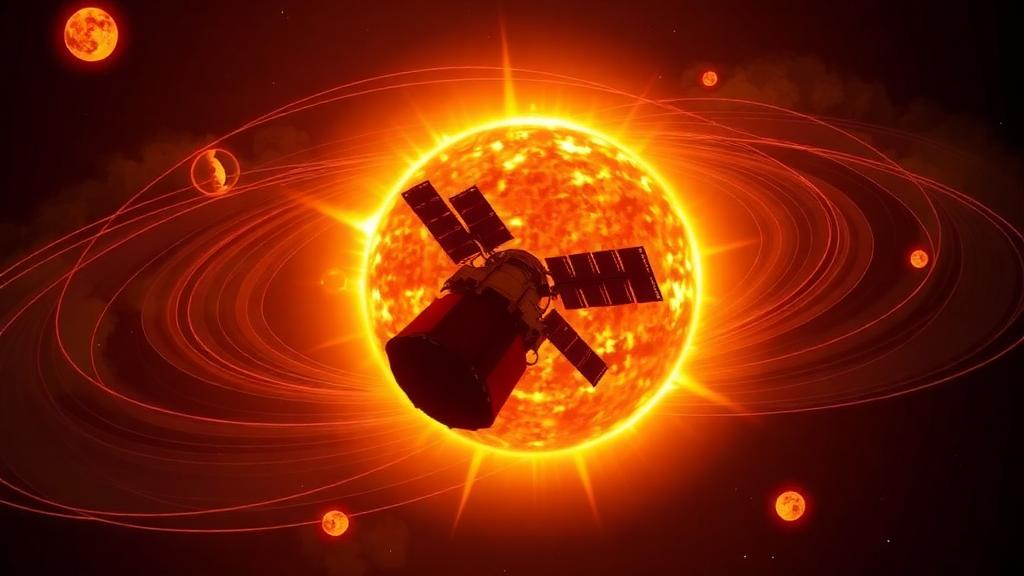
For more than half a century, physicists have wrestled with one of the most deceptively simple questions in heliophysics: how does the Sun, a body held together by its own immense gravity, manage to hurl a continuous supersonic stream of charged particles into space at speeds exceeding one million miles per hour? That stream, the solar wind, is far more than a curiosity of stellar physics. It inflates the heliosphere, the vast plasma bubble that envelops the entire solar system, it sculpts the shimmering auroras that dance over Earth’s polar regions, and it can batter satellites, disrupt radio communications, and stress power grids when gusts of it slam into our planet’s magnetic shield. Now, a study led by the Southwest Research Institute (SwRI) using data from the European Space Agency’s Solar Orbiter has delivered the most detailed close-up view yet of the heliospheric current sheet, the sprawling magnetic structure that may hold the key to understanding how the Sun’s raw corona is transformed into the wind that fills interplanetary space.
The heliospheric current sheet, or HCS, is one of the largest structures in the solar system, and yet many people have never heard of it. It is an undulating, warped surface that emanates from the Sun and spirals outward past the planets and beyond, effectively dividing the heliosphere into two vast hemispheres. In one hemisphere, the Sun’s magnetic field points away from the Sun; in the other, it points toward it. The HCS is the boundary between these oppositely directed fields, and because the Sun rotates, the sheet is twisted into a shape that scientists have long compared to a ballerina’s spinning skirt, its folds sweeping past Earth and every other planet as they spiral into the far reaches of the solar system. Anchored deep in the solar surface, the current sheet acts, in the words of the SwRI team, like a high-speed pipeline, carrying information about conditions in the innermost corona directly into the space environment around us.
Dr. Keiichi Ogasawara, lead author of the new study, describes the problem the HCS helps to solve as a cosmic paradox. For decades, scientists have known that the Sun blasts a continuous supersonic torrent of charged particles into space, but the precise mechanism by which the corona, the Sun’s outermost atmospheric layer, feeds and accelerates that torrent has remained stubbornly elusive. The key, he argues, lies in magnetic connectivity. By tracing magnetic field lines from a spacecraft back to the solar surface, researchers can link activity in a specific region of the Sun directly to gusts of solar wind measured millions of miles away. The HCS offers a particularly valuable connection point for this kind of tracing, because its magnetic signature is so distinctive: the polarity flip from one hemisphere to the other is unmistakable, allowing scientists to anchor their measurements to a known feature of the Sun’s global magnetic architecture.
The opportunity to study this structure up close arrived when Solar Orbiter, a joint mission of ESA and NASA, passed through a fold of the heliospheric current sheet at a distance of roughly 26 million miles from the Sun. That is closer to our star than the innermost planet, Mercury, and it meant the spacecraft was sampling what researchers describe as the youngest version of the solar wind ever observed. At such distances, the wind has had little time to evolve, mix, or be reshaped by interactions in transit, so its composition still bears the imprint of the coronal processes that created it. Solar Orbiter’s suite of high-quality field, plasma, and composition instruments was able to dissect the particle populations within this mysterious region with a fidelity that no previous mission at such proximity has achieved.
What the SwRI researchers found inside the current sheet was a clear and distinct change in the composition of the plasma, specifically in the relative abundance of ions, atoms that have lost or gained electrons and therefore carry an electric charge. Within the HCS region, the team identified a decrease in the ratio of iron to oxygen ions, and that decrease lined up closely with the magnetic sector boundary itself. According to Ogasawara, while the overall plasma on both sides of the boundary is similar, there is a clear compositional change that is tightly aligned with the point where the magnetic polarity flips. This alignment is significant, because it suggests that the heliospheric current sheet is not merely a geometric feature of the Sun’s magnetic field. Instead, it appears to be linked to the way the Sun sorts ions in the corona and releases them into the solar wind, hinting at physical processes of fractionation and release operating in the Sun’s lower atmosphere.
The implications of that finding extend well beyond the current sheet itself. If the HCS carries a compositional fingerprint of its coronal source regions, then measuring that fingerprint near the Sun provides a way to probe processes that are otherwise hidden from view. The corona is heated to temperatures of millions of degrees, far hotter than the Sun’s visible surface, and understanding exactly how energy and matter flow from the solar interior through the corona and out into the wind remains one of the central unsolved problems in solar physics. Compositional signatures, such as the iron-to-oxygen ratio measured by Solar Orbiter, act as tracers of those flows, recording which material was preferentially accelerated and escape, and under what magnetic conditions. A boundary that flips polarity and simultaneously changes composition is a boundary that models of coronal heating and wind acceleration must take seriously.
Importantly, the SwRI team is careful about what their data can and cannot claim. The new observations do not define the origins of the heliospheric current sheet, and the researchers do not present them as proof of any single theory of how the sheet forms. What the study does provide, they argue, are boundaries, clear constraints that future models and theories must satisfy. Ogasawara emphasizes that the team has delivered a detailed, multi-aspect view of an HCS crossing close to the Sun, and that this view includes organized, measurable variations in the types and amounts of particles within the plasma. The current sheet, in other words, is not just a simple flip of the magnetic field. Any successful future model of current sheet formation, solar wind heating, or magnetic connection between the Sun and interplanetary space will now have to explain these compositional structures alongside the magnetic ones.
This constraint-driven approach reflects a broader shift in how heliophysicists tackle problems that are too complex to solve with any single spacecraft observation or theoretical framework. Rather than betting on one mechanism for how the corona becomes the wind, researchers increasingly map out the space of possibilities, using high-fidelity measurements to eliminate models that cannot reproduce what is actually observed. A close-up crossing of the HCS, with simultaneous measurements of magnetic fields, plasma waves, particle distributions, and ion composition, is exactly the kind of dataset that can prune that space dramatically. The study, titled “Resolving Compositional Features of Solar Wind Source Regions near the Heliospheric Current Sheet at 0.3 au,” was published this month in The Astrophysical Journal, and its observations at 0.3 astronomical units, roughly the distance at which Solar Orbiter encountered the sheet, represent some of the tightest constraints yet available on the young solar wind’s composition.
There is also a practical payoff for life on Earth. Space weather, the collective term for the Sun-driven disturbances that sweep through the heliosphere, can degrade satellite electronics, endanger astronauts, interrupt GPS navigation, and, in extreme cases, overload terrestrial power infrastructure. Forecasters rely on models of the solar wind to predict when fast streams and magnetic disturbances will reach Earth, and those models are only as good as our understanding of how the wind is born and structured near the Sun. By defining the early-stage composition of the heliospheric current sheet, the SwRI study helps scientists construct more accurate models of how the solar wind evolves and how its gusts will affect Earth’s magnetic environment. Every refinement of that predictive chain, from the corona to the current sheet to the forecast of a geomagnetic storm, translates into better protection for the technological systems modern society depends on.
The work also sets the stage for what comes next. Solar Orbiter continues its mission, gradually tilting its orbit to deliver increasingly direct views of the Sun’s polar regions, while NASA’s Parker Solar Probe flies even closer to the solar surface, sampling the corona’s outer reaches directly. Together, these missions are building a three-dimensional, compositionally resolved picture of the inner heliosphere that earlier generations of scientists could scarcely imagine. The SwRI team’s demonstration that the heliospheric current sheet carries an organized, measurable compositional signature near the Sun gives future observers a specific target: repeated crossings of the sheet at varying distances and solar latitudes, each one an opportunity to test whether the iron-to-oxygen depletion they observed is a persistent feature of the boundary or a fleeting product of particular solar conditions. Either answer will sharpen our understanding of the paradox that started it all, how the Sun, day after day, converts its own atmosphere into a million-mile-per-hour wind that shapes the very bubble of space we live in.
Subject of Research: Compositional structure of the heliospheric current sheet and its role in the transformation of the solar corona into the solar wind
Article Title: SwRI study helps unravel how the Sun’s corona transforms into solar wind
Article References: SwRI study helps unravel how the Sun’s corona transforms into solar wind. (n.d.). Original publication
Image Credits: AI Generated
DOI: Not provided
Keywords: solar wind, heliospheric current sheet, Solar Orbiter, solar corona, space weather, Southwest Research Institute, ion composition, magnetic polarity, heliophysics, The Astrophysical Journal, solar magnetic field, heliosphere
Cite Scienmag News
Grant Pearson. (October 11, 2026). Solar Orbiter flies through the Sun’s magnetic boundary to reveal how corona becomes solar wind. Scienmag. https://scienmag.com/solar-orbiter-flies-through-the-suns-magnetic-boundary-to-reveal-how-corona-becomes-solar-wind/
Grant Pearson. "Solar Orbiter flies through the Sun’s magnetic boundary to reveal how corona becomes solar wind." Scienmag, 11 October 2026, https://scienmag.com/solar-orbiter-flies-through-the-suns-magnetic-boundary-to-reveal-how-corona-becomes-solar-wind/. Accessed 11 October 2026.
Grant Pearson. "Solar Orbiter flies through the Sun’s magnetic boundary to reveal how corona becomes solar wind." Scienmag. October 11, 2026. https://scienmag.com/solar-orbiter-flies-through-the-suns-magnetic-boundary-to-reveal-how-corona-becomes-solar-wind/


