


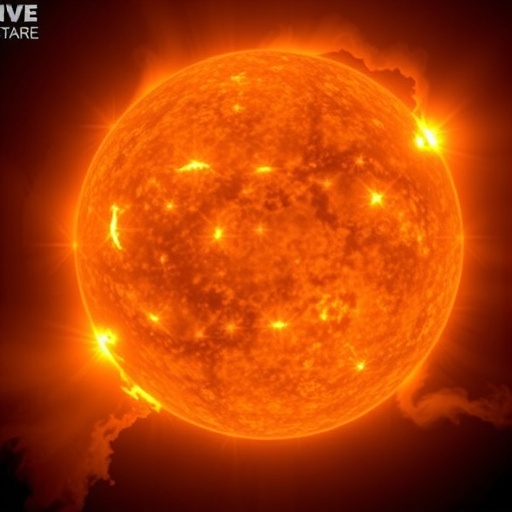
Recent research spearheaded by the University of St Andrews has unveiled staggering revelations regarding solar flares, which are explosive events occurring in the Sun’s atmosphere. For decades, scientists have grappled with the temperatures generated by these phenomena. The fresh findings suggest that particles involved in solar flares may possess temperatures as much as 6.5 times higher than previously suspected, igniting a new dialogue about the fundamental physics governing our nearest star. This notable discovery addresses long-standing enigmas that have puzzled astrophysicists for nearly half a century.
Solar flares represent some of the most dynamic activity in the solar system, with immense bursts of energy that can heat regions of the solar atmosphere to temperatures exceeding 10 million degrees Celsius. These energetic discharges result in increased emission of solar X-rays and radiation, which can pose significant hazards to satellites and astronauts while also influencing Earth’s upper atmosphere. The implications of such events extend beyond merely understanding the Sun; they touch on the safety and functionality of our technological framework on Earth.
In a groundbreaking paper published in the Astrophysical Journal Letters, the research team delved into the nuances of solar plasma, which predominantly comprises ions and electrons. Traditional models have often equated the temperatures of ions and electrons within solar flares. However, recent analysis led by Dr. Alexander Russell, a Senior Lecturer at the University of St Andrews, posits that this assumption warrants reevaluation. Their findings suggest that ions can attain extraordinary temperatures beyond 60 million degrees, a revelation that could transform the long-standing understanding of solar dynamics.
The research invokes the concept of magnetic reconnection—a process where magnetic field lines reorganize and snap, leading to the release of energy. This phenomenon appears to preferentially heat ions compared to electrons, as revealed by recent observations in various contexts, including the Earth’s magnetosphere and the solar wind. This novel understanding underscores a broader principle in astrophysics—that the excitation dynamics within solar events may not conform to historical simplifications. Such insights pave the way for a more sophisticated understanding of the thermal properties of solar plasmas.
The team’s calculations reveal that the differences in temperature between ions and electrons can persist for several minutes during solar flare events. This extended temperature disparity is critical for examining the precise dynamics of energy transfer in solar flares. The implications of these findings extend far beyond simple temperature metrics; they may indeed hold the key to decoding some of the most significant mysteries of solar physics, such as the enigmatic properties of solar flare spectrum lines.
Historically, scientists have noted that flare spectral lines—sharp peaks associated with specific wavelengths of extreme ultraviolet and X-ray radiation—have widths broader than theoretical predictions. This phenomenon has puzzled astrophysicists since the 1970s. The conventional explanation revolved around turbulent motions within the plasma, though recent scrutiny has indicated that this interpretation may not fully account for the observed effects. The assertion that ion temperatures could substantially influence spectral line widths represents a radical shift in perspective, suggesting that other factors, beyond turbulence, must also play a crucial role in shaping our understanding of solar flare dynamics.
The acknowledgment of higher temperatures among solar flare ions could potentially unify disjointed aspects of solar research and may reshape the theoretical frameworks used to analyze solar activity. This new approach promises to refine the models used for predicting solar phenomena, thus enhancing our ability to anticipate the impacts of solar storms on Earth’s technological infrastructure. As researchers strive to deepen their understanding of these explosive solar events, it becomes evident that the mysteries of our nearest star still hold many revelations waiting to be uncovered.
Furthermore, the innovative methodologies applied in this research, which involve comprehensive data and statistical analyses, underscore the increasing role of interdisciplinary studies in astrophysics. By synthesizing data from various realms, including celestial mechanics and magnetohydrodynamics, the research team has provided a robust framework for future investigations into solar phenomena. The evolution of solar physics will undoubtedly rely on such integrative approaches, which bridge gaps between theory and observation.
The implications of the research extend beyond the scientific community, affecting a range of stakeholders, including space agencies and satellite operators. As we continue to advance our understanding of solar flares and their consequences, the operational safety concerning satellites and astronauts in orbit must be prioritized. With more accurate models, it may be possible to develop better predictive tools that can alert astronauts and space missions to potential dangers posed by solar activity, ultimately safeguarding human activity in space.
As this research garners attention, the future of solar astrophysics appears brighter than ever. The renewed focus on ion temperatures may lead to innovative breakthroughs, foster collaborative endeavors across institutions, and inspire the next generation of solar physicists. The excitement surrounding the continued exploration of solar phenomena is palpable, fueling further questions and investigations that will continue to shape our understanding of the cosmos.
In conclusion, the groundbreaking research from the University of St Andrews marks a significant advancement in our understanding of the extreme temperatures observed in solar flares. By shifting the narrative surrounding ion and electron temperatures, this work not only offers potentially game-changing insights into the mechanics of solar flares but also initiates a reassessment of long-standing assumptions in the field. As scientists delve deeper into the complexities of solar plasma, we can only imagine what other significant revelations lie ahead regarding our dynamic and powerful nearest star.
Keywords
Solar Flares, Solar Physics, Plasma Temperature, Magnetic Reconnection, Astrophysical Journal.
Cite Scienmag News
Grant Pearson. (September 3, 2025). Solar Flares Found to Be Over Six Times Hotter Than Previously Estimated. Scienmag. https://scienmag.com/solar-flares-found-to-be-over-six-times-hotter-than-previously-estimated/
Grant Pearson. "Solar Flares Found to Be Over Six Times Hotter Than Previously Estimated." Scienmag, 3 September 2025, https://scienmag.com/solar-flares-found-to-be-over-six-times-hotter-than-previously-estimated/. Accessed 4 September 2026.
Grant Pearson. "Solar Flares Found to Be Over Six Times Hotter Than Previously Estimated." Scienmag. September 3, 2025. https://scienmag.com/solar-flares-found-to-be-over-six-times-hotter-than-previously-estimated/


