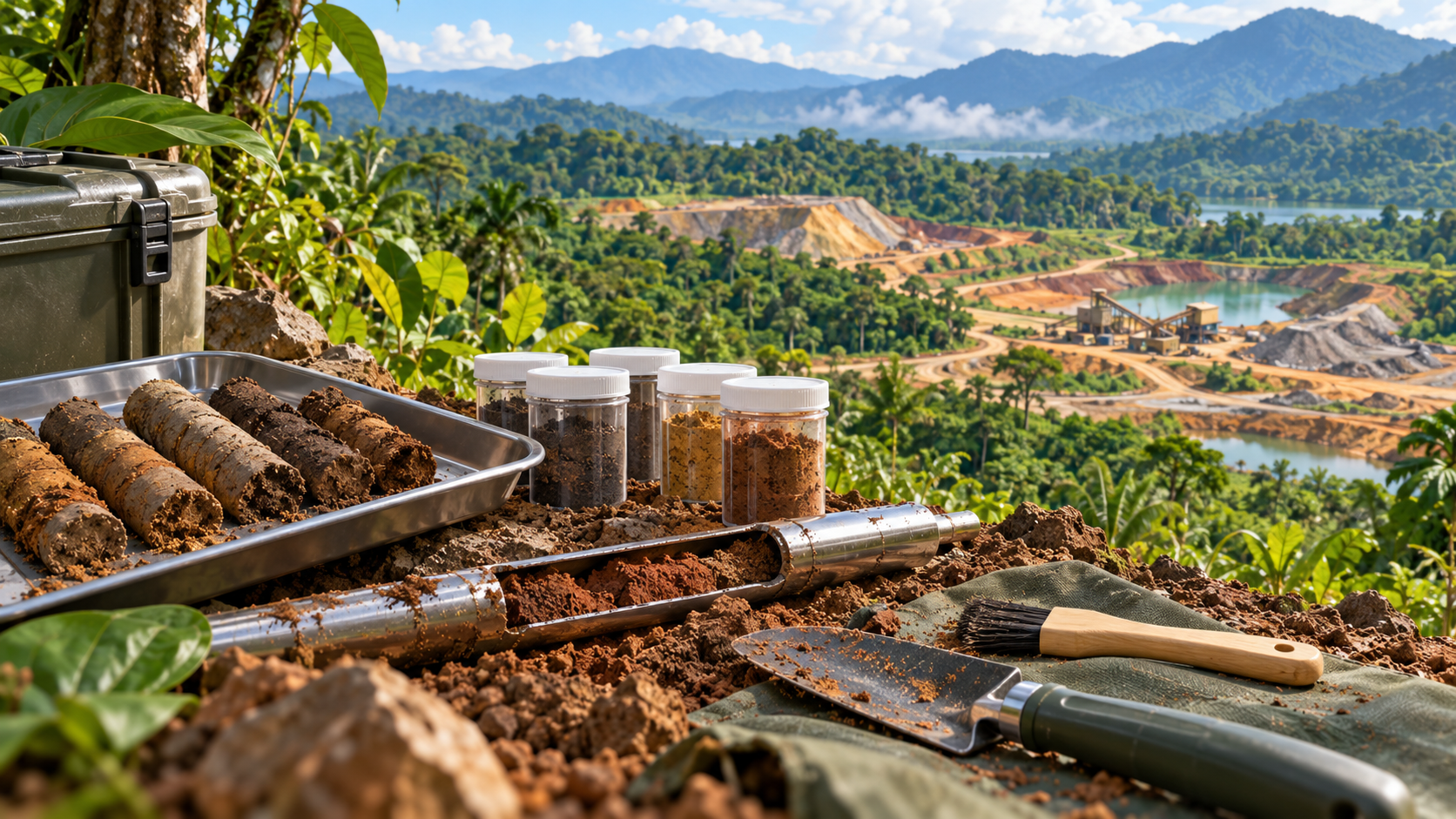
In eastern Ghana’s artisanal and small-scale gold mining areas, soil chemistry can reflect both underlying geology and human activity, making unusual combinations of elements difficult to interpret. A new study compared several statistical approaches for identifying multielement geochemical anomalies in soil samples, with the aim of helping prioritize locations for follow-up. The researchers analysed 665 B-horizon soil samples for 14 elements using X-ray fluorescence, then applied principal component analysis (PCA), two forms of Mahalanobis distance and spatial autocorrelation analysis.
The methods flagged different numbers of samples as anomalous. PCA retained three components that together explained 62.89% of the total variance and identified 60 samples, or 9.02%. Classical Mahalanobis distance identified 51 samples (7.67%), while robust Mahalanobis distance identified 120 (18.05%). Across the three detection methods, at least one method identified 164 samples (24.66%); 57 (8.57%) were identified by at least two methods, and 10 (1.50%) by all three. The differing totals show that the methods did not simply produce the same list of unusual samples.
The researchers also examined whether flagged samples had spatial patterns. PCA anomalies showed the strongest spatial dependence of the three approaches, with a Global Moran’s I of 0.1474 and p = 0.002. Local spatial analysis corroborated 25.00% of the PCA anomalies, 13.73% of those flagged by Classical Mahalanobis distance and 10.00% of robust-distance anomalies. In this analysis, spatial corroboration provides an additional way to assess whether detected anomalies are geographically patterned; it does not by itself establish why the element combinations occur.
The authors interpret the results as complementary strengths: PCA identified a more spatially coherent set of anomalies, while robust Mahalanobis distance detected a broader range of unusual multielement compositions. The overlap among methods was limited: only 10 of the 665 samples were flagged by all three. That pattern supports treating the outputs as different views of the same geochemical dataset rather than interchangeable counts. It also means the number of priority locations would depend in part on which method or combination of methods is used.
The study’s conclusion is that combining detection approaches can provide complementary evidence for prioritizing locations for field verification and environmental monitoring in mineralized and mining-affected areas. Its results come from soil sampling and statistical analysis in the study area; the abstract does not report field verification of the flagged locations or establish the source of each anomaly. A statistical anomaly is therefore a candidate for further investigation, not evidence on its own of contamination or mining impact.
Subject of Research: Statistical detection of multielement geochemical anomalies in soils from artisanal gold-mining areas in eastern Ghana
Article Title: Comparative detection of multielement geochemical anomalies using PCA and Mahalanobis distance in artisanal gold mining soils in eastern Ghana
Article References: Kazapoe, R. W., Kwaw, A. K., Sagoe, S. D., Sagru-Larr, P., Adam, A. B., Amoah, B. K., & Fynn, O. F. (2026). Comparative detection of multielement geochemical anomalies using PCA and Mahalanobis distance in artisanal gold mining soils in eastern Ghana. Scientific Reports. https://doi.org/10.1038/s41598-026-77993-6
Image Credits: AI Generated
DOI: 10.1038/s41598-026-77993-6
Keywords: soil geochemistry, Ghana, artisanal gold mining, geochemical anomalies, principal component analysis, Mahalanobis distance, spatial autocorrelation, environmental monitoring, Comparative, detection, multielement, geochemical
Cite Scienmag News
Bethany Barker. (October 29, 2026). Soil Anomaly Methods Flag Different Patterns in Ghana Mining Areas. Scienmag. https://scienmag.com/soil-anomaly-methods-flag-different-patterns-in-ghana-mining-areas/
Bethany Barker. "Soil Anomaly Methods Flag Different Patterns in Ghana Mining Areas." Scienmag, 29 October 2026, https://scienmag.com/soil-anomaly-methods-flag-different-patterns-in-ghana-mining-areas/. Accessed 1 November 2026.
Bethany Barker. "Soil Anomaly Methods Flag Different Patterns in Ghana Mining Areas." Scienmag. October 29, 2026. https://scienmag.com/soil-anomaly-methods-flag-different-patterns-in-ghana-mining-areas/