


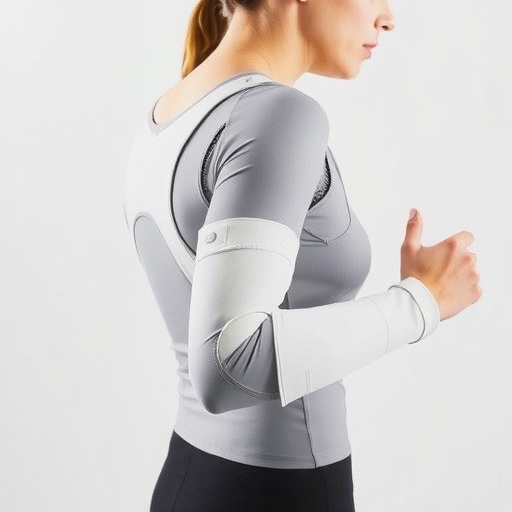
In a remarkable development within the realm of rehabilitation technology, researchers have introduced a groundbreaking approach to enhancing mobility for individuals suffering from spinal cord injuries (SCI). Spinal cord injury remains a critical challenge that severely disrupts a person’s ability to regain neuromuscular control, thus dramatically impacting their independence and overall quality of life. While there have been numerous innovative robotic solutions aimed at improving the functionality of upper limbs, many of these prototypes are still largely untested among the SCI population and predominantly focus on hand movements. In contrast, a team of scientists has pioneered a novel lightweight modular soft exosuit designed to address the needs for enhanced shoulder and elbow mobility.
The exosuit, an impressive integration of lightweight fabric-based pneumatic actuators, works in harmony with inertial sensors to deliver unparalleled assistance in both shoulder abduction and elbow flexion or extension movements. This innovative design marks a significant departure from previous exoskeletons, which often prioritize single joint movements. By utilizing advanced soft robotics technology, the developers aim to create an assistive device that not only enhances muscle function but also fits comfortably into the lives of those with limited mobility.
Initial validation of the individual elbow modules of the exosuit involved 11 healthy volunteers. These early testing phases were instrumental in refining the technology, ensuring that it would provide optimal support for targeted muscle groups while being lightweight and easy to operate. Following this initial validation, the complete exosuit, incorporating both shoulder and elbow assistive modules, was subsequently evaluated in a clinical setting involving 15 individuals diagnosed with cervical spinal cord injuries, categorized from motor incomplete to complete injuries (AIS A–D).
Results from the study painted an encouraging picture: participants with SCI experienced a remarkable improvement in their functional performance. Specifically, the support provided by the exosuit resulted in more than a 250% increase in static endurance time. This gain is particularly significant as it suggests that individuals can maintain positions and perform tasks that require prolonged muscle engagement without excessive fatigue. Moreover, the use of the exosuit was associated with up to a 50% reduction in the activity of primary muscles during dynamic tasks, indicating that the device effectively offloads some of the work from the user, allowing for easier movement.
Additionally, within the cohort of SCI participants, two individuals who retained prehensile capabilities observed meaningful enhancements in their performance on the box and block test—a common measure of upper extremity functionality and dexterity. With the exosuit’s assistance, these individuals demonstrated superior agility and proficiency in transferring blocks, highlighting the device’s potential to augment fine motor skills as well as general upper limb movement.
Complex control systems are usually a major limitation in robotics, especially where real-time adjustments are crucial for seamless user experience. The authors emphasize that their approach, which leverages inertial sensors, allows for adaptive and responsive actuation, maintaining a natural feel to the movements. This soft actuation mechanism ensures that the suit not only adheres to the user’s movements but also responds dynamically to inter-joint motions, simulating natural biomechanics more effectively than rigid exoskeleton solutions.
Participant feedback played an integral role in assessing the success of the exosuit. Users expressed that the soft and adaptive nature of the actuation provided a comfortable fit and ease of use, which contrasts sharply with traditional, bulky robotic systems that often encumber users rather than assist them. Such positive reception among participants speaks volumes about the device’s design philosophy, which prioritizes user-centered care in the development of assistive technologies.
Looking ahead, the implications of this research are substantial. The enhancements in endurance and decreased muscle strain could lead not only to improved physical capabilities but also to enhanced psychological well-being for individuals in the SCI community. Empowering individuals to perform daily tasks with greater ease can foster a sense of independence, potentially translating these physical advantages into improved quality of life.
The researchers affirm that the modularity of their exosuit provides a versatile platform that can be adapted for further applications in rehabilitation beyond the scope of this study. Given that it operates through pneumatic actuation, future iterations could see expanded functionalities, such as support for additional joint movements or even integration with digital health monitoring systems to track usage and progress over time.
However, as with any groundbreaking technology, ongoing research will be necessary to identify long-term outcomes and to refine functionality. Future studies will look to include larger cohorts and possibly longer durations of exosuit usage to fully explore the potential of this innovative rehabilitation solution.
In conclusion, this soft exosuit represents a significant leap forward in the quest to restore limb function for individuals living with spinal cord injuries. By focusing on multiple joints and employing a soft and modular design, it addresses some of the key limitations of existing assistive technologies. The potential of this research to facilitate improved functional independence and enriched lifestyles for the SCI community cannot be overstated, marking a promising horizon for neurorehabilitative advancements.
Ferroni, R., D’Avola, G., Sciarrone, G. et al. A multi-joint soft exosuit improves shoulder and elbow motor functions in individuals with spinal cord injury.
Nat Mach Intell 7, 1390–1402 (2025). https://doi.org/10.1038/s42256-025-01105-8
Cite Scienmag News
Denise Maddox. (October 11, 2025). Soft Exosuit Enhances Shoulder and Elbow Function Post-Injury. Scienmag. https://scienmag.com/soft-exosuit-enhances-shoulder-and-elbow-function-post-injury/
Denise Maddox. "Soft Exosuit Enhances Shoulder and Elbow Function Post-Injury." Scienmag, 11 October 2025, https://scienmag.com/soft-exosuit-enhances-shoulder-and-elbow-function-post-injury/. Accessed 4 September 2026.
Denise Maddox. "Soft Exosuit Enhances Shoulder and Elbow Function Post-Injury." Scienmag. October 11, 2025. https://scienmag.com/soft-exosuit-enhances-shoulder-and-elbow-function-post-injury/


