

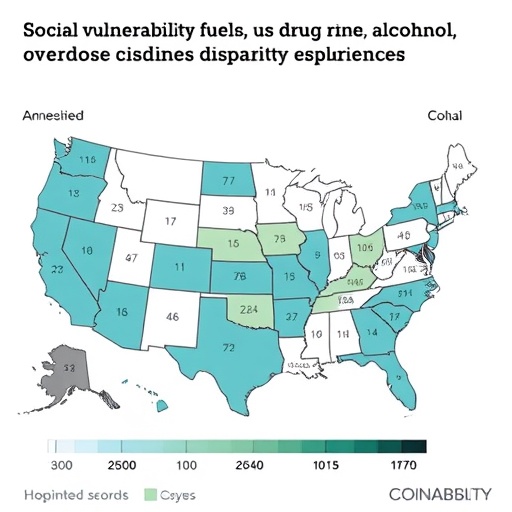
In a groundbreaking new study published in the International Journal of Mental Health and Addiction, researchers B. Grobman, A. Mansur, and C.Y. Lu illuminate the profound and often overlooked impacts of social vulnerability on drug and alcohol overdose fatalities across the United States. Their research offers a comprehensive examination of the multifaceted relationship between socioeconomic factors and overdose mortality, casting new light on the disparities that plague vulnerable communities nationwide.
The study pivots around the concept of social vulnerability, a metric that encompasses a variety of social determinants of health, such as poverty, housing instability, access to healthcare, education, and social support networks. By leveraging large-scale epidemiological data alongside sophisticated statistical modeling, the authors unveil how these factors compound to create a breeding ground for substance misuse and fatal overdoses, underscoring the urgent need for targeted public health interventions.
Central to their analysis is the use of the Social Vulnerability Index (SVI), a composite measure designed by the Centers for Disease Control and Prevention (CDC) to quantify a community’s resilience to external stresses on human health, including natural disasters and disease outbreaks. In this study, SVI serves as a critical lens through which overdose death data is not simply reported, but contextualized within the structural realities faced by populations at risk. The authors’ findings demonstrate a striking correlation between higher SVI scores and increased rates of overdose mortality, revealing a pattern of entrenched disparities.
The implications of these findings are sobering. Regions characterized by high social vulnerability often lack adequate resources for effective addiction treatment, harm reduction programs, and preventive education. Moreover, systemic barriers such as stigma, discrimination, and healthcare inequities exacerbate the challenges faced by individuals struggling with substance use disorders. The study’s granular approach exposes how these overlapping layers of disadvantage perpetuate a vicious cycle, making overdose fatalities a symptom of broader societal failures.
Methodologically, the researchers employed geospatial analytics alongside survival modeling to pinpoint hotspots of overdose deaths with an unprecedented level of precision. Their spatial analyses allowed for the mapping of overdose occurrences against socioeconomic indicators, enabling an incisive understanding of geographic disparities. The utilization of longitudinal mortality records facilitated a temporal dimension to their inquiry, tracking trends over multiple years and assessing the shifting landscape of overdose risk.
Notably, the authors identified disparities not only across geographic regions but also within demographic groups, highlighting how race, ethnicity, and age intersect with social vulnerability to influence overdose risks. This nuanced exploration challenges oversimplified narratives that often overlook the heterogeneous nature of the overdose epidemic. The study’s intersectional framework contributes significantly to the discourse on health equity and social justice in addiction research.
In terms of policy implications, the research advocates for a paradigm shift toward structural interventions that address the root causes of vulnerability. It suggests the integration of social determinants into public health strategies, emphasizing the necessity of embedding addiction services within broader social support systems. The authors argue for enhanced funding in underserved areas, tailored community outreach programs, and reforms that dismantle barriers to care, including the expansion of Medicaid and other insurance coverage for addiction treatment.
Moreover, the study calls attention to the critical role of harm reduction initiatives, such as naloxone distribution and supervised consumption sites, in mitigating overdose deaths in socially vulnerable populations. It underscores the importance of culturally competent services that acknowledge and respond to the complex realities faced by marginalized groups. These measures, the authors assert, must be coupled with sustained efforts to combat stigma and foster community engagement.
The temporal analysis in the study reveals an alarming trend: as social vulnerability increases, the trajectory of overdose mortality accelerates disproportionately. This temporal dimension highlights not only static disparities but also dynamic processes of social decay and resilience erosion. Such insights pave the way for predictive analytics in overdose prevention, enabling proactive targeting of resources before surges in overdose deaths occur.
Critically, the study integrates advanced data science methodologies, including machine learning algorithms, to refine risk assessment models. These technological innovations enhance the predictive accuracy and could revolutionize public health surveillance of overdose deaths. By harnessing these tools, policymakers and healthcare providers can design precision interventions that allocate resources more efficiently and effectively.
Ethically, the study raises compelling questions about data privacy, the potential for profiling, and the responsibility of researchers to advocate for vulnerable communities. The authors emphasize transparency, community involvement, and the application of findings to enact real-world change. Their approach demonstrates a balance between rigorous scientific inquiry and a commitment to social activism.
This pioneering research arrives at a critical juncture, as the United States continues grappling with an overdose crisis that has only deepened amid the COVID-19 pandemic’s social and economic upheavals. The integration of social vulnerability metrics with substance overdose data provides a holistic framework for understanding and combating this public health emergency.
In conclusion, Grobman, Mansur, and Lu’s study constitutes a significant advancement in addiction research by exposing the social underpinnings of overdose deaths. Their evidence-based recommendations for policy reform and community-centered intervention underscore the imperative to view substance use disorders not merely as medical conditions but as phenomena shaped by social structural realities. This work holds tremendous promise for informing a new generation of strategies tailored to reduce disparities and save lives.
As scientific communities and policymakers digest these findings, the dialogue surrounding overdose prevention is poised to evolve. The incorporation of social vulnerability into analytic models enriches our comprehension of the crisis and equips us with novel pathways toward equitable healthcare solutions. Ultimately, the study serves as a call to action for integrative, compassionate, and data-driven responses to one of the most pressing issues confronting America today.
Subject of Research: Social vulnerability and its role in disparities of drug and alcohol overdose deaths in the United States.
Article Title: Social Vulnerability and Disparities in Drug and Alcohol Overdose Deaths in the United States.
Article References:
Grobman, B., Mansur, A. & Lu, C.Y. Social Vulnerability and Disparities in Drug and Alcohol Overdose Deaths in the United States. Int J Ment Health Addiction (2026). https://doi.org/10.1007/s11469-025-01626-8
Image Credits: AI Generated


