


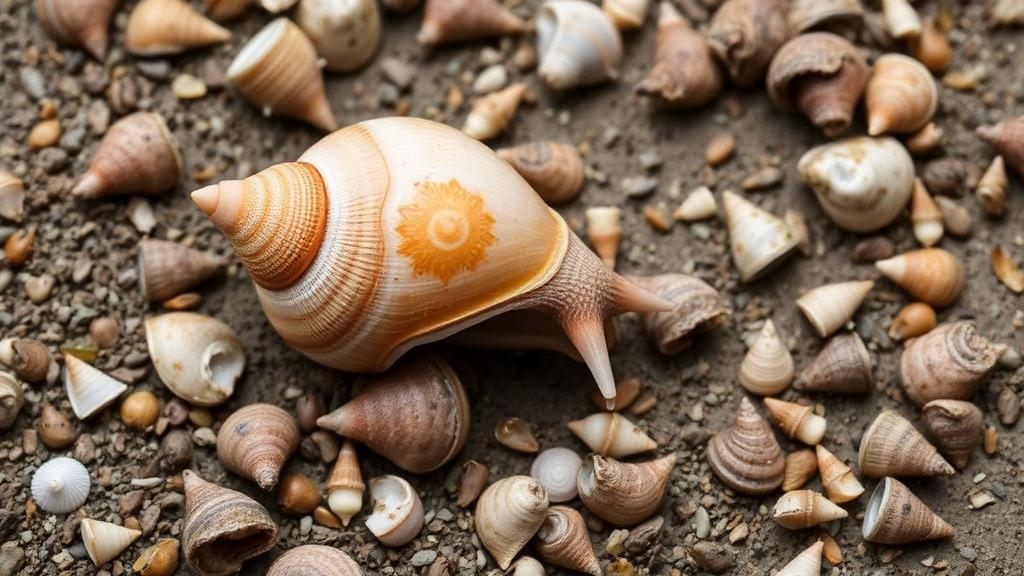
The humble garden snail, long dismissed as little more than a slow-moving garden ornament, may turn out to be one of the most unexpected archives of extreme weather in the natural world. A team of researchers at the University of Queensland has demonstrated that the shells of land snails preserve a chemical memory of the rainfall they experienced during their lives, and that this memory is not a smooth record of ordinary seasons but a dramatic log of catastrophic storms. By examining the growth bands in the shell of a single Biggenden Banded Snail collected from Coalstoun Lakes National Park in South East Queensland, the researchers found that the animal’s periods of most rapid growth coincided with the aftermath of two named tropical cyclones. The discovery, published in the journal The Holocene, opens a pathway toward reconstructing the tracks and intensity of prehistoric cyclones for which no human records exist.
The snail at the center of the study, Figuladra bayensis, is a banded land snail native to the forests of Queensland. Like trees, snails add material to their shells incrementally, producing growth bands that can be sampled and analyzed one by one. A project led by researchers in the University of Queensland’s School of the Environment took tiny samples of the shell at millimetre intervals, a resolution fine enough to resolve individual growth episodes within the animal’s lifespan. Each band, the team realized, potentially encoded both a timestamp and a weather report: the chemistry of the carbonate laid down at any moment reflects the environmental conditions the snail was experiencing as it secreted new shell material.
Dating those bands precisely was the first challenge, and the researchers turned to one of the most distinctive chronological tools of the modern era: the radiocarbon signature left by atmospheric nuclear testing. During the 1950s and 1960s, nuclear weapons tests, including tests conducted in Australia, injected large quantities of artificial radiocarbon into the atmosphere. This so-called bomb pulse was absorbed by plants, incorporated into the food chain, and ultimately recorded in the tissues and shells of animals alive at the time. Dr Nicholas Patton, who led the project, explained that the shell contained elevated levels of radiocarbon from the nuclear tests of the 1960s. Using high-resolution radiocarbon dating, the team was able to anchor the growth bands in time and determine that the snail had lived for approximately four and a half years.
With the chronology established, the researchers analyzed the stable isotopes of oxygen and carbon preserved in each band. Oxygen isotope ratios in shell carbonate are governed largely by the isotopic composition of the water the animal ingests, which in turn is strongly influenced by the source and amount of rainfall in the local environment. Carbon isotopes reflect the animal’s diet and the photosynthetic pathways of the plants it consumed. Together, these two proxies provide a complementary picture of the climate and ecology surrounding the snail as it grew. By reading the isotope values band by band, the team could reconstruct a timeline of the rainfall conditions the snail experienced across the roughly four and a half years of its life.
What the team expected to find was a straightforward relationship between shell growth and annual climate. Honorary Professor Jamie Shulmeister, a co-author of the study, said the researchers initially anticipated that the rapid growth phases would correspond to years with heavier rainfall, which would have made more food available for the snail and fueled faster shell deposition. The logic seemed sound: wetter years should mean lusher vegetation, better nutrition, and more vigorous growth. But when the team compared the growth record against the meteorological history of the region, the expected pattern failed to appear. The shell’s growth was not tracking the overall wetness of each year at all.
Instead, the data revealed something far more striking. The shell had not grown continuously during the snail’s life; rather, there were periods of rapid growth separated by periods of little or no growth. When the researchers mapped these growth spurts against the dates established by radiocarbon dating, they found that the spurts aligned with periods immediately following two major tropical cyclones: Severe Tropical Cyclone Marcia in 2015 and Tropical Cyclone Debbie in 2017. Both storms caused extreme rainfall within Coalstoun Lakes National Park, dumping extraordinary volumes of water on the landscape in short periods. The snail, it turned out, was responding not to the gentle accumulation of seasonal rain but to the deluges that follow catastrophic storms.
The implications of this finding extend well beyond the biography of one snail. Because the growth spurts in the shell could be linked so clearly to specific, dated cyclones, the researchers recognized that snail shells could serve as proxies for extreme weather events extending back into periods before modern meteorological records began. Shulmeister described the realization as surprising and quite exciting, noting that the humble snail could become a tool for reconstructing the paths of past cyclones, potentially even in prehistoric times. For a region like the Queensland coast, where tropical cyclones pose a recurrent hazard, a new archive of pre-instrumental storm activity would be scientifically and socially invaluable.
The value of such an archive is difficult to overstate. Instrumental records of cyclone activity in Australia span little more than a century, and reliable satellite-based monitoring only a few decades. Beyond that window, scientists depend on sparse historical documents, geological storm deposits, and natural proxies such as coral cores and tree rings, each with its own limitations. Land snail shells, by contrast, are abundant, widely distributed, and durable enough to survive in sediment layers for thousands of years. If each shell preserves a chemical fingerprint of the extreme rainfall events during its lifetime, then a stratified sequence of shells could yield a decade-by-decade, or even finer, chronology of past storminess.
The research team’s next step is to test exactly that proposition. Dr Patton explained that if shells can be found within different layers of sediment deposits, the individual shell records can be combined to extend the information further back in time. Stacking multiple shell chronologies from successive sediment layers would, in principle, allow researchers to build a continuous reconstruction of extreme rainfall and cyclone activity across centuries or millennia. Such a reconstruction would help answer pressing questions about the natural variability of cyclone frequency in the Southwest Pacific, providing a baseline against which the influence of modern climate change on storm behavior can be assessed.
The study was completed in collaboration with Professor Melanie Leng of the British Geological Survey and the University of Nottingham, and Dr Quan Hua of the Australian Nuclear Science and Technology Organisation, institutions whose expertise in stable isotope analysis and radiocarbon dating underpinned the technical achievement of the work. The research, published in The Holocene under the title evaluating the Biggenden Banded Snail as a climate archive for South East Queensland using stable isotopes and radiocarbon dating, was conducted as an experimental study, and the authors declared no potential conflicts of interest. For now, the finding stands as a reminder that some of the most valuable scientific archives are not locked in ice cores or deep-sea sediments, but carried quietly on the backs of creatures small enough to fit in a palm, patiently recording the fury of the skies above them one growth band at a time.
Subject of Research: Land snail shells as climate archives for reconstructing historical and prehistoric cyclone activity in Queensland, Australia
Article Title: Snail shells are surprise weather time capsules
Article References: Snail shells are surprise weather time capsules. (n.d.). Original publication
Image Credits: AI Generated
DOI: Not provided
Keywords: snail shells, paleoclimatology, cyclones, radiocarbon dating, stable isotopes, Queensland, extreme rainfall, The Holocene, University of Queensland, climate proxies, Figuladra bayensis, bomb pulse
Cite Scienmag News
Russell Cooper. (October 2, 2026). Snail Shells Record Ancient Cyclones, Queensland Study Reveals. Scienmag. https://scienmag.com/snail-shells-record-ancient-cyclones-queensland-study-reveals/
Russell Cooper. "Snail Shells Record Ancient Cyclones, Queensland Study Reveals." Scienmag, 2 October 2026, https://scienmag.com/snail-shells-record-ancient-cyclones-queensland-study-reveals/. Accessed 4 October 2026.
Russell Cooper. "Snail Shells Record Ancient Cyclones, Queensland Study Reveals." Scienmag. October 2, 2026. https://scienmag.com/snail-shells-record-ancient-cyclones-queensland-study-reveals/


