


For more than a hundred years, the evolutionary journey of mammals transitioning from sprawling postures reminiscent of reptiles to upright, limb-under-body stances characteristic of modern mammals has been a subject of enduring fascination and debate. This pivotal change in posture was not merely a superficial anatomical shift, but a profound transformation that enabled mammals to exploit diverse ecological niches and modes of locomotion. While it has long been accepted that this transition occurred gradually and linearly, recent research challenges this view, revealing a far more complex and dynamic evolutionary trajectory marked by unexpected detours and bursts of biomechanical innovation.
A recent groundbreaking study published in PLOS Biology, led by Dr. Robert Brocklehurst of Harvard University’s Department of Organismic and Evolutionary Biology, employs cutting-edge biomechanical analysis to unravel this intricate evolutionary narrative. The team meticulously examined the humerus — the upper arm bone — from over 60 fossil specimens of non-mammalian synapsids alongside more than 140 specimens of extant species including reptiles, amphibians, and diverse mammals. By integrating fossil data with advanced computational techniques, they reconstructed the locomotor postures and forelimb functions of these ancient species with unprecedented precision.
The researchers utilized a novel “slice-based” landmarking method, innovatively adapted from an existing R software package, to map the complex surface morphology of humeral bones. This approach enabled precise quantification of crucial anatomical traits such as bone length, mass distribution, muscle leverage, and torsion — a measure of the bone’s twist along its longitudinal axis. These parameters serve as biomechanical proxies, providing insight into muscle attachments and locomotor capabilities, thereby illuminating the postural adaptations that ancient synapsids and their descendants underwent during their evolutionary journey.
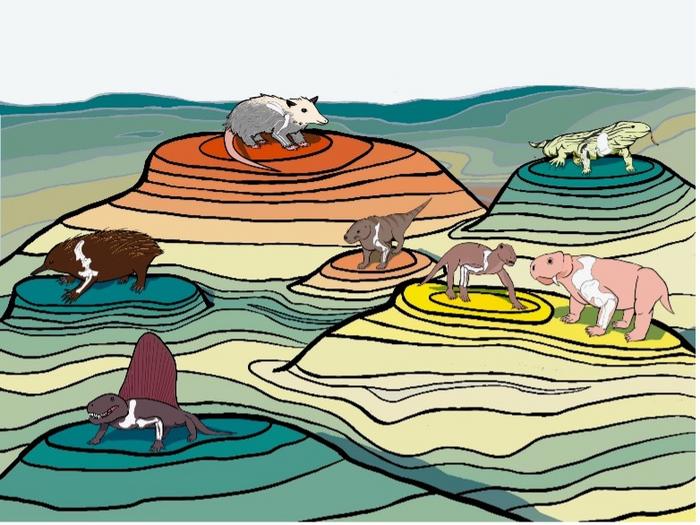
Contrary to the prevailing paradigm of a neat, stepwise evolutionary progression from sprawling to semi-sprawling and finally to upright parasagittal postures, the study revealed a more labyrinthine adaptive landscape. This landscape is characterized by multiple, distinct adaptive peaks, each corresponding to specialized functional regimes in forelimb posture and movement. Importantly, extinct synapsid lineages occupied a variety of these peaks, evincing a rich tapestry of biomechanical experimentation rather than a straightforward linear trend.
This complex evolutionary pattern suggests that mammalian ancestors engaged in repeated episodes of adaptive radiation, wherein each major group explored a spectrum of locomotor strategies. Some of these postures approximated the modern upright stance, while others represented alternative solutions fine-tuned to specific ecological contexts. Such evolutionary plasticity underscores the dynamic interplay between morphology, function, and environmental pressures throughout the mammalian lineage’s deep history.
One particularly intriguing finding relates to a fossil species closely allied to modern marsupials and placentals, which exhibited humeral features congruent with the fully upright, parasagittal posture typical of extant mammals. This discovery implies that the definitive upright gait, long assumed to be an early hallmark of mammals, actually evolved relatively late, in contrast to traditional hypotheses. These results dovetail with recent comparative studies on vertebral and hindlimb morphology, collectively reshaping our understanding of mammalian locomotor evolution.
Moreover, the study challenges the long-held assumption that early non-mammalian synapsids exhibited sprawling postures analogous to modern reptiles such as lizards and crocodilians. Rather, the forelimb biomechanics of these ancient synapsids differ substantially, indicating unique functional adaptations absent in contemporary reptiles. This finding accentuates the distinct evolutionary identity of synapsids, highlighting their departure from basal reptilian locomotor modes well before the rise of crown mammals.
The methodology employed surmounted formidable technical hurdles inherent in comparing morphological traits across a vast taxonomic and temporal spectrum. Traditional geometric morphometric techniques, often limited to homologous structures with similar shapes, proved inadequate for such a diverse dataset spanning species separated by hundreds of millions of years. By adapting and innovating analytical tools, the research team generated a robust framework capable of translating complex fossil morphology into biomechanical function, paving the way for future evolutionary biomechanical investigations.
This research builds upon a storied scientific legacy, tracing intellectual lineages back to early 20th-century pioneers like Alfred Sherwood Romer and Farish Jenkins Jr., who first grappled with the origins of mammalian posture. With contemporary tools and computational power, the team now revisits these classic questions with renewed rigor and resolution, bringing clarity to long-standing evolutionary puzzles.
Looking ahead, the research group aims to develop detailed biomechanical models of limb articulation and muscle function in select fossil taxa. Such models promise to further elucidate the functional dynamics underlying posture and locomotion during key evolutionary transitions, offering deeper insight into the anatomical and ecological contexts that shaped mammalian evolution.
In sum, this groundbreaking study reveals an intricate and nonlinear evolutionary pathway from sprawling to upright forelimb function and posture in mammals. It highlights the evolutionary plasticity and innovation that characterized the mammalian lineage, challenging simplistic narratives and enriching our understanding of vertebrate evolution. As Dr. Brocklehurst emphasizes, deciphering how mammals came to stride upright transcends mere bone morphology; it opens a window into the dynamic history of life on Earth.
News Publication Date: 24-Jun-2025
Web References:
- PLOS Biology Article DOI: 10.1371/journal.pbio.3003188
- Related studies on backbone and hindlimb evolution:
Cite Scienmag News
Gavin Prescott. (June 24, 2025). Smitten with Science: Diving Deep into Breakthrough Discoveries. Scienmag. https://scienmag.com/smitten-with-science-diving-deep-into-breakthrough-discoveries/
Gavin Prescott. "Smitten with Science: Diving Deep into Breakthrough Discoveries." Scienmag, 24 June 2025, https://scienmag.com/smitten-with-science-diving-deep-into-breakthrough-discoveries/. Accessed 4 September 2026.
Gavin Prescott. "Smitten with Science: Diving Deep into Breakthrough Discoveries." Scienmag. June 24, 2025. https://scienmag.com/smitten-with-science-diving-deep-into-breakthrough-discoveries/


