


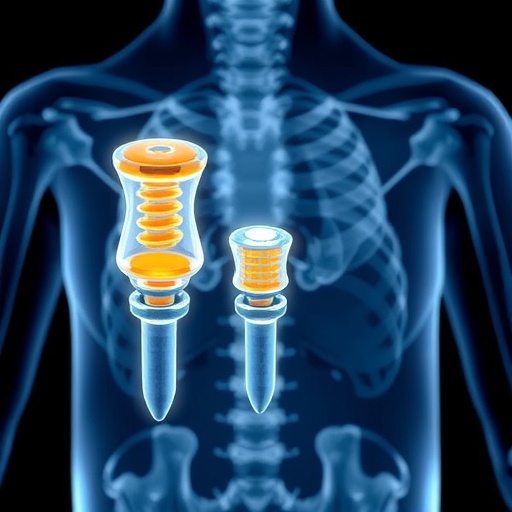
In the relentless quest to advance medical implant technology, a groundbreaking development has emerged from the forefront of biomaterials research. Scientists have engineered an intelligence-responsive wettability switch coating on magnesium implants, poised to revolutionize treatments for osteoporotic fractures. This innovation, recently detailed by Qi, G., Ma, T., Wang, Y., and colleagues in Nature Communications, offers a fascinating glimpse into the convergence of materials science, biology, and intelligent design principles applied to regenerative medicine.
Osteoporotic fractures represent a significant clinical challenge due to the compromised bone quality and impaired healing characteristic of osteoporosis. Conventional implants often face limitations in such environments, where poor bone integration and corrosion compromise the durability and safety of metallic devices. Magnesium, a metal notable for its biodegradability and mechanical properties compatible with bone, has been hailed as a promising implant material; yet its rapid corrosion demands sophisticated surface treatments to harness its full potential.
The novel coating introduced by the research team is engineered with an intelligence-response mechanism that dynamically adjusts wettability—the ability of a surface to interact with liquids—thereby optimizing the implant’s interaction within the physiological environment. Wettability plays a critical role in cell adhesion, protein absorption, and ultimately the integration of the implant with bone tissue. By switching between hydrophobic and hydrophilic states in response to biochemical or physical triggers, the coating facilitates better control over the healing microenvironment.
At the heart of this innovation lies a smart polymeric layer integrated with magnesium implants. This layer is designed to respond intelligently to the local biochemical cues such as pH changes or electrolyte concentrations, common in osteoporotic fracture sites. When the implant is introduced to the body, the coating remains in a state that discourages unwanted biofouling or rapid degradation. As healing progresses, the coating transitions to a highly hydrophilic state, encouraging cellular colonization and integration.
The fabrication of this coating involves nanostructured surface modification combined with stimuli-responsive polymers. These polymers embed molecular switches that undergo conformational changes when encountering environmental triggers. This mechanism realigns the surface energy properties, effectively modulating the implant’s wettability. Such precision engineering ensures that the implant surface is neither too repellent nor excessively adhesive at inappropriate stages, thus maintaining an optimal healing ambiance.
Importantly, this adaptive wettability also addresses the corrosion issue intrinsic to magnesium implants. Early in the implantation process, a hydrophobic state reduces initial exposure to body fluids and slows down degradation, providing a critical window for early-stage mechanical support. As new bone tissue forms, the coating transitions to enhance wettability, promoting osteoblast attachment and accelerating mineralization processes crucial for bone regeneration.
Experimental validation of these coatings showed promising outcomes in preclinical models mimicking osteoporotic fractures. The implants exhibited prolonged structural integrity and induced enhanced bone regeneration compared to conventional magnesium implants. Histological analyses revealed denser bone matrices forming at the implant interface, consistent with enhanced biocompatibility heralded by the dynamically controlled wettability.
This research unveils an exciting paradigm shift where implant surfaces are not static but evolve responsively in harmony with biological processes. Beyond magnesium, the conceptual framework of intelligence-responsive coatings may be extended to other biodegradable metals or polymers, opening new horizons for customized, patient-specific implant therapies.
The broader implications of this technology also encompass potential integration with diagnostic systems. Future iterations may incorporate sensing capabilities to monitor healing progression in real-time, providing feedback that guides further intelligent responses from the implant surface, thereby elevating clinical outcomes through personalized medicine.
While challenges remain—such as scaling manufacturing processes, ensuring long-term stability of the coatings under complex physiological conditions, and comprehensive safety assessments—the foundational principles demonstrated here provide a robust platform for next-generation implantable devices, particularly in osteoporotic and other compromised tissue contexts.
This innovation addresses a critical unmet need in orthopedics by enhancing magnesium’s clinical viability while simultaneously advancing materials science through the introduction of adaptive biomaterials. The synergy of degradability, mechanical compatibility, and intelligent surface dynamics may dramatically improve patient recovery and reduce complications associated with implant failure or rejection.
Moreover, the authors emphasize the potential for this technology to reduce reliance on secondary surgeries typically necessary to remove or replace implants, thus extending the functional lifespan of orthopedic devices and alleviating healthcare burdens. Such sustainable and intelligent systems are in high demand in the aging global population increasingly affected by osteoporosis.
The research team envisions continued exploration into multi-functional coatings that combine wettability modulation with antimicrobial properties or controlled drug release. This multifunctionality could provide a holistic therapeutic approach, simultaneously combating infection risks and promoting tissue regeneration.
Collaborations with clinical researchers will be pivotal in translating these findings into human trials, assessing efficacy, safety, and patient-specific customization strategies. The ability to tailor implant behavior to individual physiological conditions would mark a transformative milestone in orthopedic biomaterials.
In essence, the intelligence-responsive wettability switch coating on magnesium implants epitomizes an intersection of advanced materials science and biomedicine, pushing the boundaries of how implants can interact intelligently with living tissues to enhance healing. It sets a new standard for design philosophy in regenerative medicine—one that acknowledges and leverages the dynamic complexity of biological environments.
The study presents not only a technological breakthrough but also a compelling narrative of innovation driven by interdisciplinary collaboration, promising a future where implantable devices are no longer passive fixtures but active participants in healing.
Qi, G., Ma, T., Wang, Y. et al. Intelligence-responsive wettability switch coating on magnesium implants for treating osteoporotic fracture. Nat Commun (2026). https://doi.org/10.1038/s41467-026-72683-3
Cite Scienmag News
Neil Sanderson. (May 3, 2026). Smart Wettability Coating Enhances Magnesium Osteoporosis Implants. Scienmag. https://scienmag.com/smart-wettability-coating-enhances-magnesium-osteoporosis-implants/
Neil Sanderson. "Smart Wettability Coating Enhances Magnesium Osteoporosis Implants." Scienmag, 3 May 2026, https://scienmag.com/smart-wettability-coating-enhances-magnesium-osteoporosis-implants/. Accessed 4 September 2026.
Neil Sanderson. "Smart Wettability Coating Enhances Magnesium Osteoporosis Implants." Scienmag. May 3, 2026. https://scienmag.com/smart-wettability-coating-enhances-magnesium-osteoporosis-implants/


