


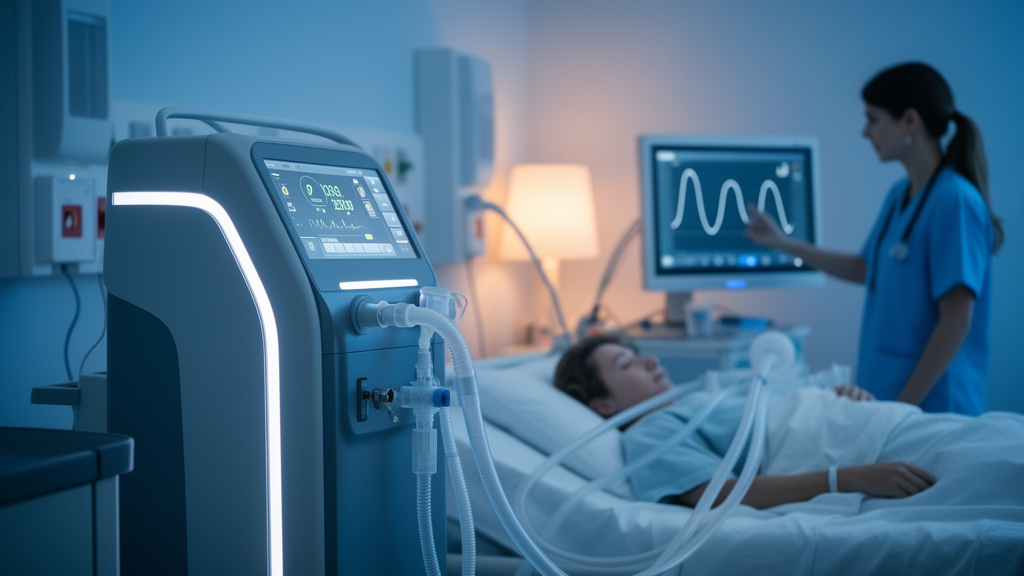
Non-invasive ventilation has become one of the most important tools in modern intensive care, allowing clinicians to support failing lungs through a mask or helmet rather than a tube pushed down the windpipe. It spares patients the dangers of intubation, preserves their ability to breathe spontaneously, and has become standard care for conditions such as acute flare-ups of chronic obstructive pulmonary disease and cardiogenic pulmonary edema. Yet a new review published in Frontiers in Anesthesiology argues that the technology’s greatest weakness lies not in what it does, but in what it cannot see. Fernando S. Guimaraes of the Federal University of Rio de Janeiro and Antonio M. Esquinas of Hospital Morales Meseguer in Murcia, Spain, synthesized the current evidence on closed-loop and adaptive ventilation strategies and reached a sobering conclusion: most of today’s so-called smart non-invasive ventilation is only partially intelligent, and no system on the market can yet be trusted to run itself.
The core problem is the leak. Unlike invasive ventilation, where the breathing circuit is sealed around an endotracheal tube, non-invasive ventilation deliberately allows air to escape through vents in the mask and, unintentionally, through gaps around the face. Those leaks wreak havoc on the ventilator’s basic assumptions. Flow sensors misread how much air is actually entering the lungs, triggering mechanisms fire late or fire when the patient has not made any effort at all, and the machine may keep pushing air into a breath the patient has already abandoned. In a landmark multicenter study of patients receiving non-invasive ventilation for acute respiratory failure, severe patient-ventilator asynchrony, defined as an asynchrony index above ten percent, occurred in forty-three percent of patients, and the magnitude of the leak correlated directly with wasted breathing efforts and delayed cycling. Every wasted effort represents work the patient performs that the machine fails to assist, and over hours it can mean the difference between recovery and exhaustion.
Engineers have responded with what the review calls the first practical closed loops. Modern ventilators embed leak-compensation algorithms that continuously estimate how much of the measured flow is escaping and adjust trigger sensitivity and cycling thresholds accordingly. Bench studies by Vignaux and colleagues showed that leaks impair intensive care ventilator performance by increasing trigger delay and reducing pressurization, and that non-invasive ventilation modes only partially corrected these defects, with performance varying widely between devices. A later randomized crossover study found that these algorithms reduced leak-related asynchronies but sometimes introduced new ones, such as premature cycling that cuts breaths short. Carteaux and colleagues demonstrated that dedicated non-invasive ventilation ventilators achieved lower asynchrony indices than general intensive care units machines, largely because they handled leaks and auto-triggering better. The lesson, the authors stress, is a fundamental principle of control engineering applied to physiology: an algorithm that fixes one form of desynchronization can create another if it does not understand the whole breathing pattern.
The most sophisticated feedback signal now being exploited is the patient’s own neural command to breathe. Neurally adjusted ventilatory assist, or NAVA, uses a specialized feeding tube with electrodes to measure the electrical activity of the diaphragm, known as EAdi, and delivers pressure in proportion to that signal. Because the trigger and cycling are driven by the diaphragm itself rather than by airflow through a leaky mask, NAVA is largely immune to the leak problem. Physiological studies by Piquilloud and Longhini showed improved patient-ventilator interaction and comfort during masked ventilation. But the randomized trial evidence is more cautious: in adults with de novo acute respiratory failure, NAVA reduced asynchrony and ventilation-related complications without reducing ventilation failure or twenty-eight-day mortality compared with conventional pressure support. In chronic obstructive pulmonary disease exacerbations, NAVA and adaptive support ventilation performed similarly, though the latter required fewer clinician adjustments. A 2026 feasibility trial of adaptive support ventilation with the IntelliSync waveform module found greater patient comfort and shorter hospital stays, with a numerically lower but statistically insignificant failure rate, leaving larger trials awaited.
Between the simple leak compensators and the neural systems sits a family of adaptive pressure modes that are already in widespread clinical use. Average volume-assured pressure support, or AVAPS, and its cousin iVAPS automatically titrate the inspiratory pressure within preset limits to hit a target tidal volume or alveolar ventilation, and some devices can even auto-adjust the expiratory pressure. These are genuine feedback loops, but narrow ones: they respond to delivered volume, not to the patient’s effort, comfort, or trajectory toward failure. The most recent evidence, a 2026 systematic review and meta-analysis by Gregory and colleagues covering eleven comparative studies, found that AVAPS was associated with a lower risk of intubation than standard bilevel ventilation in acute hypercapnic respiratory failure, without a clear mortality benefit. The authors of the review urge restraint in interpreting that result, noting that only three studies contributed complete intubation data, the evidence mixed randomized and observational designs, and the populations were dominated by COPD patients. AVAPS, they conclude, is a pressure-adaptation loop, not a fully closed-loop therapy.
Perhaps the most striking gap the review identifies is that no current system measures the thing that matters most: whether the patient’s breathing muscles are being adequately unloaded or silently injured. Persistent high respiratory drive and excessive inspiratory effort can fatigue the diaphragm, strain the cardiovascular system, and even cause what researchers call patient self-inflicted lung injury, where powerful spontaneous breaths stretch delicate tissue. A pivotal study by Tonelli and colleagues found that the relief of inspiratory effort, measured with an esophageal pressure catheter within the first two hours of non-invasive ventilation, was an early and accurate predictor of whether the treatment would succeed. That finding connects physiology directly to a life-or-death decision: whether the mask is truly resting the patient or merely postponing an inevitable intubation. The review argues that future controllers should evolve from synchrony loops into injury-avoidance loops, using esophageal pressure, airway occlusion pressure, diaphragm electrical activity, and ultrasound to keep unloading in a safe window.
Artificial intelligence promises to knit these fragments together, but the review is candid about how far away that remains. Machine learning models applied to ventilator waveforms and electronic health records are exquisitely sensitive to how data are prepared: sampling frequency, aggregation windows, prediction horizons, and missing-data handling all determine what physiology a model can actually learn, and a breath-by-breath signal is not interchangeable with a thirty-minute trend. Three research lines stand out. A newly peer-reviewed ontology for non-invasive respiratory support aims to standardize concepts across devices and records, enabling interoperability and rule-based reasoning. Computational leak estimation is improving the reconstruction of true patient flow, a prerequisite for any advanced control. And safety-oriented offline reinforcement learning combined with digital twin verification, proposed by Yu and colleagues, could allow ventilator control policies to be stress-tested in simulation before ever touching a patient, though that work remains preclinical and not specific to non-invasive ventilation.
The invasive ventilation literature offers both encouragement and a warning. A 2024 systematic review found that closed-loop systems can improve process measures and reduce staff workload, and the large randomized ACTiVE trial showed that the multivariable INTELLiVENT-ASV system improved ventilation quality and reduced severe gas-exchange derangements. Yet patients on the automated system did not spend more days free from the ventilator than those managed with protocolized conventional care. Better automation, in other words, does not automatically become better outcomes. That caution weighs heavily on non-invasive ventilation, where treatment failure is not a single control error but a clinical judgment involving gas exchange, mental status, hemodynamics, secretion burden, and airway protection, and where delayed intubation remains a central mechanism of harm.
The authors’ prescription is a hierarchical, multirate architecture with the clinician firmly in command. Fast breath-to-breath loops would handle leak estimation, triggering, and cycling; intermediate loops would regulate ventilation and muscle unloading; and a slower supervisory layer would integrate gas exchange, comfort, and failure risk, sometimes issuing not a ventilator adjustment but a recommendation to change the interface or proceed to intubation. Such systems would need bounded rates of change, fail-safe fallback modes, transparent disclosure of which signal triggered any action, and rigorous external validation. The evidence, the review concludes, supports the physiological rationale for closed-loop non-invasive ventilation but not autonomous operation or a proven major outcome benefit. Until prospective trials show that supervised, safety-constrained automation improves results without delaying escalation, the smartest machine at the bedside will remain the one with a trained intensivist behind it.
Subject of Research: Closed-loop and adaptive control strategies for non-invasive ventilation in critically ill adults
Article Title: Closed-loop non-invasive ventilation in critical care: current evidence and clinical perspectives
Article References: Guimaraes, F. S., & Esquinas, A. M. (2026). Closed-loop non-invasive ventilation in critical care: current evidence and clinical perspectives. Frontiers in Anesthesiology, 5, Article 1948602. https://doi.org/10.3389/fanes.2026.1948602
Image Credits: AI Generated
DOI: 10.3389/fanes.2026.1948602
Keywords: non-invasive ventilation, closed-loop ventilation, critical care, patient-ventilator asynchrony, NAVA, AVAPS, leak compensation, respiratory drive, artificial intelligence, waveform analysis, ventilator weaning, intensive care
Cite Scienmag News
Blake Davidson. (October 16, 2026). Smart Ventilators That Think: How Closed-Loop Breathing Support Could Transform Intensive Care. Scienmag. https://scienmag.com/smart-ventilators-that-think-how-closed-loop-breathing-support-could-transform-intensive-care/
Blake Davidson. "Smart Ventilators That Think: How Closed-Loop Breathing Support Could Transform Intensive Care." Scienmag, 16 October 2026, https://scienmag.com/smart-ventilators-that-think-how-closed-loop-breathing-support-could-transform-intensive-care/. Accessed 16 October 2026.
Blake Davidson. "Smart Ventilators That Think: How Closed-Loop Breathing Support Could Transform Intensive Care." Scienmag. October 16, 2026. https://scienmag.com/smart-ventilators-that-think-how-closed-loop-breathing-support-could-transform-intensive-care/


