
Tuesday, March 3, 2026
Science
No Result
View All Result
  • Login
  • HOME
  • SCIENCE NEWS
  • CONTACT US
  • HOME
  • SCIENCE NEWS
  • CONTACT US
No Result
View All Result
Scienmag
No Result
View All Result
Home Science News Agriculture

Smart soil can water and feed itself

July 17, 2024
in Agriculture
Reading Time: 3 mins read
0
Hydrogels 1
68
SHARES
616
VIEWS
Share on FacebookShare on Twitter
ADVERTISEMENT

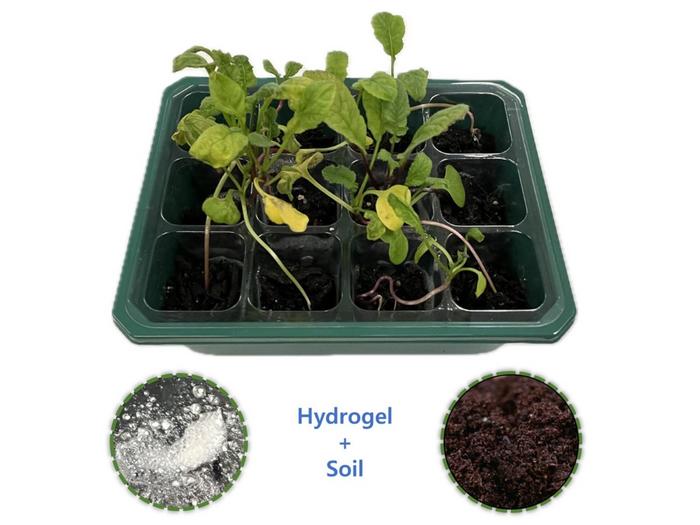
A newly engineered type of soil can capture water out of thin air to keep plants hydrated and manage controlled release of fertilizer for a constant supply of nutrients.

Hydrogels 1

Credit: The University of Texas at Austin

A newly engineered type of soil can capture water out of thin air to keep plants hydrated and manage controlled release of fertilizer for a constant supply of nutrients.

Underpinning this exciting smart soil system is a hydrogel material developed by researchers at The University of Texas at Austin. In experiments, the hydrogel-infused soil led to the growth of larger, healthier plants, compared to regular soil, all while using less water and fertilizer.

“This new gel technology can reduce the burden on farmers by decreasing the need for frequent irrigation and fertilization,” said Jungjoon Park, a graduate student in the Walker Department of Mechanical Engineering and who led the research. “The technology is also versatile enough to be adopted across a wide range of climates, from arid regions to temperate areas.”

The research was published recently in ACS Materials Letters.

Agriculture today accounts for 70% of global freshwater withdrawals and up to 95% in some developing countries as our global population continues to rise. The U.N. Food and Agriculture Organization emphasizes the importance of improving irrigation efficiency, adopting water-saving technologies and promoting crops with lower water footprints to ensure sustainable food production and water resource management.

Meanwhile, traditional farming methods, especially irrigation and fertilizing, face significant challenges, including inefficient water usage and environmental land degradation. As climate change intensifies and water resources become increasingly scarce, the need for more efficient and sustainable irrigation practices has never been more urgent. Additionally, conventional fertilization techniques often result in excessive nutrient exposure, reducing nutrient uptake efficiency and causing environmental pollution, and farmable land degradation.

“The global water scarcity coupled with a growing population has an immediate impact on food security,” said Yu, professor of materials science in the Cockrell School of Engineering’s Walker Department of Mechanical Engineering and Texas Materials Institute. “This new class of hydrogels offers a promising solution to meet the pressing needs of water scarcity and efficient nutrient uptake in modern sustainable agriculture.”

In experiments, plants rooted in the hydrogel soil saw a 138% increase in stem length compared to a control group in regular soil. And the modified soil can achieve approximately 40% water savings, significantly reducing the need for frequent irrigation and ensuring robust crop development. ​

This research builds on previous discoveries involving hydrogels that can pull water from the atmosphere and make farming more efficient. It is part of Yu’s overall mission that dates back to his childhood: to expand access to clean water to people around the globe.

This work mainly focused on calcium-based fertilizers. The project will continue, and the researchers’ next moves involve integrating different types of fertilizers and longer field tests.  

Joining Yu and Park on the project are Weixin Guan and Chuxin Lei, who are also graduate students in the materials science and engineering program and Texas Materials Institute.


Journal

ACS Materials Letters

DOI

10.1021/acsmaterialslett.4c01120

Article Title

Self-Irrigation and Slow-Release Fertilizer Hydrogels for Sustainable Agriculture

Article Publication Date

3-Jul-2024

Share27Tweet17
Previous Post

Rice neuroscientists to build state-of-the-art neural recording system

Next Post

Texas A&M geologist receives national recognition for career contributions to coal geology

Related Posts

blank
Agriculture

Unveiling the “Bloom” Cycle: How Plants Exhibit Remarkable Intelligence

March 3, 2026
blank
Agriculture

Research Reveals Two-Decade Decrease in Nitrate Pollution in Mississippi River Basin

March 2, 2026
blank
Agriculture

Researchers Discover Certain Pesticides Bypass Natural Barriers to Enter Streams

March 2, 2026
blank
Agriculture

Optimizing Fertilizer Rates Boosts Sustainable Farming in China

March 2, 2026
blank
Agriculture

Author Corrects Study on Ecological Intercropping Benefits

March 2, 2026
blank
Agriculture

New Tool Offers Hope for Overfished Gag Grouper Populations in the Gulf, USF Study Finds

March 2, 2026
Next Post
Dr. Anne Raymond

Texas A&M geologist receives national recognition for career contributions to coal geology

  • Mothers who receive childcare support from maternal grandparents show more parental warmth, finds NTU Singapore study

    Mothers who receive childcare support from maternal grandparents show more parental warmth, finds NTU Singapore study

    27619 shares
    Share 11044 Tweet 6903
  • University of Seville Breaks 120-Year-Old Mystery, Revises a Key Einstein Concept

    1023 shares
    Share 409 Tweet 256
  • Bee body mass, pathogens and local climate influence heat tolerance

    665 shares
    Share 266 Tweet 166
  • Researchers record first-ever images and data of a shark experiencing a boat strike

    532 shares
    Share 213 Tweet 133
  • Groundbreaking Clinical Trial Reveals Lubiprostone Enhances Kidney Function

    518 shares
    Share 207 Tweet 130
Science

Embark on a thrilling journey of discovery with Scienmag.com—your ultimate source for cutting-edge breakthroughs. Immerse yourself in a world where curiosity knows no limits and tomorrow’s possibilities become today’s reality!

RECENT NEWS

  • Dp44mT Targets Key Cancer Pathways via NDRG1
  • Pilot Clinical Trial Indicates Low-Dose Lithium Could Slow Decline in Verbal Memory
  • Macrophage-Derived Semaphorin 7A Promotes Atherosclerosis Through the Integrin β1/JNK/MSR1 Pathway
  • Amino Acid Residue-Guided Nanoparticle Targeting of Protein Cavities: Moving Beyond Size Complementarity

Categories

  • Agriculture
  • Anthropology
  • Archaeology
  • Athmospheric
  • Biology
  • Biotechnology
  • Blog
  • Bussines
  • Cancer
  • Chemistry
  • Climate
  • Earth Science
  • Editorial Policy
  • Marine
  • Mathematics
  • Medicine
  • Pediatry
  • Policy
  • Psychology & Psychiatry
  • Science Education
  • Social Science
  • Space
  • Technology and Engineering

Subscribe to Blog via Email

Enter your email address to subscribe to this blog and receive notifications of new posts by email.

Join 5,190 other subscribers

© 2025 Scienmag - Science Magazine

Welcome Back!

Login to your account below

Forgotten Password?

Retrieve your password

Please enter your username or email address to reset your password.

Log In
No Result
View All Result
  • HOME
  • SCIENCE NEWS
  • CONTACT US

© 2025 Scienmag - Science Magazine

Discover more from Science

Subscribe now to keep reading and get access to the full archive.

Continue reading