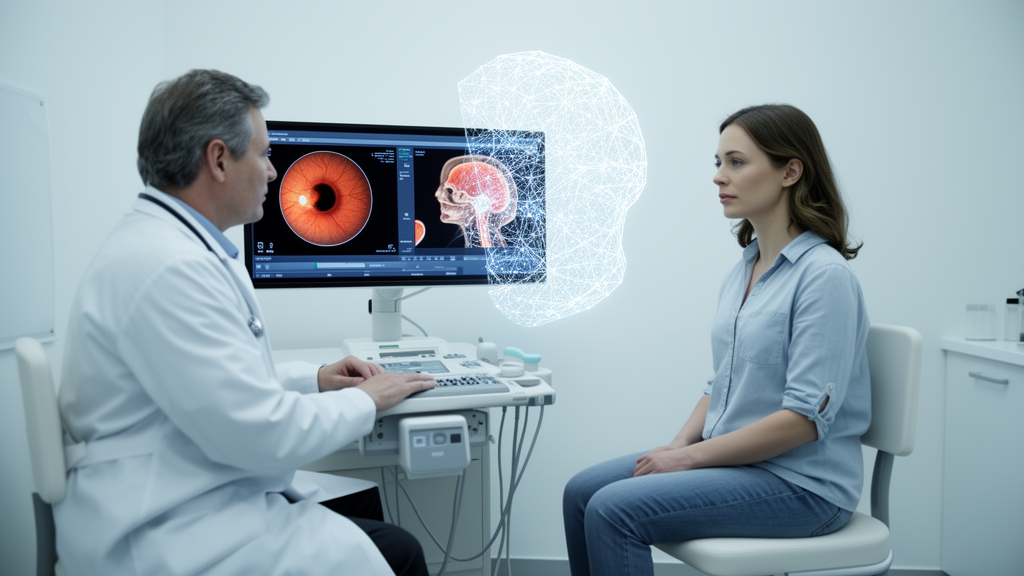
Smart healthcare systems are moving beyond the ability to recognize patterns in medical images toward the harder challenge of combining images, physiological signals, laboratory results, records and time-course observations into conclusions that clinicians can inspect. A 2026 editorial in Frontiers in Signal Processing argues that this transition depends less on producing more fluent answers than on creating an accountable chain from raw observations to clinical decisions. The authors, Rui Sun, Tao Lei and Asoke K. Nandi, frame multimodal vision-language models as one part of a broader clinical-intelligence system that must preserve evidence, communicate uncertainty and make its reasoning testable.
The starting point is perceptual reliability. Conventional artificial-intelligence systems can perform strongly in classification, detection and segmentation, but a prediction detached from patient context, uncertainty and interpretable evidence has limited clinical value. Clinical reasoning instead requires a system to retain relevant findings, reconcile complementary information and expose the basis of a conclusion so that a clinician can critically examine it. The editorial does not present a single new vision-language model or claim a proven clinical benefit. It synthesizes contributions to a research collection on “multimodal VLMs in smart healthcare” and identifies several requirements that any future system would have to meet.
One contribution, from Shang and colleagues, addresses reliable visual grounding through PDSA-DBUNet, a model for segmenting abdominal organs and tumors. The architecture combines local convolutional features with sparse global representations, an approach intended to preserve clinically relevant anatomical structure while limiting computational complexity. Its reported improvement in anatomical delineation supports a broader lesson from the collection: perception is not simply a matter of increasing model capacity. A model must selectively retain the structures on which a task depends, and its representation must remain useful when extended into later stages of fusion, explanation and decision-making.
The same requirement applies when medical evidence arrives as continuous physiological signals rather than images. Khalid and colleagues study seizure detection by jointly analyzing electroencephalography, electrocardiography, electromyography and accelerometer data. Their equation-level formulation is designed to regulate each modality’s contribution, cross-modal interaction and numerical stability. Data-quality screening occurs before fusion, while patient-wise splitting reduces subject-level overlap between training and evaluation sets. The work illustrates why multimodal learning should not be reduced to concatenating features: heterogeneous signals differ in quality, relevance and behavior, and a coherent clinical representation must make their interactions traceable rather than hiding them.
Accurate representations are not enough if clinicians cannot determine how an output was produced. In a review of explainable artificial intelligence for cardiovascular imaging, Yan and colleagues examine major attribution methods and identify continuing weaknesses in explanation stability, clinical relevance, cross-center generalization and evaluation standards. The editorial stresses that a heatmap is not equivalent to clinical reasoning. It may show where a model is sensitive, but that alone does not establish whether the highlighted region faithfully accounts for the output or qualifies as clinically valid evidence. Future explanatory systems should clarify what each modality contributes, represent interactions among modalities and connect computational evidence with anatomical, physiological and clinical knowledge.
Language models make this problem especially visible because they can produce polished recommendations even when their underlying reasoning is incomplete. Leon and colleagues evaluated large language models with expert-designed cardiac-surgery scenarios and a blinded, two-phase assessment. Reasoning-optimized models performed better overall, yet every model retained weaknesses in patient safety, hallucination avoidance and clinical efficiency. They were more dependable on structured or guideline-oriented tasks than on questions requiring longitudinal, uncertainty-tolerant or highly specialized reasoning. These findings concern performance in the tested scenarios, not evidence that the models are ready for autonomous care or that reasoning optimization resolves safety problems.
Human interaction is another critical part of the measurement. The cardiac-surgery evaluation found that overacceptance occurred more often than underrecognition on safety-critical dimensions, while well-structured responses could conceal subtle but potentially harmful errors. Fluent presentation may therefore encourage unwarranted confidence even when a model’s reasoning is wrong. The editorial consequently treats trustworthiness as a property of the entire human-AI system rather than of an algorithm alone. Evaluation must consider not only whether an answer is correct, but also whether its presentation helps users identify uncertainty, verify supporting evidence and reject unsafe recommendations before those outputs influence care.
Combining multimodal representation, longitudinal prediction and structured reasoning points toward a longer-term prospect: medical world models. These systems would aim to learn dynamic representations of patient states across anatomy, physiology and time, along with the interventions that may alter their trajectories. With appropriate causal assumptions and intervention-aware training, the authors say, such models could support disease forecasting, patient-specific simulation and exploration of possible clinical courses. None of the contributions summarized in the editorial directly develops a medical world model, however, and none demonstrates that simulated trajectories improve treatment or patient outcomes. Statistical prediction is not the same as causal understanding, and a plausible simulation is not evidence of therapeutic benefit.
Turning that prospect into reliable technology will require data and safeguards that the current collection does not resolve. The authors call for temporally aligned records, explicit intervention modeling, transparent uncertainty, traceable links to observable evidence and external validation across institutions and populations. Future evaluations also need to test performance when modalities are missing or degraded, when patient populations and disease distributions shift, when rare events occur and when clinical states change over time. Explanations should be judged for faithfulness and clinical utility, while external and prospective studies—not retrospective benchmark scores alone—would have to establish whether multimodal systems improve decisions, workflows or patient outcomes.
The editorial’s central message is that the next stage of smart healthcare will be defined by evidence-grounded reasoning rather than linguistic polish alone. Knowledge-grounded learning, causal modeling, retrieval, uncertainty communication and task-specific safeguards may help connect perception with decision-making, but equally important are interfaces that expose disagreement, absent evidence and model limitations. The collection’s studies and reviews are not a finished prescription for clinical deployment; they are an agenda for testing the systems on which such deployment would depend. For vision-language models to progress from describing medical observations to reasoning about them, future systems must preserve what was measured, explain what was inferred, acknowledge what remains uncertain and keep human responsibility visible when outcomes carry the greatest risk.
Subject of Research: Evaluation requirements for multimodal vision-language models in smart healthcare
Article Title: Editorial: From description to reasoning: multimodal VLMs in smart healthcare
Article References: Sun, R., Lei, T., & Nandi, A. K. (2026). Editorial: From description to reasoning: multimodal VLMs in smart healthcare. Frontiers in Signal Processing, 6, Article 2004707. https://doi.org/10.3389/frsip.2026.2004707
Image Credits: AI Generated
DOI: 10.3389/frsip.2026.2004707
Keywords: multimodal AI, vision-language models, clinical reasoning, medical imaging, explainable AI, signal fusion, medical world models, AI safety, healthcare, seizure detection, Editorial, description
Cite Scienmag News
Ophelia Keating. (October 21, 2026). Smart Healthcare’s Next Test: Can Vision-Language Models Reason Safely? Scienmag. https://scienmag.com/smart-healthcares-next-test-can-vision-language-models-reason-safely/
Ophelia Keating. "Smart Healthcare’s Next Test: Can Vision-Language Models Reason Safely?" Scienmag, 21 October 2026, https://scienmag.com/smart-healthcares-next-test-can-vision-language-models-reason-safely/. Accessed 21 October 2026.
Ophelia Keating. "Smart Healthcare’s Next Test: Can Vision-Language Models Reason Safely?" Scienmag. October 21, 2026. https://scienmag.com/smart-healthcares-next-test-can-vision-language-models-reason-safely/