


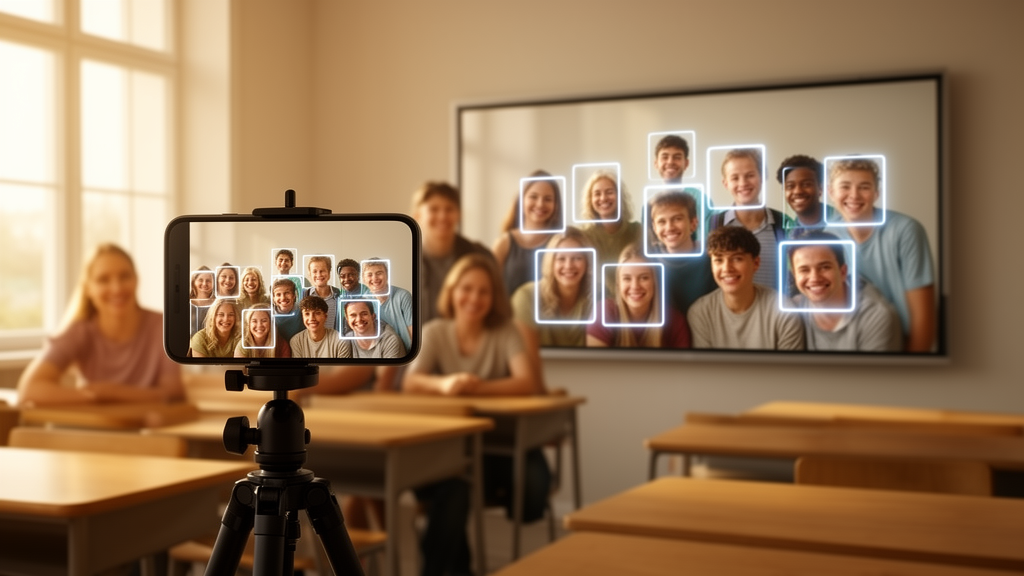
Manual attendance tracking remains widespread in academic settings, and the methods in use carry well-documented weaknesses. Roll calls and sign-in sheets are time-consuming and error-prone, and they can be manipulated through proxy signing, in which one person impersonates another. In university examinations and certification events, the researchers note, such manipulation can have serious academic and legal repercussions. Radio Frequency Identification cards require dedicated infrastructure and can simply be passed between people, while fingerprint scanners bind identity strongly but demand a physical scan from every attendee and cannot passively verify a whole room from a single capture point. A research team at Symbiosis Institute of Technology in Pune now reports a prototype that attacks this problem with nothing more than a group photograph, a smartphone camera, and a laptop without a GPU.
The system, called Smart Click and described in the journal Discover Artificial Intelligence, chains two deep learning models into a pipeline that converts one group photo into a list of verified identities written directly into a database. The first model, the Multi-task Cascaded Convolutional Neural Network, or MTCNN, hunts for faces. It is not a single network but a cascade of three, each refining the output of the last. P-Net, a fully convolutional network, slides a 12-pixel window across an image pyramid, scanning the photograph at multiple scales so that faces both near the camera and far away can be caught. R-Net then resamples the surviving candidates to 24 by 24 pixels and rejects most of them with a deeper convolutional network. O-Net, the final stage, works at 48 by 48 pixels and performs the last classification while also pinpointing five facial landmarks: two eyes, the nose tip, and two mouth corners. In the Smart Click configuration, the minimum detectable face is 20 pixels, the pyramid shrinks by a factor of 0.709 at each step, and the three stages use confidence thresholds of 0.6, 0.7, and 0.8, with overlapping boxes pruned by non-maximum suppression at 0.5.
Once MTCNN has drawn its bounding boxes, each cropped face is resized to 160 by 160 pixels and normalized to the range from minus one to one, matching the input requirements of the second model: FaceNet. Developed by Schroff, Kalenichenko, and Philbin, FaceNet is a deep convolutional network with an Inception-ResNet-v1 backbone that maps every face to a point in a 128-dimensional space. The network was trained with a triplet loss, a scheme in which each training sample contains three images: an anchor, a positive image of the same person, and a negative image of a different person. The loss pushes the anchor and the positive together in the embedding space while enforcing a margin of 0.2 between the anchor and the negative. The result is a learned geometry in which all the faces of one individual cluster together and the faces of different identities lie far apart. After L2 normalization, every embedding sits on a unit hypersphere, which makes cosine similarity equivalent to a simple dot product between any two vectors.
Identity matching in Smart Click is therefore a distance computation. For every face detected in a group photo, the system compares its query embedding against 91 stored reference embeddings, one per enrolled subject, and sorts the cosine distances from lowest to highest. If the best match falls below the recognition threshold of 0.65, the face is declared to belong to that student; anything above the threshold is labeled unknown. The threshold was not arbitrary. The team swept values from 0.55 to 0.90 and found that 0.65 delivered approximately zero false acceptances alongside a false rejection rate of 4.76 percent. Tighter thresholds rejected legitimate users too often, while looser ones invited misidentification and ambiguity. Attendance records, including the student’s registration ID, session date-time, and a status of Present, Absent, or Unknown, are written automatically into a MySQL 8.0 database, closing the loop without any human transcription.
The most distinctive component is an ambiguity detector aimed at a problem few attendance systems acknowledge: look-alikes. When the best match belongs to a pre-registered pair of visually similar students, the system checks the gap between the best and second-best cosine distances. If that difference is 0.02 or less, the two candidates are considered indistinguishable, and the system refuses to guess. Instead of marking attendance automatically, it issues an alert for manual verification by a supervising faculty member. The margin approach is applied selectively, only to pairs known in advance to resemble each other, so the rest of the room proceeds at full speed. In a test involving seven students, including visually similar cases, the system achieved 100 percent recognition with no false positives or false negatives.
The dataset behind these results is a primary collection of roughly 520 smartphone photographs of 91 enrolled subjects, captured indoors and outdoors under natural lighting. Each subject contributed five to six images spanning frontal views, small head turns of 15 to 20 degrees, profile angles of 45 to 60 degrees, tilts of about 15 degrees, neutral and smiling expressions, and accessories such as glasses, with low-light indoor shots deliberately included. The team also applied data augmentation, adding random rotation, horizontal flipping, cropping, scaling, brightness and gamma corrections, CLAHE, Gaussian noise and blur, and simulated occlusions from glasses and face masks. All participants gave informed consent, images were used solely for recognition research and attendance management, embeddings and photographs were stored on password-protected institutional systems and not shared with third parties, and the data will be deleted or anonymized under institutional retention policies.
Six test cases probed the pipeline from every angle. A single registered face under indoor light produced a cosine distance of just 0.09, far below the threshold. A group photo of six people yielded three correct recognitions, one false rejection, and two correct identifications of unregistered individuals, for 83.33 percent accuracy. A mixed group of four registered and two unregistered subjects achieved perfect scores: every registered face matched, every stranger was rejected, and the false acceptance rate was zero. Under bright daylight, normal lighting, and dim indoor conditions, cosine distances stayed between 0.06 and 0.33, and all four enrolled subjects were recognized while three unknowns were correctly turned away. The team credits the deliberate inclusion of low-light enrolment images for this illumination robustness, since no model retraining or threshold adjustment was needed.
The stress test came from the largest group: 33 detected faces mixing registered and unregistered attendees. Here recognition dropped to 88.89 percent, with 16 of 18 registered faces matched, two false negatives, two ambiguity cases, and eleven duplicate detections arising from visual similarity and the complexity of the photo. Across all scenarios, the overall recognition accuracy settled at 95.26 percent with a false rejection rate of 4.76 percent. Processing time scaled with crowd size, from 0.846 seconds for a single face to 14.515 seconds for the largest group, averaging 6.34 seconds per photograph. Notably, all experiments ran on standard hardware with no GPU, using Python 3.9, with NumPy handling array operations and cosine distances, OpenCV managing image input, color conversion, resizing, and annotation, and MySQL storing both reference embeddings and attendance records.
The comparison against a traditional baseline was stark. The team rebuilt a face recognition system using Local Binary Pattern Histograms, a hand-crafted feature method, while keeping MTCNN detection and the same test images constant so that only the recognition algorithm varied. LBPH recognized only 6 faces in total, an 18.75 percent recognition rate, and failed to identify a single person in two of the group photos, a collapse the authors attribute to the vulnerability of hand-crafted features to pose and lighting changes. Smart Click, by contrast, achieved recognition rates ranging from 60.0 to 100 percent in the individual group cases and 95.26 percent overall. The gap illustrates a broader shift in computer vision, in which learned embeddings have outperformed engineered features in unconstrained, real-life conditions.
The authors are candid about the limits. The 520-image dataset, though larger than many predecessors, may not represent the diversity of real deployments, and the 0.65 threshold was tuned empirically for this population and would need adjustment for new populations and conditions. The system has been tested only on still photographs, not real-time video, and the ambiguity detector was validated on a small number of look-alike subjects, so its performance on twins in broader databases remains unverified. No usability study has yet measured how invigilators, administrators, and students would accept the technology, and because faces are biometric data, privacy and security considerations loom over any institutional rollout. Still, the prototype needs nothing more than a smartphone camera and a laptop, and future work will target larger datasets, video-based attendance, varied environmental setups, and model fine-tuning on institutional data.
Subject of Research: Automated face recognition attendance verification using MTCNN and FaceNet in institutional gatherings
Article Title: An automated attendance and presence verification system using MTCNN and FaceNet on institutional gatherings
Article References: Pillarishetty, T. K., Dakhole, D., Agrawal, R., & Sharma, S. (2026). An automated attendance and presence verification system using MTCNN and FaceNet on institutional gatherings. Discover Artificial Intelligence, 6(1), Article 1601. https://doi.org/10.1007/s44163-026-02589-y
Image Credits: AI Generated
DOI: 10.1007/s44163-026-02589-y
Keywords: face recognition, MTCNN, FaceNet, deep learning, attendance automation, biometrics, computer vision, Smart Click, cosine similarity, institutional gatherings, LBPH comparison, privacy
Cite Scienmag News
Blake Davidson. (October 26, 2026). Smart Click: A Single Group Photo Automates Attendance with MTCNN and FaceNet. Scienmag. https://scienmag.com/smart-click-a-single-group-photo-automates-attendance-with-mtcnn-and-facenet/
Blake Davidson. "Smart Click: A Single Group Photo Automates Attendance with MTCNN and FaceNet." Scienmag, 26 October 2026, https://scienmag.com/smart-click-a-single-group-photo-automates-attendance-with-mtcnn-and-facenet/. Accessed 26 October 2026.
Blake Davidson. "Smart Click: A Single Group Photo Automates Attendance with MTCNN and FaceNet." Scienmag. October 26, 2026. https://scienmag.com/smart-click-a-single-group-photo-automates-attendance-with-mtcnn-and-facenet/


