

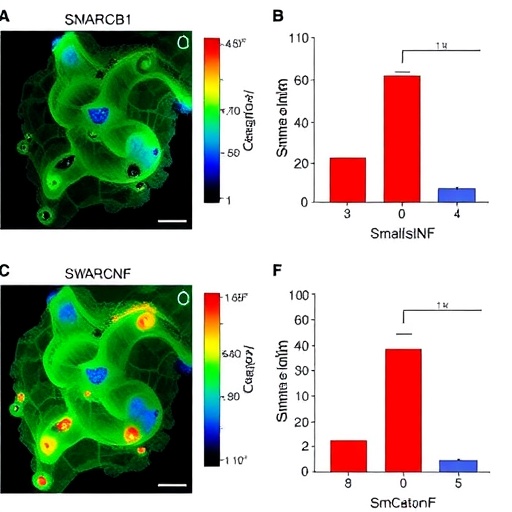
In a groundbreaking study destined to reshape our understanding of chromatin dynamics and cancer biology, researchers have unveiled how missense mutations in the SMARCB1 gene critically impair the stability and remodeling function of the SWI/SNF chromatin remodeling complex. The findings, set to appear in Nature Communications in 2026, illuminate the intricate molecular mechanisms by which specific SMARCB1 alterations undermine chromatin structure modulation, contributing to oncogenic transformation. This discovery paves the way for novel therapeutic interventions targeting disrupted epigenetic landscapes in cancer cells.
Chromatin remodeling complexes act as masters of genome architecture, dynamically repositioning, ejecting, or restructuring nucleosomes to regulate DNA accessibility for transcription, replication, and repair. Among these, the SWI/SNF complex is evolutionarily conserved and essential for orchestrating gene expression programs fundamental to cell identity and proliferation. Central to the SWI/SNF complex’s function is SMARCB1, also known as INI1, a core subunit that stabilizes the complex’s architecture and coordinates its ATP-dependent remodeling activity.
Despite the well-established tumor suppressor role of SMARCB1, particularly in atypical teratoid/rhabdoid tumors and other aggressive malignancies, the detailed impact of clinically observed missense mutations on SWI/SNF complex integrity and chromatin remodeling remained elusive. The current study employed advanced biochemical assays, high-resolution structural analyses, and functional genomics to precisely delineate how specific amino acid substitutions in SMARCB1 disrupt the holo-complex.
Biochemical reconstitution experiments demonstrated that missense mutants of SMARCB1, many localized within its core domain interfaces, significantly reduce the stability of the entire SWI/SNF assembly. These mutants compromised the subunit-subunit interactions necessary for maintaining the conformational flexibility required for efficient nucleosome remodeling. Importantly, the impaired complexes exhibited diminished ATPase-driven DNA translocation, highlighting a direct mechanistic link between SMARCB1 integrity and the energy transduction essential for chromatin reorganization.
Structural insights gained via cryo-electron microscopy provided unprecedented visualization of disrupted contact networks within the mutant SWI/SNF complexes. These alterations resulted in aberrant conformations that hindered the remodeler’s ability to engage nucleosomal substrates effectively. Such structural perturbations rationalize the observed loss of complex remodeling activity, underscoring the critical role of SMARCB1 in maintaining functional allosteric regulation within the assembly.
Moreover, genome-wide chromatin accessibility assays in cells harboring endogenous SMARCB1 missense mutations revealed widespread alterations in nucleosome positioning and decreased openness at enhancers and promoters. This epigenetic reprogramming correlated with aberrant transcriptional repression of tumor suppressor genes and activation of oncogenic pathways, providing a functional link between SMARCB1 mutations, disrupted chromatin remodeling, and malignant phenotypes.
The study further explored the resilience of SWI/SNF complexes to partial SMARCB1 dysfunction and discovered a threshold effect wherein minor destabilizations precipitated a disproportionate loss of activity. This sensitiveness highlights potential vulnerabilities that could be exploited therapeutically by designing molecules that restore or mimic SMARCB1-mediated stability, thereby reactivating chromatin remodeling in cancer cells.
In addition to delineating pathogenic mechanisms, the researchers evaluated the therapeutic implications of their findings. Pharmacological agents targeting residual SWI/SNF activity or its downstream epigenetic consequences demonstrated selective cytotoxicity in SMARCB1 mutant cancer models. This suggests a promising avenue for precision medicine approaches that capitalize on the unique chromatin remodeling defects engendered by SMARCB1 mutations.
One of the most striking aspects of this research is its integrative approach, combining structural biology, biochemistry, epigenomics, and cancer biology to produce a cohesive mechanistic narrative. This comprehensive strategy enabled the team to move beyond descriptive mutation cataloging toward a functional elucidation that informs both basic biology and translational potential.
Furthermore, the study sheds light on the broader principle that single amino acid substitutions in core chromatin regulatory proteins can propagate structural disruptions with profound genome-wide consequences. This insight urges a reevaluation of other chromatin remodeler mutations found in cancer and developmental disorders, potentially unveiling common mechanistic threads amenable to targeted therapy.
The ramifications of disrupted SWI/SNF function extend beyond chromatin accessibility, impacting DNA damage response, replication timing, and higher-order genome organization. Indeed, perturbations in these processes due to defective SMARCB1 contribute to genomic instability, a hallmark of cancer evolution, further emphasizing the multifaceted role of this complex in maintaining cellular homeostasis.
Additionally, the findings raise intriguing questions about the evolutionary conservation of SWI/SNF components and their modular assembly. The sensitive interplay revealed between SMARCB1 and other subunits underscores the delicate balance required for chromatin remodeling sophistication, which, when perturbed, yields pathologic consequences.
Given the prevalence of SWI/SNF mutations across diverse tumor types, this work provides a compelling rationale for incorporating chromatin remodeling status into diagnostic and prognostic frameworks. Such molecular stratification could enhance the precision of therapeutic regimens and facilitate the development of bespoke treatment strategies targeting epigenetic machinery.
Especially compelling is the potential for synthetic lethality approaches targeting vulnerabilities unique to SMARCB1-mutant cells, as exploited vulnerabilities arising from remodeler instability may be leveraged to selectively eliminate cancer cells while sparing normal tissues. The elucidation of mutation-induced functional losses informs candidate pathways for such interventions.
Looking forward, the study opens numerous investigative paths including the exploration of compensatory mechanisms that cells may deploy to counteract SWI/SNF dysfunction, the identification of cofactors modifying the impact of SMARCB1 missense mutations, and the design of small molecules or peptides restoring complex stability.
In conclusion, the research by Cooper et al. represents a monumental advance in our molecular understanding of how SMARCB1 missense mutations destabilize the SWI/SNF complex, undermining chromatin remodeling and promoting oncogenesis. The integration of structural, biochemical, and functional data presents a powerful framework for future endeavors aiming to harness chromatin remodeling biology for therapeutic benefit. This work not only unravels the mechanistic underpinnings of a critical tumor suppressor pathway but also holds promise for transforming cancer treatment paradigms by targeting epigenetic vulnerabilities.
Subject of Research: The impact of SMARCB1 missense mutations on the stability and chromatin remodeling function of the SWI/SNF complex.
Article Title: SMARCB1 missense mutants disrupt SWI/SNF complex stability and remodeling activity
Article References: Cooper, G.W., Lee, B.P., Kim, W.J. et al. SMARCB1 missense mutants disrupt SWI/SNF complex stability and remodeling activity. Nat Commun (2026). https://doi.org/10.1038/s41467-026-71531-8
Image Credits: AI Generated


