


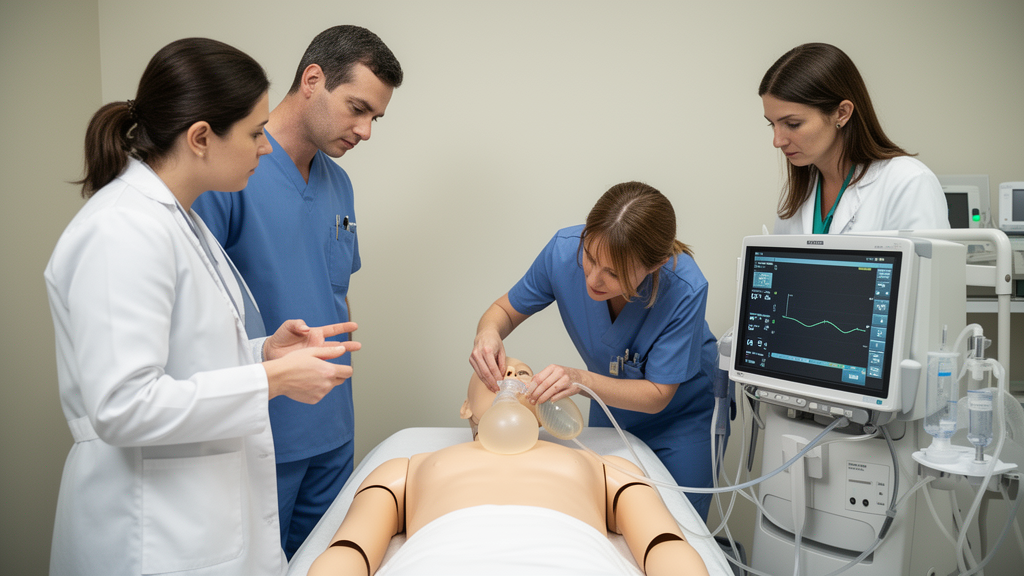
A small comparative study of 17 pulmonology residents found that a structured ventilation course combining theory-based classes with practice-based simulation was associated with score increases across high-flow nasal oxygen, non-invasive ventilation and mechanical ventilation. Residents attending classes alone showed score increases in high-flow nasal oxygen and non-invasive ventilation, but not in mechanical ventilation. The participants were junior and senior pulmonology residents training for work in respiratory intensive care units, where they routinely encounter cases of acute respiratory failure.
Although practical, structured training in ventilation is described as an important but limited part of critical-care education, opportunities to undertake such training remain restricted. The study therefore evaluated a course designed to combine theoretical instruction with simulation-based practice in managing acute respiratory failure. Because the sample was small and the reported evaluation covered immediate course outcomes, the findings cannot establish whether the gains were sustained or transferred to clinical practice.
Before the intervention, all 17 residents completed a questionnaire containing a standardized 15-item multiple-choice examination. They were subsequently assigned to one of two educational groups: group A received theory-based classes only, while group B received theory-based classes plus practice-based simulation. Skill was assessed through the examination rather than through direct observation of residents managing patients in intensive care, making the measured outcome an assessment of knowledge and skills associated with the course.
The simulation component consisted of four scenarios involving acute exacerbations of chronic lung disease. Residents practiced using high-flow nasal oxygen, non-invasive ventilation and mechanical ventilation under simulated conditions. Following the intervention, skill-assessment scores increased in all three respiratory modalities in group B, which combined classes with simulation.
In group A, increases were reported for high-flow nasal oxygen and non-invasive ventilation, while no increase was reported for mechanical ventilation. Scores did not differ between the three ventilation modalities at baseline or after the intervention. At baseline, senior residents had higher scores than junior residents; after training, higher scores were observed among both senior and junior residents in group B, but among senior residents only in group A.
Course satisfaction was also high. Both junior and senior residents reported gains in confidence and perceived competence, although these were self-reported experiences and were not accompanied by evidence of improved patient outcomes. The results are consistent with the course’s stated aim of strengthening residents’ ability to manage ventilatory support for acute respiratory failure, but the assessment does not establish that the training altered treatment decisions, reduced clinical delays or improved the care received by critically ill patients.
Nor did the study determine whether the score increases remained after participants returned to clinical work or whether the same approach would be useful for other members of the care team. Overall, the study provides measured support for adding structured simulation to respiratory intensive care education. Its clearest finding is that residents who received both theory and practice recorded post-course assessment gains across all three ventilation modalities, while the classroom-only group recorded gains in two.
The authors identified long-term retention, transfer to clinical practice and inter-professional applications as important questions for future work. Until those issues are addressed, the results should be viewed as evidence of immediate assessment gains from a combined ventilation course rather than proof of superior training, durable competence or better patient outcomes.
Subject of Research: Evaluation of a simulation-based ventilation training course for pulmonology residents in respiratory intensive care.
Article Title: Impact of a simulation-based ventilation training course for respiratory intensive care residents
Article References: Artaud-Macari, E., Fresnel, E., Kerfourn, A., Melone, M.-A., Mazellier, N., Roger, P.-A., Lebret, M., Cuvelier, A., Girault, C., Médrinal, C., & Salaün, M. (2026). Impact of a simulation-based ventilation training course for respiratory intensive care residents. BMC Medical Education. https://doi.org/10.1186/s12909-026-10046-8
Image Credits: AI Generated
DOI: 10.1186/s12909-026-10046-8
Keywords: simulation-based medical education, pulmonology residents, respiratory intensive care, acute respiratory failure, mechanical ventilation, non-invasive ventilation, high-flow nasal oxygen, clinical skills training, medical education, Impact, simulation-based, ventilation
Cite Scienmag News
Courtney Benton. (October 21, 2026). Small Study Links Simulation Training to Ventilation Assessment Gains. Scienmag. https://scienmag.com/small-study-links-simulation-training-to-ventilation-assessment-gains/
Courtney Benton. "Small Study Links Simulation Training to Ventilation Assessment Gains." Scienmag, 21 October 2026, https://scienmag.com/small-study-links-simulation-training-to-ventilation-assessment-gains/. Accessed 16 November 2026.
Courtney Benton. "Small Study Links Simulation Training to Ventilation Assessment Gains." Scienmag. October 21, 2026. https://scienmag.com/small-study-links-simulation-training-to-ventilation-assessment-gains/




