

Saturday, May 9, 2026
Science
No Result
View All Result
  • Login
  • HOME
  • SCIENCE NEWS
  • CONTACT US
  • HOME
  • SCIENCE NEWS
  • CONTACT US
No Result
View All Result
Scienmag
No Result
View All Result
Home Science News Chemistry

Small powerhouses for very special light

June 28, 2024
in Chemistry
Reading Time: 3 mins read
0
SSMB
66
SHARES
600
VIEWS
Share on FacebookShare on Twitter
ADVERTISEMENT

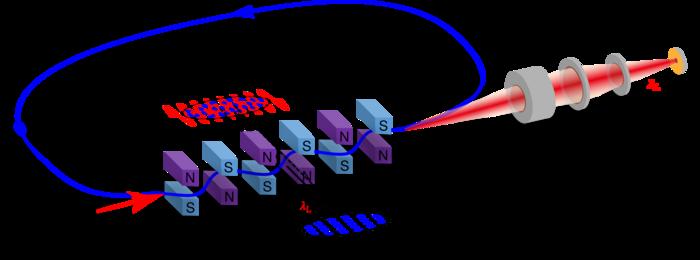
When ultrafast electrons are deflected, they emit light – synchrotron radiation. This is used in so called storage rings in which magnets force the particles onto a closed path. This light is longitudinally incoherent and consists of a broad spectrum of wavelengths. Its high brilliance makes it an excellent tool for materials research. Monochromators can be used to pick out individual wavelengths from the spectrum, but this reduces the radiant power by many orders of magnitude to values of a few watts only.

SSMB

Credit: HZB/ Communications Physics

When ultrafast electrons are deflected, they emit light – synchrotron radiation. This is used in so called storage rings in which magnets force the particles onto a closed path. This light is longitudinally incoherent and consists of a broad spectrum of wavelengths. Its high brilliance makes it an excellent tool for materials research. Monochromators can be used to pick out individual wavelengths from the spectrum, but this reduces the radiant power by many orders of magnitude to values of a few watts only.

Size matters

But what if a storage ring were instead to deliver monochromatic, coherent light with outputs of several kilowatts, analogous to a high-power laser? Physicist Alexander Chao and his doctoral student Daniel Ratner found an answer to this challenge in 2010: if the electron bunches orbiting in a storage ring become shorter than the wavelength of the light they emit, the emitted radiation becomes coherent and therefore millions of times more powerful.

“You need to know that the electrons in a storage ring are not homogeneously distributed,” explains Arnold Kruschinski, PhD student at HZB and lead author of the paper. “They move in bunches with a typical length of about a centimetre and a distance around 60 centimetres. That is six orders of magnitude more than the micro-bunches proposed by Alexander Chao.” Chinese theorist Xiujie Deng has defined a set of settings for a specific type of circular accelerator, the isochrone or “low-alpha” rings, for the Steady-State Micro-Bunching project (SSMB). After interacting with a laser, these create short particle bunches that are only one micrometre long.

The research team from HZB, Tsinghua University and PTB already demonstrated that this works in a proof-of-principle experiment in 2021. They used the Metrology Light Source (MLS) in Adlershof – the first storage ring ever designed for low-alpha operation. The team has now been able to fully verify Deng’s theory for generating micro-bunches in extensive experiments. “For us, this is an important step on the way to a new type of SSMB radiation source,” says Arnold Kruschinski.

The long road to success

However, HZB project manager Jörg Feikes is certain that it will take some time until then. He sees some parallels between the SSMB and the development of free-electron lasers. “After initial experiments and decades of development work, this idea turned into kilometre-long, superconducting accelerator,” he says. “Such developments are very long-term. It starts with an idea, then a theory, and then there are experimenters who gradually realise it and I think that SSMB will develop in the same way.”


Text by Kai Dürfeld / Science writer


Journal

Communications Physics

DOI

10.1038/s42005-024-01657-y

Method of Research

Experimental study

Subject of Research

Not applicable

Article Title

Confirming the theoretical foundation of steady-state microbunching

Article Publication Date

21-May-2024

COI Statement

none

Share26Tweet17
Previous Post

Source-specific air pollution and loss of independence in older adults across the US

Next Post

Drowning in waste: Pollution hotspots in aquatic environments

Related Posts

Miniature Sensor Uses Light to Detect Touch — Chemistry
Chemistry

Miniature Sensor Uses Light to Detect Touch

May 8, 2026
Iron Minerals Determine Whether Dissolved Organic Matter Fuels Microbes or Becomes Long-Term Carbon Storage — Chemistry
Chemistry

Iron Minerals Determine Whether Dissolved Organic Matter Fuels Microbes or Becomes Long-Term Carbon Storage

May 8, 2026
Kate Evans Appointed Associate Lab Director for Biological and Environmental Systems Science at ORNL — Chemistry
Chemistry

Kate Evans Appointed Associate Lab Director for Biological and Environmental Systems Science at ORNL

May 8, 2026
Advancing Multiscale Modeling and Overcoming Operational Challenges in Autothermal CO₂-to-Methanol Reactors — Chemistry
Chemistry

Advancing Multiscale Modeling and Overcoming Operational Challenges in Autothermal CO₂-to-Methanol Reactors

May 8, 2026
New CuBi₂S₄/Al₂WO₆/Ti₃C₂ MXene Ternary Photocatalyst Enables Efficient Visible-Light-Driven Reduction of Nitrate, CO₂, and Water — Chemistry
Chemistry

New CuBi₂S₄/Al₂WO₆/Ti₃C₂ MXene Ternary Photocatalyst Enables Efficient Visible-Light-Driven Reduction of Nitrate, CO₂, and Water

May 8, 2026
Numerical Simulation Unveils Reaction Mechanisms in Atmospheric Pressure Non-Equilibrium CO₂–H₂O Plasma Discharge — Chemistry
Chemistry

Numerical Simulation Unveils Reaction Mechanisms in Atmospheric Pressure Non-Equilibrium CO₂–H₂O Plasma Discharge

May 8, 2026
Next Post
Aquatic ecosystems at higher risk of receiving land-based waste. Dark blue highlights key areas (including rivers and their basins, and coastal zones) with the highest risk of receiving land-based waste.

Drowning in waste: Pollution hotspots in aquatic environments

  • Mothers who receive childcare support from maternal grandparents show more parental warmth, finds NTU Singapore study

    Mothers who receive childcare support from maternal grandparents show more parental warmth, finds NTU Singapore study

    27642 shares
    Share 11053 Tweet 6908
  • University of Seville Breaks 120-Year-Old Mystery, Revises a Key Einstein Concept

    1044 shares
    Share 418 Tweet 261
  • Bee body mass, pathogens and local climate influence heat tolerance

    678 shares
    Share 271 Tweet 170
  • Researchers record first-ever images and data of a shark experiencing a boat strike

    541 shares
    Share 216 Tweet 135
  • Groundbreaking Clinical Trial Reveals Lubiprostone Enhances Kidney Function

    528 shares
    Share 211 Tweet 132
Science

Embark on a thrilling journey of discovery with Scienmag.com—your ultimate source for cutting-edge breakthroughs. Immerse yourself in a world where curiosity knows no limits and tomorrow’s possibilities become today’s reality!

RECENT NEWS

  • Multi-Omics Predicts 17 UK Biobank Diseases
  • Akkermansia Boosts Gut-Bladder Nerve Sensitivity via 5-HT3aR
  • Btg2 Blocks Fmo1 UFMylation, Worsens Liver Injury
  • Generalizing Neurobiology Findings in First-Episode Psychosis

Categories

  • Agriculture
  • Anthropology
  • Archaeology
  • Athmospheric
  • Biology
  • Biotechnology
  • Blog
  • Bussines
  • Cancer
  • Chemistry
  • Climate
  • Earth Science
  • Editorial Policy
  • Marine
  • Mathematics
  • Medicine
  • Pediatry
  • Policy
  • Psychology & Psychiatry
  • Science Education
  • Social Science
  • Space
  • Technology and Engineering

Subscribe to Blog via Email

Enter your email address to subscribe to this blog and receive notifications of new posts by email.

Join 5,146 other subscribers

© 2025 Scienmag - Science Magazine

Welcome Back!

Login to your account below

Forgotten Password?

Retrieve your password

Please enter your username or email address to reset your password.

Log In
No Result
View All Result
  • HOME
  • SCIENCE NEWS
  • CONTACT US

© 2025 Scienmag - Science Magazine

Discover more from Science

Subscribe now to keep reading and get access to the full archive.

Continue reading
