


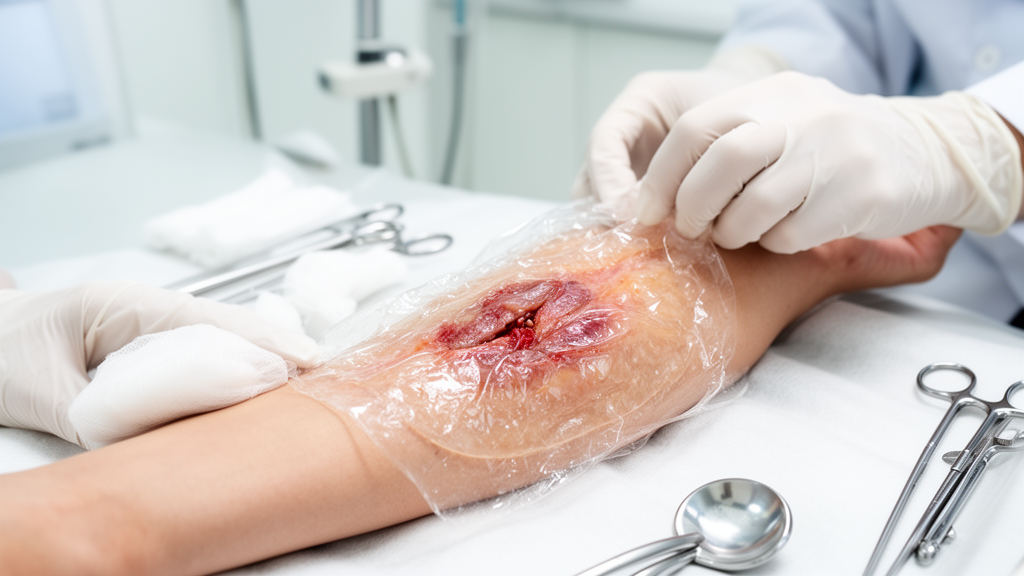
A hydrogel-based dermal template supported healing in 13 complex wounds treated at Fox Chase Cancer Center, including wounds left by skin cancer surgery, according to a small pilot case series published in Plastic and Reconstructive Surgery–Global Open. The study included 10 patients whose wounds involved the face, scalp, extremities and radial forearm free-flap donor sites. Researchers reported favorable healing and cosmetic outcomes, with no major complications related to the template, but emphasized that larger studies with longer follow-up are needed before drawing firm conclusions about the approach.
The investigators evaluated the DermiSphere Hydrogel Dermal Regeneration Template from Fesarius Therapeutics as a scaffold intended to encourage the body’s own cells to regenerate healthy tissue. In the reported cases, the template rapidly developed its own blood supply, permitting surgeons to cover it with skin immediately, delay grafting, or, in selected cases, allow wounds to heal without grafting. The publication was described as the largest case series to date evaluating the template.
Although the research release noted that many existing dermal regenerative templates require weeks before reconstruction can be completed, the pilot reported that the hydrogel template became vascularized rapidly, giving clinicians several options for managing each wound. Reconstructing full-thickness wounds after cancer removal often requires skin grafts or more extensive flap reconstruction, which can create additional wounds and prolong recovery. The study therefore examined whether the hydrogel template could provide another route to tissue reconstruction.
The 13 wounds arose from skin cancer surgery, trauma or reconstruction of tissue-donor sites rather than from skin cancer removal alone. Across this mixed population, the template was associated with favorable healing and cosmetic results, and the researchers reported no major complications attributable to its use. The findings indicate that the approach was feasible in the selected cases, but the small uncontrolled series does not establish that it was more effective or less burdensome than existing reconstructive methods.
One potential application involved radial forearm free-flap donor sites, which are commonly created during head and neck cancer reconstruction and can be prone to complications. The researchers found that the template could help protect exposed tendons and nerves while providing durable wound coverage. Adam C. Walchak, an author of the study and assistant professor in Fox Chase Cancer Center’s Department of Surgical Oncology, said the additional reconstructive option could allow treatment to be tailored to individual needs while potentially reducing the morbidity associated with more extensive procedures.
Sameer A. Patel, chief of the Division of Plastic and Reconstructive Surgery at Fox Chase, said the early experience suggested that the technology could produce functional and aesthetic outcomes while helping carefully selected patients avoid larger reconstructive procedures. Coauthor Opeyemi Asanbe participated in early laboratory research on the technology while she was a medical student and later helped evaluate it in patients. Patel stressed that the technology does not treat cancer itself; its proposed benefit is to address reconstructive challenges that can follow treatment.
The study’s principal limitation is its scope: only 10 patients and 13 wounds were evaluated, no comparison group was described, and follow-up was not reported in the supplied account. The authors called for larger studies with longer follow-up to compare the template with existing approaches and determine which patients are most likely to benefit.
Subject of Research: Pilot evaluation of a hydrogel dermal regeneration template for 13 complex wounds in 10 patients.
Article Title: Promising new option for skin cancer reconstruction
Article References: Promising new option for skin cancer reconstruction. Original publication (Bibliographic details unavailable.)
Image Credits: AI Generated
DOI: Not provided
Keywords: hydrogel scaffold, skin cancer surgery, wound reconstruction, dermal regeneration, clinical case series, skin grafting, flap reconstruction, radial forearm flap, Fox Chase Cancer Center, wound healing, Promising, option
Cite Scienmag News
Nathaniel Bowman. (October 22, 2026). Small case series links hydrogel template to healing in 13 complex wounds. Scienmag. https://scienmag.com/small-case-series-links-hydrogel-template-to-healing-in-13-complex-wounds/
Nathaniel Bowman. "Small case series links hydrogel template to healing in 13 complex wounds." Scienmag, 22 October 2026, https://scienmag.com/small-case-series-links-hydrogel-template-to-healing-in-13-complex-wounds/. Accessed 22 October 2026.
Nathaniel Bowman. "Small case series links hydrogel template to healing in 13 complex wounds." Scienmag. October 22, 2026. https://scienmag.com/small-case-series-links-hydrogel-template-to-healing-in-13-complex-wounds/


