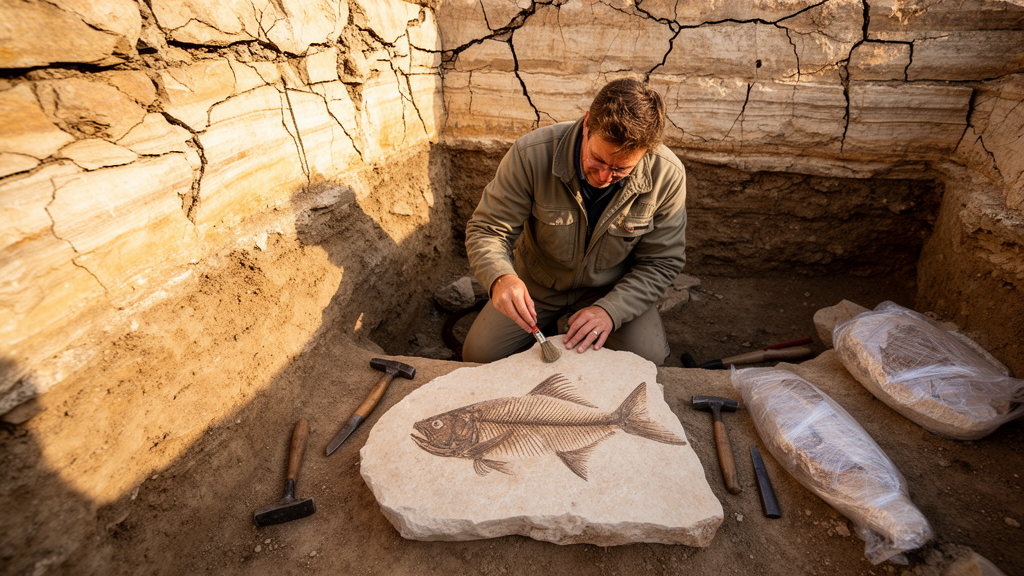
For nearly 1,600 years, the limestone quarries of Mount Lebanon have yielded something almost unbelievable: entire marine ecosystems frozen mid-swim in slabs of fine-grained rock. Fish with gills, scales and stomach contents intact. Squids still clutching their tentacles. Shrimps, eels, rays, pterosaurs and even insects, all preserved with a fidelity that has made the Lebanese fossil sites among the most celebrated windows into the Cretaceous seas. Now, a comprehensive new study published in the Swiss Journal of Palaeontology has tackled one of the longest-standing puzzles surrounding these world-famous deposits: exactly how old are they, and what kind of strange seafloor environment could have produced such extraordinary accumulations of life and death?
The three sites at the heart of the study — Haqel, Hjoula and Nammoura — are Konservat-Lagerstätten, a technical term for fossil deposits of exceptional preservation. They sit within Cenomanian limestones, rocks deposited roughly 100 million years ago during the middle portion of the Late Cretaceous, when Lebanon lay beneath a warm shallow sea on the northern rim of the Gondwana super-continent. Cenomanian limestones cover about 40 percent of Lebanon’s territory, but only a handful of levels within them contain the spectacular fish faunas. Despite centuries of study, the stratigraphic assignment of the fossil-bearing level has remained controversial, with different researchers proposing ages ranging from the early Cenomanian to the Turonian, depending on which index fossils they trusted.
To resolve the dispute, the research team measured detailed stratigraphic sections at each of the three quarries and processed the limestones for their microscopic fossil content. One hundred petrographic thin sections were manufactured and examined, revealing a rich inventory of benthic and planktonic foraminifera — single-celled organisms whose shells are among the most reliable timekeepers in the Cretaceous rock record. The benthic assemblages included families such as Orbitolinidae, Nezzazatidae, Cuneolinidae and Gavelinellidae, while the planktonic component was dominated by hedbergellids, with rarer rotaliporids and heterohelicids. Abundant calcispheres, most likely resting stages of planktonic algae, riddled nearly every sample, alongside rare dasycladalean algae, bryozoans, ostracods, echinoderm fragments and bone debris.
The microfossils delivered a clear verdict. The presence of the larger benthic foraminifer Conicorbitolina conica together with the planktonic species Favusella washitensis within the Haqel and Hjoula Lagerstätten points to a middle Cenomanian age. Orbitolina, irrespective of the species involved, is particularly important because it provides a reliable constraint indicating an age no younger than the middle Cenomanian. But here the story takes a twist that has left palaeontologists genuinely puzzled: the macrofossil assemblages — echinoids and ammonites found above and below the fish beds — stubbornly refuse to agree. Well-preserved ammonites described in recent work from Hjoula, including Eucalycoceras rowei and Eucalycoceras pentagonum, characterise the lower Late Cenomanian Calycoceras guerangeri Zone, suggesting the fish layers are slightly younger than the foraminifera imply. The discrepancy between ammonite and foraminiferal dating remains an open question, one the authors suggest may only be settled by future fieldwork that pins new ammonite finds to precise positions within the measured sections — a difficult task in a region so fractured by tectonics that Saint-Marc warned decades ago it would demand an extremely close study.
The team also tested whether geochemistry could break the deadlock. Carbon and oxygen isotope ratios were measured on carbonate powders from all three outcrops, reacted with phosphoric acid and analysed on a Delta V Plus mass spectrometer in Germany with a reproducibility of ±0.04 per mil. The result: a fairly homogeneous distribution with no significant shifts across facies, meaning the isotope data could not be used as a stratigraphic tool. Elemental mapping with a field-emission scanning electron microscope did, however, reveal a sharp transition in a Haqel sample from a layer rich in magnesium to one deprived of the element — a subtle chemical fingerprint of changing water conditions that may reward future investigation.
The palaeoenvironmental reconstruction is where the study turns genuinely viral in its implications. The microfacies tell of small, quiet basins: thin-bedded muddy wackestones packed with calcispheres and small planktonic foraminifera, with mud-dwelling foraminifers such as Istriloculina indicating a low-energy decantation environment. Crucially, the rich benthic foraminiferal assemblage typical of the Cenomanian shelf is almost entirely absent from the sections — it appears only in very rare thin laminae, probably transported from shallower settings by small distal turbidites or tempestites, underwater avalanches dragging shelf material down into the basins. The planktonic assemblage is dominated by small hedbergellids and Favusella washitensis, species characteristic of warm, shallow epicontinental and marginal seas, while the rarer keeled genera Thalmanninella and Praeglobotruncana, generally deeper-dwelling forms, indicate only moderate water depth. The dominance of epicontinental species suggests the basins lay in waters no deeper than about 100 metres.
Then there is the fish fauna itself — and this is where the Lebanese sites leave every other Mesozoic locality in the dust. The updated inventory compiled from fieldwork and literature counts 93 species at Haqel, 72 at Hjoula and 40 at Nammoura, and taken together the three assemblages comprise 141 ray-finned fish species. That is nearly double the 74 species of the famous Late Jurassic Solnhofen Archipelago in Germany, and equal to the 74 species of Monte San Giorgio on the Italian-Swiss border — despite both of those celebrated localities spanning longer time periods and wider geographic ranges. The Lebanese Cenomanian assemblages therefore represent the richest ray-finned fish fauna ever reported from the Mesozoic and one of the richest of the entire Phanerozoic. Only the Eocene deposits of Monte Bolca in Italy, with roughly 250 described species, surpass them. New taxa are still being excavated at a rate of one to five per year, and the past two decades alone have seen described species increase by 20 percent at Haqel, 24 percent at Hjoula and 33 percent at Nammoura.
Many of the new discoveries belong to pycnodonts, a group of deep-bodied, crushing-toothed fish ecologically analogous to modern triggerfish — and the Lebanese pycnodonts are spectacularly strange. Two-thirds of the pycnodont genera from Haqel and Hjoula belong to families with morphologies unique in the entire long history of the clade, restricted to this single window of Cenomanian time and space. Gladiopycnodontids sported dorsal spines, cephalic and nuchal horns and an enlarged pectoral girdle; gebrayelichthyids had an extremely deep and short silhouette; coccodontids carried armoured trunks and rostrums reminiscent of pipefish. The authors suggest the gladiopycnodontids and gebrayelichthyids were suction feeders on small planktonic crustaceans, while other pycnodonts crushed shelly invertebrates near the bottom. The reconstructed food web also includes schooling planktivores such as Armigatus and Scombroclupea, often preserved in monospecific mass-mortality layers; demersal beryciforms and myctophiforms feeding on invertebrates and small fish; and apex piscivores among the aulopiformes and the ichthyodectiform Eubiodectes. Intriguingly, several clades now abundant in deep waters, such as beryciformes and aulopiformes, first diversified in shallow Cretaceous seas before migrating downward, probably driven out by new competitors.
So what killed and concentrated all this life? For decades the standard explanation blamed toxic algal blooms — the abundant calcisphaerulids in the sediments were taken as evidence of plankton blooms that poisoned the water. But the authors point out a paradox: calcisphaerulid-rich sediments are common worldwide, contemporary with the Lebanese deposits or not, and they are almost never associated with such rich fossil faunas. The blooms alone cannot explain the sites. Instead, the team proposes that the topography was the decisive factor. Hückel described the fish beds as accumulating in deep holes in the seafloor — roughly 600 metres across and 150 metres deep at Haqel — and the new study interprets these structures as submerged sinkholes, small cup-shaped depressions of probable tectonic origin in an actively deforming region. The model is strikingly supported by modern analogues: off the Florida coast, researchers recorded an aggregation of spawning barbfish, Polymixia lowei, inside a sinkhole — a fish phylogenetically related to genera found at Hjoula and Haqel — while shallower sinkholes off Brazil are documented biodiversity and productivity hotspots. In the Lebanese scenario, the water column above each sinkhole offered favourable living conditions, but the bottom was anoxic and azoic. When fish and other animals perished, perhaps from algal blooms or simply died and sank, their carcasses settled onto a seafloor with no scavengers and no currents to dismember them, and were buried in fine mud with smooth, undisturbed deposition.
The sites still guard their secrets. Haqel and Hjoula, separated by only 3.7 kilometres, share roughly 44 percent of their species, while Nammoura overlaps by only about 20 percent with the other two — figures that have remained remarkably stable even as the species counts have grown. Whether the differences between the faunas reflect real environmental distinctions or collection bias remains undecided, and the exact contemporaneity of the Lagerstätten is still unresolved. But the new synthesis makes one thing clear: the Lebanese Cenomanian sites owe their unmatched richness to a rare conspiracy of circumstances — shallow warm seas teeming with diversifying fish, small tectonic traps on the seafloor, anoxic bottoms that froze out scavengers, and fine carbonate mud that entombed everything from plankton to pterosaurs. It is a combination that has occurred perhaps nowhere else in the Mesozoic rock record, and it is why slabs of Lebanese limestone, split open for sixteen centuries, still stop scientists — and everyone else — in their tracks.
Subject of Research: Biostratigraphy and palaeoenvironments of the Upper Cretaceous fossil fish Konservat-Lagerstätten of Lebanon
Article Title: Biostratigraphy and palaeoenvironments of the Upper Cretaceous fossil fish Konservat – Lagerstätten of Lebanon
Article References: Maksoud, S., El Hossny, T., Cavin, L., Abi Saad, P., Azar, D., Piuz, A., & Samankassou, E. (2026). Biostratigraphy and palaeoenvironments of the Upper Cretaceous fossil fish Konservat-Lagerstätten of Lebanon. Swiss Journal of Palaeontology, 145, 433-474. https://doi.org/10.3897/sjp.145.181847
Image Credits: AI Generated
Keywords: Lebanon, Haqel, Hjoula, Nammoura, Cenomanian, Konservat-Lagerstätten, fossil fish, foraminifera, biostratigraphy, palaeoenvironment, sinkholes, pycnodonts
Cite Scienmag News
Kristina Jarvis. (October 18, 2026). Sinkholes of Stone: New Study Rewrites the Story of Lebanon’s Spectacular Cretaceous Fish Fossils. Scienmag. https://scienmag.com/sinkholes-of-stone-new-study-rewrites-the-story-of-lebanons-spectacular-cretaceous-fish-fossils/
Kristina Jarvis. "Sinkholes of Stone: New Study Rewrites the Story of Lebanon’s Spectacular Cretaceous Fish Fossils." Scienmag, 18 October 2026, https://scienmag.com/sinkholes-of-stone-new-study-rewrites-the-story-of-lebanons-spectacular-cretaceous-fish-fossils/. Accessed 18 October 2026.
Kristina Jarvis. "Sinkholes of Stone: New Study Rewrites the Story of Lebanon’s Spectacular Cretaceous Fish Fossils." Scienmag. October 18, 2026. https://scienmag.com/sinkholes-of-stone-new-study-rewrites-the-story-of-lebanons-spectacular-cretaceous-fish-fossils/