


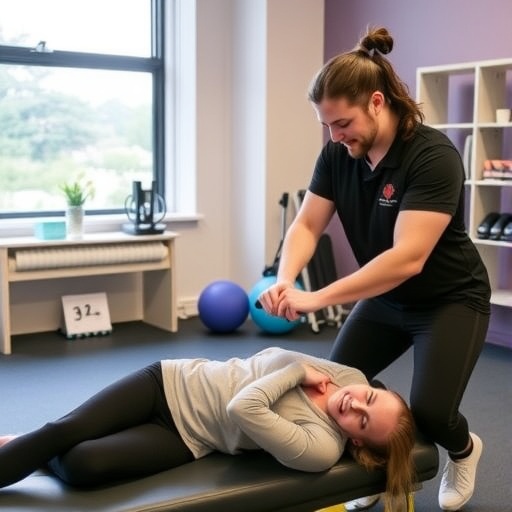
In a groundbreaking study that has implications for the future of physiotherapy education, a team of researchers, including Gärtner, Peters, and Holzhausen, has uncovered crucial insights into how teaching methods can significantly affect cognitive load in physiotherapy students. Their randomized controlled trial, published in the esteemed journal BMC Medical Education, examined the effects of focusing on a single manual therapy technique at a time, setting a precedent for educational structures in health sciences. This innovative approach could reshape the way manual therapy is taught, leading to better-trained practitioners who can serve patients more effectively.
Cognitive load theory asserts that our brains have a limited capacity for processing information. When this capacity is overwhelmed, particularly in fields requiring complex physical skills, learning becomes less effective. By honing in on a singular manual therapy technique, the researchers aimed to alleviate cognitive load, giving students a chance to master each skill without the distraction of multitasking or conflicting information. This study sheds light on an often-overlooked aspect of learning—how the method of instruction can inadvertently create barriers to student success.
A significant aspect of this research was its randomized controlled design, which lends a high degree of reliability to the findings. Physiotherapy students were divided into two groups: one that learned multiple techniques simultaneously and another that focused solely on a single technique. Through this structured comparison, the researchers were able to quantify the impact of cognitive load on performance outcomes. Notably, this kind of methodical approach is crucial in education research, as it provides clear evidence on the efficacy of different teaching strategies.
The results revealed a stark difference between the two groups of students. Those who concentrated on a single manual therapy technique reported lower cognitive load and demonstrated greater proficiency in executing the technique. This not only speaks to the advantages of focused learning but also highlights how overwhelming cognitive load can hinder the development of essential skills in budding physiotherapists. The implications of these findings call for a reevaluation of current teaching practices in physiotherapy and perhaps even other health-related fields.
Feedback from the students themselves offered illuminating insights into their experiences. Many expressed that attempting to absorb multiple techniques at once was not only challenging but also discouraging. The pressure to perform while juggling several skills can lead to increased anxiety levels, which in turn can impede learning and retention. Conversely, the participants who experienced the focused learning environment spoke of feeling more confident and prepared to put the skills into practice. This points to an essential truth in education: less can often be more.
What’s remarkable about Gärtner and her team’s work is its immediate applicability in educational settings. Many institutions have already begun reevaluating their syllabi in light of these findings, contemplating a more strategic approach to teaching manual therapy techniques. By fostering a curriculum focused on depth over breadth, educators can nurture stronger clinicians who are better equipped for real-world challenges. As the landscape of medical education continues to evolve, evidence-based practices like these are crucial to fostering innovation within the classroom and beyond.
The study’s conclusions extend beyond physiotherapy; they resonate with broader educational principles applicable across disciplines. In today’s fast-paced world, where attention is constantly divided, learning centered around singular concepts can encourage deeper understanding and retention of knowledge. This could inspire a shift in pedagogical approaches not only in healthcare but also in fields like engineering, arts, and even business education.
Additionally, the ramifications of this research could influence how educators assess and evaluate student performance. Traditional assessment methods often overlook the cognitive load imposed on students, which could explain why some students struggle despite having the requisite intelligence and motivation. Implementing assessments that account for cognitive processing limitations could lead to a fairer evaluation of student capabilities and foster an educational environment more conducive to learning.
In light of these findings, it is crucial for educational institutions to engage in dialogues about their teaching methodologies. Training programs must be receptive to feedback from both students and educators concerning the efficacy of different approaches. A collaborative environment that promotes ongoing assessment and innovation can lead to a culture of continuous improvement in the teaching and learning processes.
As the field of physiotherapy grows, the implications of lower cognitive load teaching strategies should not be seen as a limitation but rather as an opportunity for teachers to refine and adapt their methods. Faculty training programs could incorporate techniques learned from this study, emphasizing the importance of focusing instruction to improve student competence. This represents a significant shift toward embracing evidence-based practices in classroom settings.
The study serves as a clarion call for educators across disciplines to rethink the way techniques and concepts are taught. Cognitive load reduction may very well be the key to unlocking student potential, fostering a generation of learners who are not just knowledgeable but actually skilled in applying what they have learned in practical settings. As we look to the future of education, lessons learned from Gärtner and her colleagues could serve as a vital foundation for teaching practices across numerous fields.
In sum, this research not only provides valuable insights for physiotherapy education but also invites a broader discourse on pedagogical strategies in various domains. By shining a light on the relationship between cognitive load and learning efficacy, it prompts us to reconsider how knowledge is imparted to future generations of professionals. As the field moves forward, let us embrace these findings and strive toward a smarter, more effective approach to education that focuses on mastering individual skills for a more competent and confident workforce.
Gärtner, R., Peters, H. & Holzhausen, Y. Teaching a single manual therapy technique at a time reduces cognitive load in physiotherapy students: a randomized controlled educational study.
BMC Med Educ 25, 1422 (2025). https://doi.org/10.1186/s12909-025-08083-w
Cite Scienmag News
Courtney Benton. (October 16, 2025). Single Technique Training Eases Learning for Physio Students. Scienmag. https://scienmag.com/single-technique-training-eases-learning-for-physio-students/
Courtney Benton. "Single Technique Training Eases Learning for Physio Students." Scienmag, 16 October 2025, https://scienmag.com/single-technique-training-eases-learning-for-physio-students/. Accessed 3 September 2026.
Courtney Benton. "Single Technique Training Eases Learning for Physio Students." Scienmag. October 16, 2025. https://scienmag.com/single-technique-training-eases-learning-for-physio-students/


