


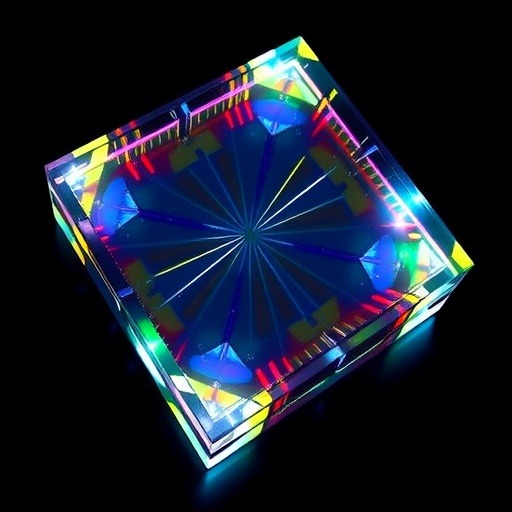
In a groundbreaking advancement poised to redefine the realm of photonics and material science, researchers have unveiled a pioneering lithographic technique that harnesses single-pulse laser technology to fabricate amorphous photonic architectures within all-inorganic dielectric crystals. This innovative approach, reported by Wang, Ma, Lin, and colleagues, offers unprecedented precision and control in sculpting complex photonic structures, potentially paving the way for revolutionary applications in optical communications, quantum computing, and next-generation photonic devices.
At the heart of this breakthrough is the ability to induce localized amorphization within pristine dielectric crystals using ultrafast laser pulses. Traditionally, photonic crystal fabrication has relied on multi-step, time-intensive processes often constrained by material incompatibilities and structural limitations. The novel single-pulse lithography technique circumvents these challenges by delivering ultrashort, high-intensity laser bursts that reconfigure the crystal lattice from its ordered state to an amorphous form. This transformation fundamentally alters the optical properties of the targeted regions, enabling the precise definition of photonic architectures with bespoke refractive index profiles.
The process begins with a meticulously controlled delivery of single laser pulses, calibrated to exceed the threshold needed for initiating localized structural phase transitions without causing bulk damage. When focused inside the volume of an all-inorganic dielectric crystal, such as sapphire or lithium niobate, the pulse instantly disrupts the long-range order of the lattice, generating amorphous domains embedded within an otherwise perfectly crystalline matrix. These domains act as photonic elements that can guide, confine, or scatter light in complex manners unattainable by conventional laser writing or etching techniques.
One of the most remarkable aspects of this technique is its ability to achieve three-dimensional, volumetric patterning within transparent dielectric materials. Unlike surface lithography methods or planar patterning techniques, single-pulse amorphization permits the sculpting of intricate internal architectures that manipulate photons in all spatial dimensions. This breakthrough opens avenues for fabricating three-dimensional photonic crystals, waveguides, resonators, and other sophisticated optical components in essentially monolithic form factors, enhancing device robustness and miniaturization potential.
The researchers employed rigorous characterization methods to validate the structural and optical changes induced by the single-pulse process. High-resolution transmission electron microscopy revealed the distinct amorphous phases embedded within the crystalline host, while spectroscopic analyses confirmed significant modulation of refractive indices in these zones. The optical performance demonstrated the effective confinement and manipulation of light, suggesting that these amorphous inclusions could serve as functional building blocks for integrated photonic circuits.
From a materials science perspective, the ability to trigger controlled amorphization with a single, non-repetitive laser pulse signifies a leap forward in understanding laser-matter interactions at ultrafast timescales. The dynamics governing the phase transition unveil how energy deposition and rapid cooling rates can stabilize amorphous states in materials conventionally considered as rigidly crystalline. This insight not only advances fundamental solid-state physics but also informs the design of future laser fabrication strategies across diverse crystalline systems.
Moreover, the all-inorganic nature of the host crystals ensures exceptional thermal stability, chemical inertness, and mechanical durability for the fabricated photonic structures. This robustness is critical for applications demanding long-term reliability under harsh operating conditions, such as high-power lasers, spaceborne optical systems, and industrial photonic sensors. The new lithographic method thereby bridges the gap between performance and practicality, achieving a harmony rarely encountered in existing photonic manufacturing approaches.
Another transformative implication of this research lies in its scalability and compatibility with existing fabrication workflows. The simplicity of the single-pulse approach reduces processing time and cost, offering a viable path for mass production of complex photonic components. Additionally, its adaptability to various inorganic crystals broadens the material palette for device engineers, enabling the tailoring of photonic properties to specific application needs across a broad spectrum of wavelengths.
The technique’s rapid inscription speed also holds promise for dynamic photonic device prototyping and customization. By adjusting pulse energies, focal depths, and spatial positioning, designers can swiftly iterate on photonic structure designs without the delays inherent in traditional lithography or etching. This agility could accelerate innovation in fields dependent on fast turnaround cycles, such as telecommunication network upgrades, lab-on-a-chip sensor development, and on-demand quantum device fabrication.
Crucially, the method presents an exciting platform for integrating photonic functionalities with emerging quantum materials. The controlled introduction of amorphous domains inside crystalline hosts may influence the local electromagnetic environment, facilitating enhanced interaction with quantum emitters, nonlinear optical processes, or defect-mediated quantum states. This synergy could expedite the realization of quantum photonic circuits and contribute to the development of quantum information technologies with improved coherence and scalability.
The research team also explored the limits of spatial resolution achievable with this technique. By tailoring laser focusing optics and pulse parameters, they successfully patterned features at scales approaching the diffraction limit. Such resolution is integral for manipulating light at subwavelength scales, essential for metamaterial creation, enhanced light-matter coupling, and miniaturized optical components operating at terahertz or visible frequencies.
In their comprehensive experimental demonstrations, the authors showed not only static photonic structures but also possibilities for dynamic tuning through post-processing or additional laser pulses. This aspect introduces a layer of functional versatility, allowing the modification or modulation of photonic properties after initial fabrication, a feature highly sought in adaptive optics and reconfigurable photonic devices.
Beyond photonics, the underlying methodology of single-pulse induced amorphization inside inorganic crystals could influence other fields such as microelectronics, data storage, and sensor manufacturing. For example, the ability to locally alter crystalline order may be exploited for creating electrically or magnetically active domains with tailored properties. Such cross-disciplinary potential underscores the broad impact of this technology beyond its immediate photonic applications.
While the current study focuses on fundamental proof-of-concept and material characterization, ongoing research is expected to refine the technique for higher throughput, integration with complementary fabrication technologies, and exploration of diverse material systems. Addressing challenges related to uniformity across large-scale substrates and stability of amorphous regions under various operational conditions will be pivotal for commercial adoption.
In conclusion, this seminal work by Wang et al. on single-pulse lithography of amorphous photonic architectures inside all-inorganic dielectric crystals establishes a new paradigm in photonic device fabrication. By combining ultrafast laser processing, controlled phase transitions, and volumetric patterning within robust crystalline hosts, the technique unlocks capabilities that were previously unattainable with conventional lithography. The implications for advancing optical technologies are vast, touching on communication, computing, sensing, and quantum science. As the photonics community embraces this cutting-edge approach, the era of rapid, precise, and scalable 3D photonic manufacturing in dielectric crystals may soon become reality.
Cite Scienmag News
Katie Riggs. (March 18, 2026). Single-Pulse Lithography Creates Photonic Structures in Crystals. Scienmag. https://scienmag.com/single-pulse-lithography-creates-photonic-structures-in-crystals/
Katie Riggs. "Single-Pulse Lithography Creates Photonic Structures in Crystals." Scienmag, 18 March 2026, https://scienmag.com/single-pulse-lithography-creates-photonic-structures-in-crystals/. Accessed 3 September 2026.
Katie Riggs. "Single-Pulse Lithography Creates Photonic Structures in Crystals." Scienmag. March 18, 2026. https://scienmag.com/single-pulse-lithography-creates-photonic-structures-in-crystals/


