


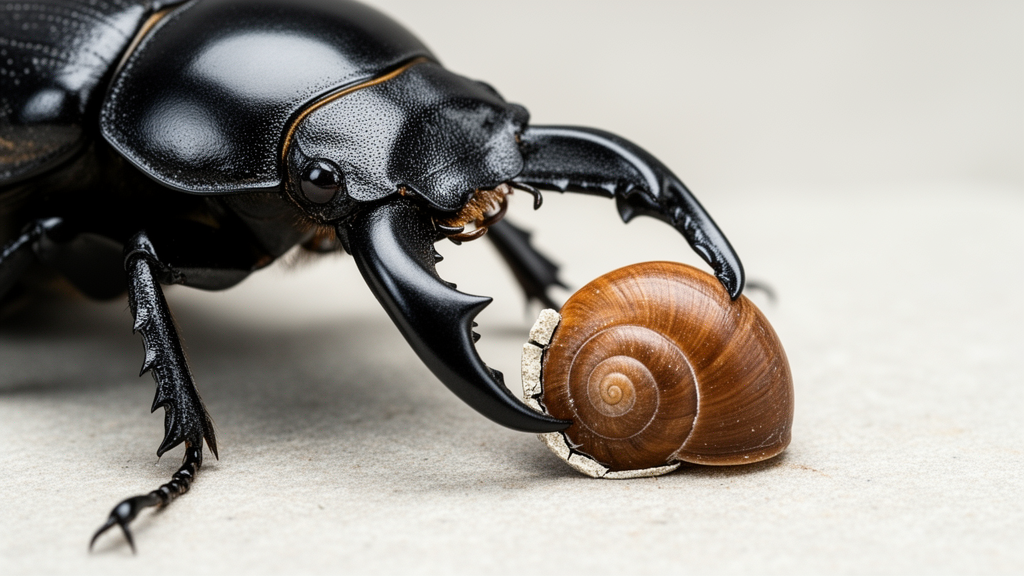
A single male Licinus depressus ground beetle opened shells of the small land snail Chondrina arcadica by alternating shell breaking with feeding, consuming about two-thirds of the snail’s soft body. Across four laboratory cases, prey handling and feeding lasted 2.5 to 4 minutes. These observations document the species’ previously undescribed predatory behaviour, although the findings are based on one animal and five predation events, including an initial field observation.
The beetle was found feeding on a C. arcadica snail beneath a flat piece of limestone at the foot of a stone pile in the Great Alvar grassland on Öland, Sweden, on 8 October 1995. The prey species has a cylindro-conical shell with about seven moderately convex whorls and reaches 5–6 millimetres in height when fully grown. Several empty C. arcadica shells with characteristic beetle-predation traces were found under the same stone.
For the laboratory observations, researchers kept the captured beetle in a transparent plastic box measuring 14 by 10 by 7 centimetres. The container included a flat piece of limestone and moistened paper towel covering its base. Adult C. arcadica collected from the capture site were offered as prey on four consecutive days. Each active snail was placed on the moistened stone, and prey handling and feeding were observed under dimmed light. The examined L. depressus specimen was deposited in the Natural History Museum of Basel, Switzerland.
Within a few minutes, the beetle located each snail. It grasped the shell with its forelegs while maintaining stability with its middle and hind legs, holding the snail at the first and second whorls with the shell apex directed toward the beetle’s rear. After breaking the outer lip of the right-handed shell, the beetle rotated the conical shell by 20–30 degrees counter-clockwise and bit again. It opened the shell progressively along the dorsal portions of the whorls toward the apex, producing clearly audible shell cracking.
After six to eight bites, spanning approximately 120 degrees of a whorl, the beetle stopped opening the shell and began pulling the snail’s soft tissue through the opening. It continued to hold the shell with its forelegs and did not change position while feeding. The beetle subsequently resumed breaking the shell, followed by another feeding phase. This sequence alternated between shell opening and feeding until two to two and a half whorls had been opened, out of the snail’s total six to seven whorls. It then stopped because it could no longer hold the remaining unbroken shell with its forelegs. The beetle consumed about two-thirds of the soft body, and the complete process lasted 2.5 to 4 minutes in each of the four observed laboratory cases.
The observed method differed from previously described prey handling by other Licinini beetles. In accounts involving Badister pictus and three Licinus species, the prey was at least half the beetle’s size and often substantially larger. Those beetles held large shells against the ground and moved around them while opening them. Shell breaking took four hours or more, and feeding began only after at least one complete whorl had been opened; consuming the soft tissue then took 12 hours or more, depending on snail size. L. depressus instead held a small prey shell with its forelegs throughout the rapid sequence of shell breaking and feeding.
Despite the procedural differences, both approaches left a substantial portion of the snail uneaten. The authors identified two possible explanations for the uneaten tissue: the inner whorls may have been too narrow for the mandibles to open, or the additional food may not have justified the extra handling time. Neither explanation was tested. For L. depressus, loss of the ability to grip the partly opened shell was an additional mechanical constraint. Comparisons using shell length–biomass relationships estimated that snails with shell diameters of 13–20 millimetres have soft-body dry weights of 13–27 milligrams, compared with 3 milligrams for a 5.5-millimetre-long C. arcadica. On that basis, the authors estimated that a beetle would need one or two C. arcadica per day to obtain food intake similar to that of a beetle consuming one larger snail every five days.
The ecological setting was consistent with the use of small prey. C. arcadica occurred at high densities in the Great Alvar, principally on stone walls, in stone piles and on limestone pavements, whereas large snails were rare apart from Helicigona lapicida in abandoned limestone quarries. Empty shells of several similarly sized snail species have also been found with Licinini feeding marks in dry grasslands of the Swiss Jura and in the Alps. However, shell traces alone cannot identify the beetle species responsible. The researchers’ observations were limited by the involvement of one L. depressus individual and five predation events, although the numerous marked shells in the field suggest that this handling pattern occurs regularly in the species and possibly in other Licinini beetles.
The beetle’s asymmetrical mandibles and its method of holding conical shells also linked its feeding to shell coiling direction. The observed behaviour allowed L. depressus to open right-handed shells, whereas Balea perversa, a similarly sized snail occurring in the same stony habitats, has left-handed shells. The researchers had not found B. perversa shells with beetle-predation traces in the Great Alvar and proposed that its rare left-handed coiling might provide an advantage against attacks by L. depressus. That interpretation was not tested experimentally. More broadly, the observations expand the documented repertoire of Licinini predatory behaviour and are consistent with previously proposed behavioural plasticity within the tribe.
Subject of Research: Laboratory and field observations of prey handling and feeding by the snail-predatory ground beetle Licinus depressus
Article Title: Prey handling and feeding habits of the snail predator Licinus depressus ( Coleoptera , Carabidae )
Article References: Baur, B., Gilgado, J. D., & Coray, A. (2023). Prey handling and feeding habits of the snail predator Licinus depressus (Coleoptera, Carabidae). Alpine Entomology, 7, 63-68. https://doi.org/10.3897/alpento.7.103164
Image Credits: AI Generated
Keywords: Licinus depressus, Chondrina arcadica, snail predation, ground beetles, Carabidae, Licinini, shell breaking, feeding behaviour, Öland, Great Alvar, Prey, handling
Cite Scienmag News
Gavin Prescott. (October 21, 2026). Single-beetle observations document rapid, alternating shell opening and feeding by Licinus depressus. Scienmag. https://scienmag.com/single-beetle-observations-document-rapid-alternating-shell-opening-and-feeding-by-licinus-depressus/
Gavin Prescott. "Single-beetle observations document rapid, alternating shell opening and feeding by Licinus depressus." Scienmag, 21 October 2026, https://scienmag.com/single-beetle-observations-document-rapid-alternating-shell-opening-and-feeding-by-licinus-depressus/. Accessed 21 October 2026.
Gavin Prescott. "Single-beetle observations document rapid, alternating shell opening and feeding by Licinus depressus." Scienmag. October 21, 2026. https://scienmag.com/single-beetle-observations-document-rapid-alternating-shell-opening-and-feeding-by-licinus-depressus/


