

A new collaboration between researchers from the Netherlands Institute for Neuroscience, the University of Amsterdam and the University of Chieti explores the neural substrates of blushing in a MRI scanner.
Credit: Netherlands Institute for Neuroscience
A new collaboration between researchers from the Netherlands Institute for Neuroscience, the University of Amsterdam and the University of Chieti explores the neural substrates of blushing in a MRI scanner.
Most of us know what it feels like to blush. The face becomes warm and red, and we experience self-conscious emotions, such as embarrassment, shyness, shame, and pride. It is perhaps no wonder that Charles Darwin referred to it as “the most peculiar and the most human of all expressions”. But why do we blush, and what are the underlying mechanisms of blushing?
To answer this question, Milica Nikolic and Disa Sauter form the University of Amsterdam collaborated with Simone di Plinio from the University of Chieti under the supervision of Christian Keysers and Valeria Gazzola from the Netherlands Institute for Neuroscience.
“Blushing is a really interesting phenomenon because we still don’t know which cognitive skills are needed for it to occur”, developmental psychologist Nikolic explains. “There’s this idea in psychology that dates back to Darwin, who said that blushing occurs when we think about what other people think of us, which involves relatively complex cognitive skills”.
Blushing in a karaoke setting
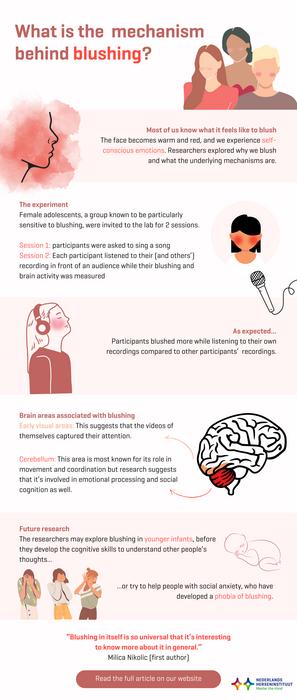
The researchers investigated blushing by looking at the activated brain areas in an MRI scanner while measuring the cheek temperature—an indicator of blushing. Their participants were female adolescents, a group known to be particularly sensitive to social judgement. “It is known that blushing increases during this life stage, since adolescents are very sensitive to other people’s opinions and can be afraid of rejection or leaving wrong impression” Nikolic explains.
To evoke a blushing response in a controlled experimental setting, participants came to the lab for two separate sessions. During the first session, they were asked to sing purposefully-chosen difficult karaoke songs and, in the second session, they watched recordings of their own singing while their brain activity and physiological responses were measured.
Adding salt to the wound, they were also told that an audience would watch their recording with them. Finally, the participants were shown recordings from another participant who had sung at comparable level, and a professional singer who was disguised as a third participant.
The mechanism behind blushing
As expected, the researchers found that participants blushed more while watching their own recordings in comparison to other participants’ recordings.
The correlating brain areas were somewhat surprising. Blushing was associated with increased activity in the cerebellum, an area most known for its role in movement and coordination. “Lately, there has been a lot of research suggesting its involvement in emotional processing”, Nikolic adds. The researchers also found increased activation in the early visual areas, suggesting that the videos of own singing captured blushing participants’ attention the most.
Surprisingly, there was no activation in areas that are traditionally known to be involved in the process of understanding the mental state of oneself or others. “Based on this we concluded that thinking about others’ thoughts may not be necessary for blushing to occur” Nikolic concludes. “Blushing may be a part of the automatic arousal you feel when you are exposed and there is something that is relevant to the self”.
Universal phenomenon
Nikolic: “The next step would be to look at blushing under different conditions, or perhaps, even explore the phenomenon in younger children, before they have developed the cognitive skills to think about other people’s thoughts.”
“Blushing in itself is very interesting because it’s universal. There are even people who develop a phobia of blushing, for example, people with a social anxiety disorder. When we understand the mechanisms of blushing, we can target the fear of blushing better as well. Aside from that, it’s interesting to know more about blushing in a general sense as well, since it happens very often and is a common part of our everyday lives.”
Source: Proceedings of the Royal Society B
Journal
Proceedings of the Royal Society B Biological Sciences
Article Title
The Blushing Brain: Neural Substrates of Cheek Temperature Increase in Response to Self-Observation
Article Publication Date
17-Jul-2024
Cite Scienmag News
Courtney Benton. (July 17, 2024). Singing the science: Using karaoke to examine blushing. Scienmag. https://scienmag.com/singing-the-science-using-karaoke-to-examine-blushing/
Courtney Benton. "Singing the science: Using karaoke to examine blushing." Scienmag, 17 July 2024, https://scienmag.com/singing-the-science-using-karaoke-to-examine-blushing/. Accessed 19 November 2026.
Courtney Benton. "Singing the science: Using karaoke to examine blushing." Scienmag. July 17, 2024. https://scienmag.com/singing-the-science-using-karaoke-to-examine-blushing/