

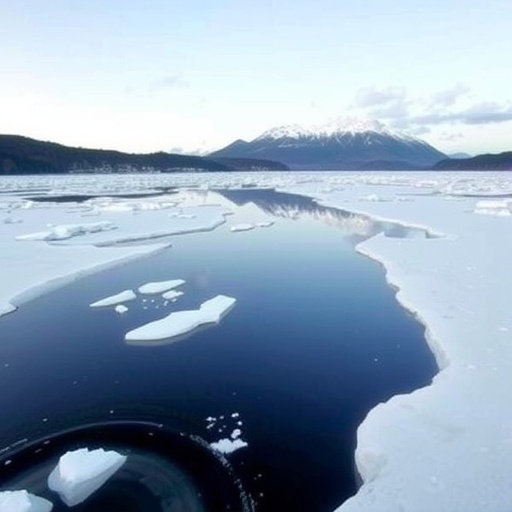
During the last glacial period, spanning approximately from 70,000 to 15,000 years ago, Earth’s climate underwent dramatic fluctuations across millennial timescales. One of the most captivating phenomena of this interval is the pronounced temperature asynchrony between the Northern and Southern Hemispheres, commonly referred to as the bipolar seesaw. This climatic seesaw is especially evident during Heinrich Stadials, episodic events characterized by intense cooling in the North Atlantic region associated with interruptions to the Atlantic Meridional Overturning Circulation (AMOC). These stadials have been linked to surges of icebergs and meltwater from northern ice sheets into the North Atlantic, drastically altering ocean circulation and atmospheric patterns.
Traditionally, the bipolar seesaw pattern depicts cooling in the Northern Hemisphere coinciding with warming in the Southern Hemisphere, as ocean heat redistributes globally in response to disruptions in the thermohaline circulation. Yet, the story becomes complex when looking beyond polar ice core data. Mid-latitude ice sheets and glaciers, which are sensitive archives of paleoclimate variability, have shown somewhat synchronous fluctuations in both hemispheres during Heinrich Stadials. This observation has puzzled researchers, as it seems at odds with the asynchronous temperature patterns recorded in polar ice cores, raising questions about the nature and drivers of interhemispheric climate teleconnections during glacial times.
In a groundbreaking study recently published in Nature Geoscience, Toucanne and colleagues present a continuous and detailed millennial-scale record of glacier dynamics in New Zealand derived from glaciogenic sediments deposited offshore of the South Island. This new archive sheds crucial light on Southern Hemisphere ice mass responses during Heinrich Stadials, bridging critical gaps in our understanding of the interplay between the bipolar seesaw and mid-latitude ice sheet behavior on both hemispheres during the last glacial period.
The research team meticulously analyzed sediment cores rich in glaciogenic materials—sediments produced or influenced by glacial erosion and transport processes. These sediments, nestled beneath the ocean floor, encode a compelling history of glacier advance and retreat on the adjacent landmass. Their high-resolution temporal framework reveals that millennial-scale glacier retreat events in New Zealand correlate strongly with Heinrich Stadials, periods historically marked by weakened Atlantic overturning circulation and significant North Atlantic cold episodes.
This linkage is further substantiated by biotic proxy data derived from planktic foraminiferal assemblages, which indicate a pronounced southerly migration of the South Pacific Subtropical Front during these stadials. The Subtropical Front is a significant oceanographic boundary separating warm and cool water masses, and its migration signals shifts in ocean and atmospheric circulation patterns that ultimately impact regional climate and glacier mass balances. The alignment of glacier retreats with shifts in ocean fronts implies a broad-scale reorganization of climate systems across the Southern Hemisphere during these critical intervals.
What stands out in this study is the remarkable synchronicity between glacier retreats in the New Zealand mid-latitudes and enhanced meltwater and iceberg discharge pulses from both the North American and European ice sheets. This synchronicity, constrained within a temporal window of one to two thousand years, establishes that mid-latitude ice masses in both hemispheres were not operating independently during Heinrich Stadials but instead responded in concert to global climate forcings.
The authors suggest a compelling underlying mechanism where the global retreat of mid-latitude ice masses during these stadials is driven by a net gain in Earth’s energy budget. This energy gain could stem from the disruption of the AMOC, which reduces northward heat transport and causes heat to accumulate in the Southern Hemisphere’s ocean and atmosphere. This rechanneled heat likely fueled ice mass loss in southern mid-latitude regions, sustaining glacier retreats despite the cold conditions prevailing in the Northern Hemisphere.
Furthermore, this persistent bipolar retreat pattern emphasizes that the impacts of Heinrich Stadials were not localized phenomena confined to the North Atlantic but had far-reaching global effects. The weakening of deep water formation in the North Atlantic during these stadials could trigger a cascade of climatic feedbacks propagating through oceanic and atmospheric teleconnections, influencing ice dynamics across vast and distant regions.
This expanded understanding challenges simplified notions of a mere seesaw temperature response and underscores the complexity and interconnectedness of ice-ocean-atmosphere systems during glacial climate oscillations. The recognition of synchronous glacier retreats across hemispheres refines our perception of past climate sensitivity and the mechanisms governing ice-sheet stability under variable climate forcing.
The study also provides a pivotal chronological backbone for future research, as the precise temporal correlation of glacier dynamics and oceanographic shifts in the Southern Hemisphere allows for more targeted investigations of the feedback processes involved. It serves as a compelling case for integrating marine sedimentary records with polar ice cores and terrestrial glacier evidence, collectively reconstructing a more holistic picture of glacial climate variability.
Moreover, such refined paleoclimate reconstructions bear significant implications for contemporary climate science. Understanding how ice masses have historically responded to abrupt climate perturbations informs projections of future glacier and ice-sheet behavior in the context of ongoing anthropogenic warming. The mechanisms elucidated here—especially those involving ocean circulation changes and heat redistribution—are vitally relevant as modern analogs of glacial Heinrich Stadials manifest via evolving AMOC dynamics and Southern Hemisphere climate trends.
This research thus exemplifies the power of interdisciplinary approaches combining sedimentology, paleoceanography, and glaciology to unravel complex Earth system interactions. The foundation provided by these findings invites enhanced climate model development and calibration, with potential to reduce uncertainties in predicting ice mass responses to future climate scenarios.
In summary, the evidence presented by Toucanne et al. decisively demonstrates that millennial-scale glacier retreats in New Zealand occurred synchronously with Northern Hemisphere Heinrich Stadials. These events coincided with significant changes in ocean circulation patterns, tightly coupling ice-sheet dynamics across hemispheres via global energy redistribution mechanisms. This study redefines our understanding of interhemispheric climate teleconnections during the last glacial period and highlights the need to consider global ice mass responses in unified frameworks rather than treating hemispheric cryospheric changes in isolation.
As climate science continues to probe Earth’s intricate past, investigations of such bipolar synchrony and the ocean-atmosphere-cryosphere feedbacks involved will remain vital. The nuance and detail uncovered here expand the horizons of paleoclimate research and enhance our capability to decode the legacy of Earth’s glacial cycles—a legacy that continues to shape the trajectory of our planet’s climate system.
Subject of Research: Millennial-scale glacier fluctuations during the last glacial period and their synchronicity with Northern Hemisphere Heinrich Stadials.
Article Title: Synchronous bipolar retreat of mid-latitude ice masses during Heinrich Stadials.
Article References:
Toucanne, S., Vázquez Riveiros, N., Soulet, G. et al. Synchronous bipolar retreat of mid-latitude ice masses during Heinrich Stadials. Nat. Geosci. (2026). https://doi.org/10.1038/s41561-025-01887-x
Image Credits: AI Generated


