


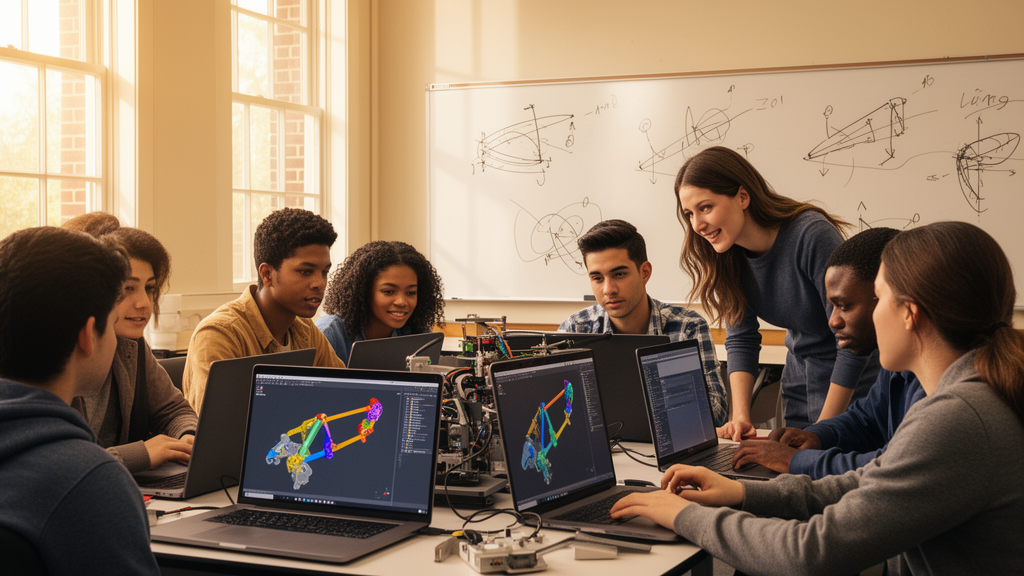
Engineering dynamics is the course that separates students who understand physics from students who memorize it. It demands kinematics, free body diagrams, Newtonian and Lagrangian mechanics, and vibration analysis all at once, and institutions worldwide report withdrawal, failure, and incomplete rates exceeding 20 to 30 percent in introductory mechanics sequences. A new study from SVKM’s NMIMS Mukesh Patel School of Technology Management and Engineering in Mumbai, published in Frontiers in Education, argues that the fix is not more lectures but a carefully structured pipeline in which students derive equations of motion from first principles and then watch their own mathematics come alive in Python-based simulation. The results are striking: self-efficacy jumped from a mean of 2.92 to 3.80 on a five-point scale, a paired t-test of t(52) = 13.91 with p < .001 and a pooled Cohen’s d of 2.72, one of the very largest effect sizes reported in engineering education research.
The framework, called Simulation-Focused Problem-Based Learning (SF-PBL), was embedded in a 15-week undergraduate Dynamic System Modeling course for 53 second-year B.Tech Mechatronics Engineering students during January to April 2026. It rests on a four-phase computational pipeline: System Identification, Mathematical Modelling, Computational Simulation, and Validation and Communication. Unlike classical problem-based learning, where the learning artefact is a diagnostic report, and unlike capstone design, where a physical prototype takes centre stage, SF-PBL makes the hand-derived mathematical model and its computational verification the core intellectual product. Students selected their own real engineering systems with no prescribed list, from humanoid and hexapod robots to rocket landing simulations, self-balancing platforms, automotive shock absorbers, and digital twins of DC motors.
Each of the 17 student teams progressed through escalating deliverables. In weeks 1 to 4, they identified degrees of freedom, kinematic constraints, and generalised coordinates for their chosen system. In weeks 5 to 9, they drew free body diagrams by hand and applied Newton’s Second Law or the Lagrangian formulation to derive coupled equations of motion, converting the second-order system to first-order state-space form. In weeks 10 to 13, they implemented the model in Python 3.10 using SciPy’s solve_ivp solver, generated time-domain response plots of position, velocity, and energy, and tuned PID gains for controlled systems, with all code version-controlled on GitHub. The final two weeks were devoted to validation against analytical benchmarks such as energy conservation and limit cases, and to defending the work publicly.
That defence took place at a Mini Project Exhibition on 25 April 2026, judged by a six-member external expert panel spanning five professional domains: manufacturing production engineering, patent and innovation consultancy, external mathematics academia, Siemens Industry 4.0 and digital twin expertise, and communication and behavioural science. No judge was affiliated with the institution. The rubric allocated 20 points each to problem formulation, mathematical rigour, simulation accuracy, validation quality, and communication, and the combined panel mean was 82.62 out of 100 with a standard deviation of 9.98 and a range from 53 to 96, confirming genuine discrimination across project quality. Composite reliability across the six judges was high, with Cronbach’s alpha of 0.829, and Kendall’s coefficient of concordance of 0.448 showed statistically significant agreement in rank-ordering despite the judges evaluating distinct professional constructs.
The quantitative gains were broad-based. Conceptual knowledge, measured by five multiple-choice items on degrees of freedom, the Lagrangian, pendulum natural frequency, viscous damping, and Newton’s rotation law, rose from a pre-course mean of 1.96 out of 5 to 3.28, t(52) = 11.32, p < .001, d = 1.20. Hake’s normalised gain of 0.50 places the course in the medium interactive-engagement band, in the upper half of that category. In Hake’s landmark 1998 survey of 62 introductory physics courses, only 14 of 48 interactive-engagement courses exceeded this threshold. The score distribution shifted from strongly left-skewed, with 52.8 percent of students scoring 2 out of 5 and no student achieving a perfect score, to right-skewed, with 22.6 percent achieving 5 out of 5 after the course.
Every one of the ten self-efficacy items improved significantly at p < .001. The two largest gains appeared on PID controller tuning, d = 2.22, and Newton’s equations of motion derivation, d = 2.14, precisely the competencies most directly activated by the modelling and simulation phases. The smallest gain, state-space conversion at d = 1.46, still exceeds Cohen’s large threshold and reflects the most cognitively demanding junction in the pipeline: translating coupled non-linear equations into first-order form before numerical implementation. The authors note that the very narrow pre-survey standard deviation of 0.21 reflects baseline range restriction, which mathematically amplifies standardised effect sizes, and they point to the absolute gain of 0.88 points, with a 95 percent confidence interval of 0.75 to 1.00, as the most practically informative metric: a reliable cohort-wide shift from Neutral toward Agree on domain-specific competency statements.
Perhaps the most timely finding concerns artificial intelligence. Eighty-five percent of students reported using AI tools, with ChatGPT the most common, alone or combined with GitHub Copilot. But the usage was strikingly phase-dependent: AI adoption concentrated in Phase 3, the Python simulation coding and debugging stage, while mathematical derivation remained predominantly human-led. Nearly 40 percent of students estimated that 50 to 75 percent of their derivation was completed without AI, and a further 22.6 percent reported 75 to 100 percent without AI. The rubric explicitly required hand-drawn free body diagrams and hand-derived equations, scored by the external mathematics judge, creating a curricular incentive to complete the intellectual core without AI and use it only to accelerate the implementation of understood mathematics. The 15 percent who used no AI tools reported equivalent breakthrough themes, an important equity signal for institutions with variable AI access.
Qualitative reflections triangulated the numbers. The dominant breakthrough theme, reported by 37.7 percent of students, was the moment when simulation output matched the analytical solution. One student wrote that the instant the simulation plot matched the hand-derived equations, they finally understood what the equations meant physically. The second-ranked theme, understanding PID tuning from first principles at 22.6 percent, aligns with the highest-gain self-efficacy item, providing cross-strand validation of the framework’s core mechanism. Satisfaction with the problem-based experience was high and remarkably consistent, with a total mean of 3.74 and a standard deviation of only 0.30, suggesting the framework was experienced reliably rather than showing high inter-individual variation.
The course was designed under Outcome-Based Education principles with backward design from NBA Programme Outcomes to five Course Outcomes, each assigned a Bloom’s taxonomy level from Apply to Create. Course Outcome attainment evidence showed the largest direct gain on Lagrangian mechanics, rising 62.3 percentage points on the corresponding MCQ item, while Newton’s equations reached near-ceiling post-intervention attainment of 96.2 percent. A noteworthy discrepancy emerged for kinematics and free body diagram construction, where direct MCQ attainment remained modest at 39.6 and 30.2 percent while indirect self-efficacy attainment was strong near 70 percent, identifying these foundational competencies as targets for additional scaffolding in future implementations.
The authors are careful about limitations. The single-group pre-post design without a concurrent control condition means gains cannot be exclusively attributed to the framework; maturation and assessment familiarity remain plausible alternatives. The sample comes from a single institution, programme, and cohort in the Indian engineering education context, AI usage data is self-reported, and outcomes were captured at one post-point immediately following the exhibition. They call for multi-institution replication with quasi-experimental designs, longitudinal follow-up at six and twelve months, and investigation of the derivation-to-simulation breakthrough as a targetable threshold concept. Even so, the study offers a replicable, empirically evaluated, accreditation-compliant model whose central pedagogical logic, derive first, simulate second, validate third, is broadly applicable across thermodynamics, fluid mechanics, structural analysis, and control systems, and whose emergent human-AI complementarity may serve as a template for AI integration policy in STEM education.
Subject of Research: A computationally-integrated simulation-focused problem-based learning framework for engineering dynamics: design, implementation, and mixed-methods evaluation in an OBE-aligned undergraduate course
Article Title: A computationally-integrated simulation-focused problem-based learning framework for engineering dynamics: design, implementation, and mixed-methods evaluation in an OBE-aligned undergraduate course
Article References: Nanade, S., Dash, D., Sarkar, S., & Anne, K. (2026). A computationally-integrated simulation-focused problem-based learning framework for engineering dynamics: design, implementation, and mixed-methods evaluation in an OBE-aligned undergraduate course. Frontiers in Education, 11, Article 1948391. https://doi.org/10.3389/feduc.2026.1948391
Image Credits: AI Generated
DOI: 10.3389/feduc.2026.1948391
Keywords: engineering dynamics, problem-based learning, computational simulation, self-efficacy, Outcome-Based Education, AI-assisted learning, authentic assessment, STEM education, computationally-integrated, simulation-focused, problem-based, learning
Cite Scienmag News
Denise Maddox. (October 16, 2026). Simulation-Driven Problem-Based Learning Yields Very Large Gains in Engineering Dynamics Confidence and Knowledge. Scienmag. https://scienmag.com/simulation-driven-problem-based-learning-yields-very-large-gains-in-engineering-dynamics-confidence-and-knowledge/
Denise Maddox. "Simulation-Driven Problem-Based Learning Yields Very Large Gains in Engineering Dynamics Confidence and Knowledge." Scienmag, 16 October 2026, https://scienmag.com/simulation-driven-problem-based-learning-yields-very-large-gains-in-engineering-dynamics-confidence-and-knowledge/. Accessed 16 October 2026.
Denise Maddox. "Simulation-Driven Problem-Based Learning Yields Very Large Gains in Engineering Dynamics Confidence and Knowledge." Scienmag. October 16, 2026. https://scienmag.com/simulation-driven-problem-based-learning-yields-very-large-gains-in-engineering-dynamics-confidence-and-knowledge/


