


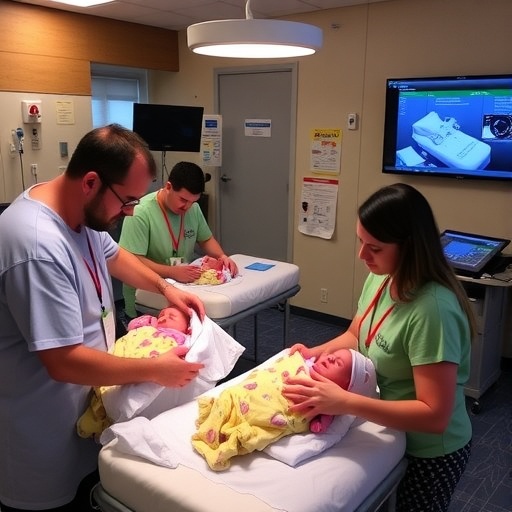
Neonatal-Perinatal Medicine (NPM) fellowships are built to prepare physicians for high-stakes care at the edge of viability, where rapid decisions and precise interventions can determine outcomes. A new report highlights how simulation can close a growing training gap created by changing intensive care unit (ICU) exposure patterns and evolving work-hour restrictions.
Over an eight-year period, Chaudhary and colleagues describe an intensive “simulation boot camp” designed for NPM senior fellows. The program targets realistic, complex neonatal-perinatal scenarios—situations that trainees may not repeatedly encounter during routine rotations, particularly when clinical time is constrained.
The core of the initiative is structured practice that replicates critical workflows, including emergency stabilization and coordinated team responses. Rather than focusing solely on knowledge acquisition, the boot camp emphasizes applied clinical reasoning, prioritization under uncertainty, and procedural competence in time-sensitive settings.
Technical realism is a key feature. Fellows engage with lifelike patient presentations and must execute management strategies that mirror bedside constraints such as rapid physiology changes, medication timing, and coordinated communication. This approach supports rehearsal of both technical steps and the non-technical behaviors needed in neonatal emergencies.
Because work-hour limits reduce continuous exposure to rare events, simulation offers an alternative training “volume.” The authors argue that repeated exposure to standardized yet challenging cases helps trainees refine performance and reduces variability in preparedness across fellows.
Importantly, the program’s educational value is linked to feedback and iterative improvement. By confronting scenarios that test escalation pathways and critical management principles, fellows can convert mistakes into actionable learning before entering high-pressure clinical environments.
The study’s 8-year experience suggests that simulation-based training can function as a resilient educational scaffold—one that maintains competency development even when clinical exposure time is curtailed. In doing so, it supports the ultimate aim of neonatal care: safe, evidence-informed decisions when seconds matter.
Overall, the boot camp provides a practical model for fellowship programs seeking to enhance readiness for neonatal-perinatal emergencies using simulation as a scalable resource. The authors frame their results as a response to modern training constraints, positioning simulation as essential rather than supplemental in contemporary NPM education.
Cite Scienmag News
Harold Sullivan. (July 27, 2026). Simulation Boot Camp Improves Neonatal Critical Care Skills for Senior Fellows. Scienmag. https://scienmag.com/simulation-boot-camp-improves-neonatal-critical-care-skills-for-senior-fellows/
Harold Sullivan. "Simulation Boot Camp Improves Neonatal Critical Care Skills for Senior Fellows." Scienmag, 27 July 2026, https://scienmag.com/simulation-boot-camp-improves-neonatal-critical-care-skills-for-senior-fellows/. Accessed 4 September 2026.
Harold Sullivan. "Simulation Boot Camp Improves Neonatal Critical Care Skills for Senior Fellows." Scienmag. July 27, 2026. https://scienmag.com/simulation-boot-camp-improves-neonatal-critical-care-skills-for-senior-fellows/


