


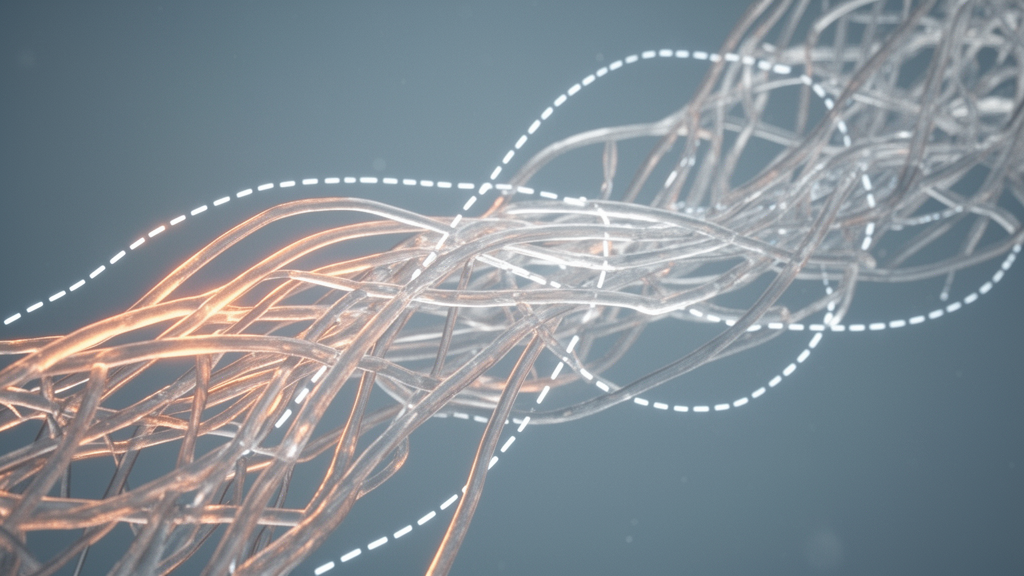
Cellulose acetate nanofiber morphology was linked to electrospinning conditions in a study combining molecular dynamics simulations with experiments. The abstract reports that higher cellulose acetate concentration increased hydrogen bonding and restricted molecular-chain motion, while producing larger fibers and a transition from a bead-like state to continuous fibers. It also identifies a balance between solvent composition and electric-field effects that produced the most uniform fiber surfaces under the tested conditions.
The simulations and experiments examined hydrogen-bond network evolution, molecular-chain dynamics and electric-field-induced conformational changes. According to the abstract, increasing cellulose acetate concentration strengthened hydrogen bonding and reduced molecular-chain movement, contributing to increased fiber diameter and a morphological shift from beads to a continuous structure. The DMAc/acetone ratio regulated competition among hydrogen-bonding interactions, with a ratio of 1:2 described as providing the best match between solvation and molecular entanglement.
Electric-field intensity also affected fiber structure. The study’s simulation and experimental results indicate that an applied field could promote dynamic hydrogen-bond breaking and molecular-chain extension, contributing to finer fibers. Under conditions of 14 wt% cellulose acetate concentration, a DMAc/acetone ratio of 1:2 and an applied voltage of 20 kV, the authors report an optimal combination of hydrogen-bonding, molecular entanglement and electric-field stretching. Fibers produced under those conditions had smooth, uniform surfaces and the smallest coefficient of variation in diameter among the reported results.
This is a simulation-and-experimental materials study, not a clinical investigation, and the supplied evidence consists only of the publisher’s abstract and bibliographic information. The abstract therefore supports the reported parameter effects and the 14 wt%, 1:2 and 20 kV combination, but it does not provide enough detail to independently assess the full methods, replicate numbers, measurement procedures or statistical analyses. The reported optimum is consequently limited to the conditions described in the abstract, and the findings should not be treated as evidence that the same settings will apply to other cellulose acetate formulations, solvent systems or electrospinning arrangements.
Subject of Research: Effects of electrospinning parameters on cellulose acetate nanofiber morphology in simulations and experiments
Article Title: Electrospinning parameters regulate cellulose acetate nanofiber morphology: molecular dynamics simulation study and experimental verification
Article References: Li, W., Xiong, H., Shi, K., Li, J., Yuan, Y., & Zhang, Y. (2026). Electrospinning parameters regulate cellulose acetate nanofiber morphology: molecular dynamics simulation study and experimental verification. Journal of Materials Science, 61(43), 33670-33695. https://doi.org/10.1007/s10853-026-13757-x
Image Credits: AI Generated
DOI: 10.1007/s10853-026-13757-x
Keywords: cellulose acetate, electrospinning, nanofibers, molecular dynamics, hydrogen bonding, fiber diameter, DMAc, acetone, electric field, materials simulation, parameters, regulate
Cite Scienmag News
Denise Maddox. (October 20, 2026). Simulation and experiments link electrospinning parameters to cellulose acetate nanofiber morphology. Scienmag. https://scienmag.com/simulation-and-experiments-link-electrospinning-parameters-to-cellulose-acetate-nanofiber-morphology/
Denise Maddox. "Simulation and experiments link electrospinning parameters to cellulose acetate nanofiber morphology." Scienmag, 20 October 2026, https://scienmag.com/simulation-and-experiments-link-electrospinning-parameters-to-cellulose-acetate-nanofiber-morphology/. Accessed 20 October 2026.
Denise Maddox. "Simulation and experiments link electrospinning parameters to cellulose acetate nanofiber morphology." Scienmag. October 20, 2026. https://scienmag.com/simulation-and-experiments-link-electrospinning-parameters-to-cellulose-acetate-nanofiber-morphology/


