


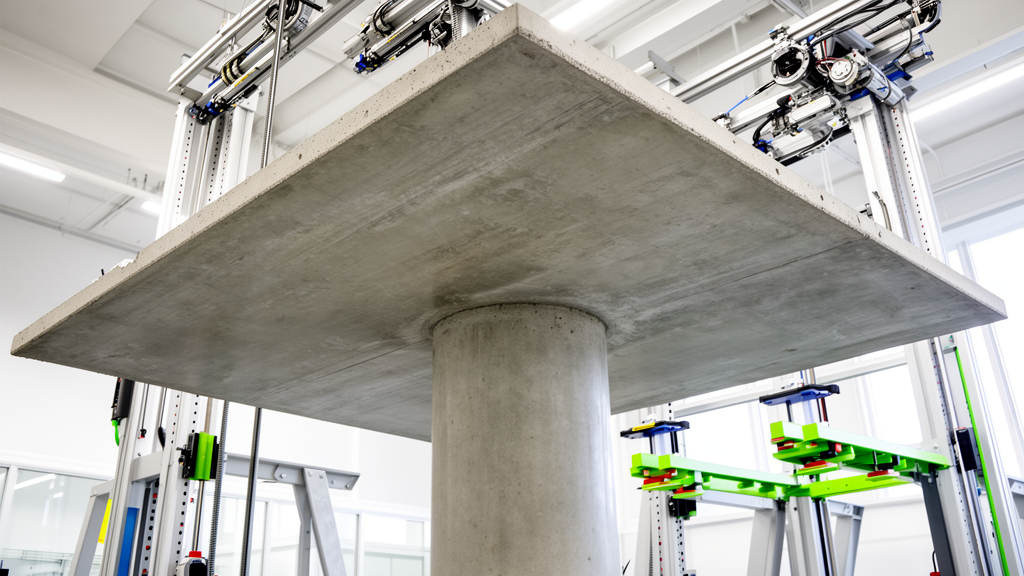
A comparative structural investigation has revealed that traditional simplified analysis methods return lower design actions at critical slab-column regions than three-dimensional continuum modeling, indicating that simplified approaches should be considered non-conservative at these connections under Eurocode 2 design rules. Researchers Benjamin Osalumese Edogun, Hilary Ijeoma Owamah, John Ebipuakebina Agori, Ikechukwu Etienne Umeonyiagu, and Solomon Ugwa Okoroafor evaluated how analytical choices govern the estimation of concentrated bending and shear forces across reinforced concrete flat slab systems with and without drop panels.
Because reinforced concrete flat slabs inherently concentrate severe bending moments and shear stresses at the junctions where slabs meet supporting columns, the analytical framework selected by structural engineers directly dictates the calculated magnitude of those internal forces. The study systematically evaluated three distinct design and analysis frameworks on an identical structural configuration: the Direct Design Method, the Equivalent Frame Method, and a three-dimensional linear-elastic finite element model developed using SAFE 2016 software.
The benchmark structural geometry comprised a symmetrical three-by-three grid consisting of nine 6.5-meter bays, supported by 400-millimeter square concrete columns and incorporating a baseline slab thickness of 250 millimeters. In the drop panel configurations, the model incorporated square drop panels measuring 2.5 meters on each side with an added depth of 100 millimeters. The entire assembly was evaluated under the Eurocode 2 fundamental ultimate limit state load combination of 1.35 times characteristic permanent actions plus 1.5 times characteristic variable actions, producing a design surface loading of 17.96 kilonewtons per square meter.
To establish a rigorous basis of comparison across two-dimensional frame idealizations and continuum representations, internal bending moments, one-way shear stresses, punching shear stresses, service deflections, and necessary reinforcement areas were extracted on a normalized per-meter-width strip basis. The data demonstrated that introducing drop panels reduced midspan sagging moments by 7.9 percent in the Equivalent Frame Method, 9.2 percent in the Direct Design Method, and 18.6 percent in the finite element model. Negative hogging moments at supports decreased by 7.9 percent, 8.1 percent, and 25.4 percent across the respective methods, demonstrating that two-dimensional simplifications capture only a minor fraction of the connection stiffening attributed to drop panels by continuum modeling.
The finite element simulations concentrated internal bending moments and shear forces into the column strips substantially more aggressively than the coefficient-based formulas. Consequently, the simplified Direct Design and Equivalent Frame methods generated lower design actions directly at the slab-column interface. The authors emphasized that because the finite element model was linear-elastic, uncracked, and not experimentally validated against physical test specimens, the numerical results must be interpreted as alternative predictions rather than an absolute baseline truth.
Evaluation of serviceability deflections underscored another vital distinction between analytical techniques. On an uncracked section, the linear-elastic finite element model produced unrealistically low deflections between 6 and 7 millimeters. When cracked-section stiffness adjustments defined by Eurocode 2 were implemented, finite element deflections increased to between 18 and 24 millimeters, aligning closely with the simplified method predictions and demonstrating that uncracked linear-elastic simulations cannot be relied upon for deflection verification. The researchers concluded that while the Direct Design Method and Equivalent Frame Method remain appropriate for preliminary member sizing, final engineering verification of slab-column connections and slabs incorporating drop panels requires cracked or nonlinear finite element analysis.
Subject of Research: Structural evaluation of analytical design methods for reinforced concrete flat slabs
Article Title: Comparative evaluation of finite element direct design and equivalent frame methods for reinforced concrete flat slabs with and without drop panels under Eurocode 2
Article References: Edogun, B. O., Owamah, H. I., Agori, J. E., Umeonyiagu, I. E., & Okoroafor, S. U. (2026). Comparative evaluation of finite element direct design and equivalent frame methods for reinforced concrete flat slabs with and without drop panels under Eurocode 2. Discover Applied Sciences. https://doi.org/10.1007/s42452-026-09702-x
Image Credits: AI Generated
DOI: 10.1007/s42452-026-09702-x
Keywords: reinforced concrete, flat slabs, drop panels, Eurocode 2, Direct Design Method, Equivalent Frame Method, finite element method, SAFE 2016, slab-column connections, punching shear, bending moments, service deflection, cracked section stiffness, column strip, structural analysis, sagging moments, hogging moments
Cite Scienmag News
Denise Maddox. (November 12, 2026). Simplified Slab Design Methods Underestimate Column Connection Forces Under Eurocode 2. Scienmag. https://scienmag.com/simplified-slab-design-methods-underestimate-column-connection-forces-under-eurocode-2/
Denise Maddox. "Simplified Slab Design Methods Underestimate Column Connection Forces Under Eurocode 2." Scienmag, 12 November 2026, https://scienmag.com/simplified-slab-design-methods-underestimate-column-connection-forces-under-eurocode-2/. Accessed 12 November 2026.
Denise Maddox. "Simplified Slab Design Methods Underestimate Column Connection Forces Under Eurocode 2." Scienmag. November 12, 2026. https://scienmag.com/simplified-slab-design-methods-underestimate-column-connection-forces-under-eurocode-2/




