


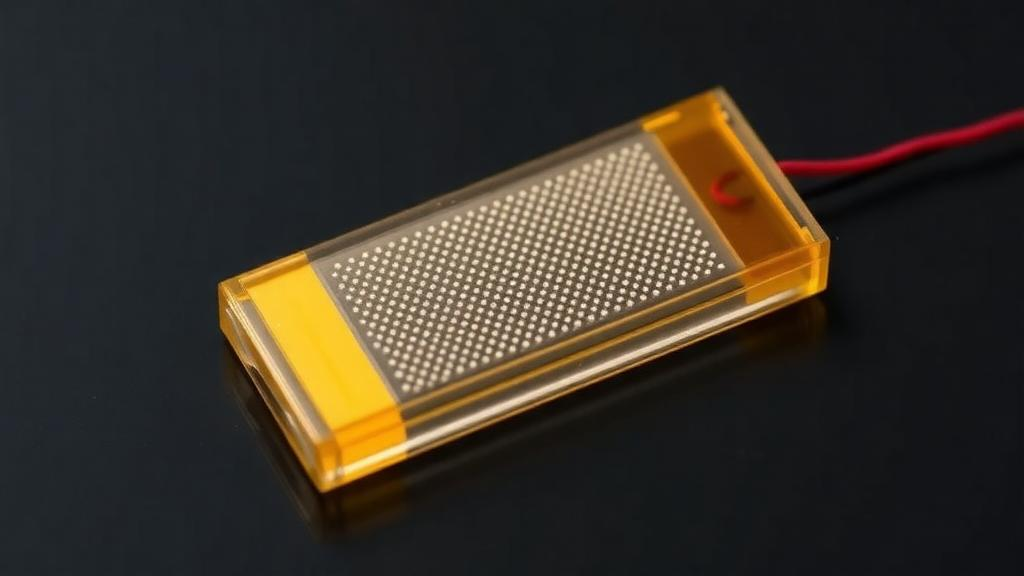
Flexible batteries that can bend, twist, and drape around a wrist have become the quiet bottleneck of the wearable electronics boom. Smartwatches, electronic skin patches, and health-monitoring bands all need power sources that survive deformation without leaking, cracking, or losing capacity. Zinc-air batteries have long been touted as a candidate chemistry for this role because they pack a great deal of energy into a light, safe, and inexpensive package, drawing their cathode reactant, oxygen, straight from the surrounding air. Yet the versions that dominate the literature rely on strongly alkaline electrolytes, and those caustic environments quietly sabotage the very devices they are meant to power. A team at Southwest University of Science and Technology in Sichuan, China, reporting in the journal Ionics, has now assembled a flexible zinc-air battery that sidesteps the alkaline problem altogether, pairing a neutral gelatin-based hydrogel electrolyte with a carefully engineered silver-decorated titanium dioxide air cathode.
The case for moving away from alkaline electrolytes is rooted in the peculiar chemistry of the zinc anode. In concentrated alkaline solutions, zinc metal is thermodynamically restless. It corrodes, converting itself into soluble zincate ions and releasing hydrogen gas as a byproduct. That hydrogen evolution dries out cells, builds pressure, and wastes capacity. At the same time, uneven dissolution and redeposition of zinc during repeated charge and discharge cycles encourages the growth of dendrites, needle-like metallic structures that can pierce separators and short-circuit the cell. These parasitic processes, well documented across the zinc-battery literature, are the principal reason alkaline zinc-air prototypes often fade after relatively few cycles. Neutral electrolytes, operating near pH 7, dramatically slow all three failure modes: corrosion, hydrogen evolution, and dendrite propagation. The catch is that neutral electrolytes are less conductive and less kinetically forgiving, so the rest of the cell, especially the air cathode, has to work harder to compensate.
The Sichuan group attacked both halves of the problem simultaneously. On the electrolyte side, they formulated a hydrogel built from gelatin, the same protein-derived polymer that gives dessert jelly its bounce. Gelatin carries abundant functional groups along its polypeptide chains, including carboxyl and amine groups, which can bind water and interact with dissolved ions, helping the gel retain electrolyte and conduct charge. Because the hydrogel is a soft, conformable solid rather than a free-flowing liquid, it eliminates the leakage and infiltration problems that plague liquid-electrolyte flexible cells, and it maintains intimate contact with both electrodes even when the battery is folded around a wrist or a fingertip. The researchers prepared this gelatin hydrogel under neutral conditions, creating a mechanically resilient ion-conducting bridge between the zinc anode and the air-breathing cathode.
The cathode, however, is where the study makes its most distinctive contribution. Air cathodes are the workhorses of zinc-air chemistry: during discharge they must catalyze the oxygen reduction reaction, in which oxygen molecules from the air accept electrons to form hydroxide or related species, and during recharge they must run the reverse oxygen evolution reaction. Both reactions are notoriously sluggish, and the catalysts that drive them well, typically platinum-group metals or complex transition-metal oxides, are expensive or difficult to synthesize. Titanium dioxide, an abundant, cheap, and chemically robust semiconductor, has attracted attention as an oxygen reduction catalyst when its surfaces are properly engineered, but its poor electrical conductivity has always limited its usefulness in a battery electrode where electrons must arrive at every catalytic site.
The researchers’ solution was to decorate titanium dioxide particles with a small, controlled loading of silver nanoparticles, prepared by chemical reduction. Silver is one of the best electrical conductors known, and even a modest fraction of it, dispersed as nanoscale islands across the oxide surface, creates conductive pathways that let electrons flow efficiently through the composite cathode material. The team designated their best formulation TA-0.05, indicating the optimized silver loading level. Beyond simply wiring the oxide particles together, the silver-titania interface can also influence the catalytic chemistry itself, since metal-semiconductor junctions alter how charge is distributed at active sites. The result is a cathode that conducts better, catalyzes oxygen reduction more effectively, and holds up under the repeated potential swings of cycling, all while using only a low loading of a relatively affordable noble metal rather than a heavy dose of platinum.
When the TA-0.05 cathode was coupled with the gelatin hydrogel electrolyte and a zinc anode to form a complete flexible cell, the performance figures were striking for a neutral-electrolyte device. The battery sustained stable charge-discharge cycling for more than fifty hours at a current density of one milliampere per square centimeter, a benchmark that matters because flexible wearables typically draw currents in precisely this low-to-moderate range. Fifty hours of continuous cycling implies that the cell resisted the corrosion, gas evolution, and dendrite problems that would have degraded an alkaline equivalent, while the conductive cathode kept the voltage gaps between charge and discharge acceptably narrow, preserving round-trip energy efficiency. In the world of neutral zinc-air batteries, where sluggish kinetics often inflate those voltage gaps and erode efficiency, this combination of stability and efficiency is a meaningful advance.
The demonstration that will likely capture the public imagination, though, is the simplest one. The researchers connected two of their flexible batteries in series and used the pair to light a light-emitting diode, not on a laboratory bench but while the assembly was being bent. The LED stayed illuminated under deformation, showing that the gelatin hydrogel maintained ionic contact and the cathode retained its structural integrity through mechanical stress. For a wearable device, that is the test that counts: a battery that only works when it is flat is not a wearable battery at all. The image of a soft, protein-based power cell glowing steadily while flexed is exactly the kind of proof-of-concept that moves a technology from an electrochemistry paper toward a product roadmap.
The broader significance of the work lies in its systems-level design philosophy. Rather than optimizing a single component in isolation, the team matched the electrolyte and the cathode to each other’s constraints. The neutral hydrogel tames the zinc anode’s destructive side reactions, but it demands a cathode with excellent conductivity and catalytic activity to overcome the kinetic penalties of near-neutral operation. The low-loading silver-titania composite answers that demand with inexpensive, scalable materials: titanium dioxide is a commodity chemical, silver is far cheaper than platinum, and gelatin is a biopolymer produced industrially on enormous scales. None of the ingredients is exotic, which matters enormously for any technology hoping to be manufactured by the kilometer for consumer wearables. The chemical reduction synthesis used to deposit the silver nanoparticles is likewise a routine, low-temperature procedure compatible with large-area flexible substrates.
Challenges remain before such cells can power a smartwatch on a store shelf. Neutral zinc-air batteries generally deliver lower power densities than their alkaline cousins, and the reported cycling was conducted at a modest current density, so performance under the heavier loads of, say, a wireless radio burst remains to be demonstrated. Long-term questions about hydrogel dehydration, gelatin biostability over months of use, and the durability of the silver-titania interface across thousands of cycles will need answers from extended testing. The authors themselves frame the work as a promising strategy for next-generation wearable electronics rather than a finished product. Still, by showing that a food-safe polymer gel and a sprinkle of silver on cheap titanium dioxide can keep a flexible battery glowing through fifty hours of cycling and through repeated bending, the Sichuan team has sketched a credible, low-cost path to power sources that flex as naturally as the skin they sit on.
Subject of Research: Development of a silver nanoparticle-decorated TiO2 air cathode with a gelatin hydrogel electrolyte for flexible neutral zinc-air batteries
Article Title: Low-loading Ag nanoparticle-decorated TiO2 air cathode coupled with a gelatin hydrogel electrolyte for flexible neutral zinc–air batteries
Article References: Kong, X., Qin, Q., Wang, Z., Li, J., & Zeng, M. (2026). Low-loading Ag nanoparticle-decorated TiO2 air cathode coupled with a gelatin hydrogel electrolyte for flexible neutral zinc–air batteries. Ionics. https://doi.org/10.1007/s11581-026-07495-y
Image Credits: AI Generated
DOI: 10.1007/s11581-026-07495-y
Keywords: zinc-air battery, flexible battery, gelatin hydrogel, titanium dioxide, silver nanoparticles, air cathode, oxygen reduction reaction, neutral electrolyte, wearable electronics, electrocatalysis, energy storage, nanomaterials
Cite Scienmag News
Denise Maddox. (October 6, 2026). Silver-Dotted Titanium Dioxide Cathode and Gelatin Gel Push Flexible Zinc-Air Batteries Toward Wearables. Scienmag. https://scienmag.com/silver-dotted-titanium-dioxide-cathode-and-gelatin-gel-push-flexible-zinc-air-batteries-toward-wearables/
Denise Maddox. "Silver-Dotted Titanium Dioxide Cathode and Gelatin Gel Push Flexible Zinc-Air Batteries Toward Wearables." Scienmag, 6 October 2026, https://scienmag.com/silver-dotted-titanium-dioxide-cathode-and-gelatin-gel-push-flexible-zinc-air-batteries-toward-wearables/. Accessed 6 October 2026.
Denise Maddox. "Silver-Dotted Titanium Dioxide Cathode and Gelatin Gel Push Flexible Zinc-Air Batteries Toward Wearables." Scienmag. October 6, 2026. https://scienmag.com/silver-dotted-titanium-dioxide-cathode-and-gelatin-gel-push-flexible-zinc-air-batteries-toward-wearables/


