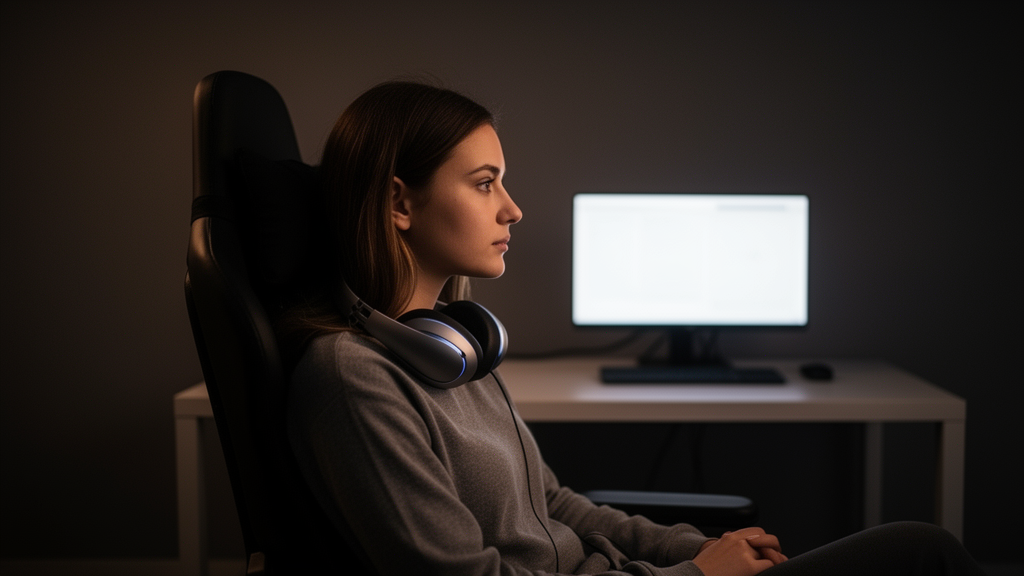
A brief moment of silence can make the visual world seem to speed up. In a new psychophysical study published in Attention, Perception, & Psychophysics, researchers Go Furusawa and Hideaki Kawabata report that an abrupt transition from sound to silence systematically compresses the perceived duration of visual stimuli that follow it, while leaving the precision of temporal discrimination untouched.
Across four forced-choice temporal discrimination experiments, participants judged the durations of visual stimuli presented under continuous background noise or after a brief silent interval created by switching the sound off. The silent gap acted as a sound offset inserted between a standard and a comparison stimulus. Visual stimuli shown immediately after the offset were consistently judged shorter than physically identical stimuli presented during continuous noise. The compression proved robust for simple geometric shapes and generalized to dynamic video content, indicating that the effect is not tied to a particular class of visual material.
A key detail lies in how the bias affected performance. Sound offset significantly shifted the point of subjective equality, the stimulus duration at which participants judged a comparison equal to the standard, meaning their duration estimates were biased toward shorter values. Yet measures of temporal sensitivity, including the difference limen and the Weber fraction, were unaffected. In other words, silence recalibrated the reference frame against which durations were judged without degrading participants’ ability to discriminate between durations.
Additional control experiments strengthened the interpretation. The compression effect could not be explained by graded changes in sound intensity, and it persisted across various interstimulus intervals between the offset and the visual test stimuli. The authors argue that silence should not be viewed as the mere absence of auditory input; rather, accumulating evidence suggests that the omission and offset of sound are processed as psychologically salient perceptual events. On this view, a transition into silence functions as a categorical contextual event that recalibrates the temporal reference framework used for subsequent duration judgments.
The findings highlight how auditory context transitions shape multisensory time perception, showing that what happens between sounds can actively bias how long the visual world appears to last. The trial-level data for all experiments are publicly available on the Open Science Framework, though none of the experiments were preregistered.
Subject of Research: How abrupt transitions from sound to silence bias the perceived duration of subsequent visual stimuli.
Article Title: The calm before the storm: Silence compresses subsequent visual time without reducing temporal precision
Article References: Furusawa, G., & Kawabata, H. (2026). The calm before the storm: Silence compresses subsequent visual time without reducing temporal precision. Attention, Perception, & Psychophysics, 88(8), Article 216. https://doi.org/10.3758/s13414-026-03365-x
Image Credits: AI Generated
DOI: 10.3758/s13414-026-03365-x
Keywords: time perception, silence, sound offset, duration compression, psychophysics, multisensory perception, temporal discrimination, point of subjective equality, Weber fraction, auditory context, calm, storm
Cite Scienmag News
Glenn Wilkins. (October 29, 2026). Silence After Sound Shrinks Perceived Visual Time, Study Finds. Scienmag. https://scienmag.com/silence-after-sound-shrinks-perceived-visual-time-study-finds/
Glenn Wilkins. "Silence After Sound Shrinks Perceived Visual Time, Study Finds." Scienmag, 29 October 2026, https://scienmag.com/silence-after-sound-shrinks-perceived-visual-time-study-finds/. Accessed 31 October 2026.
Glenn Wilkins. "Silence After Sound Shrinks Perceived Visual Time, Study Finds." Scienmag. October 29, 2026. https://scienmag.com/silence-after-sound-shrinks-perceived-visual-time-study-finds/