


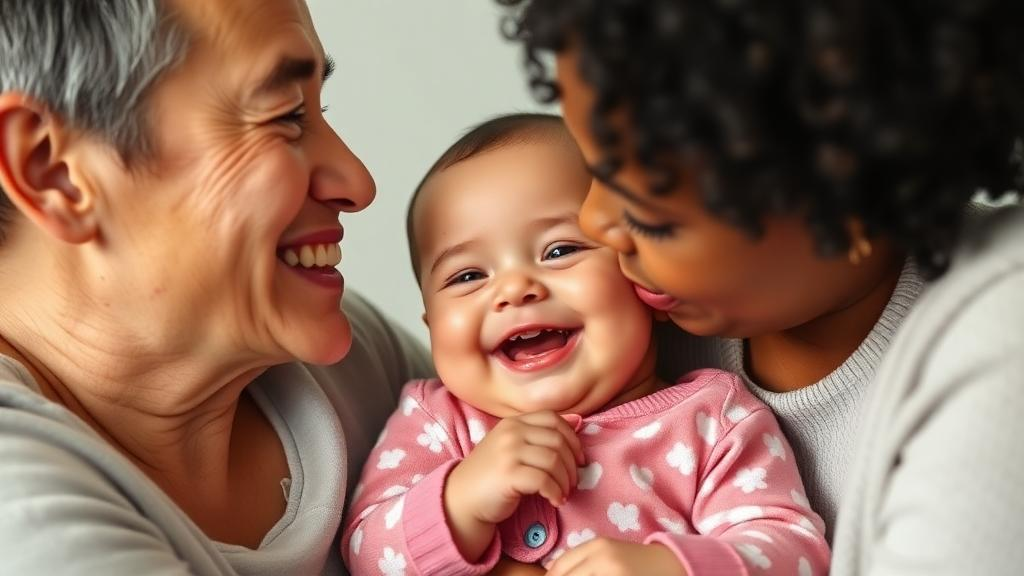
A mother and her baby gazing at each other and breaking into smiles is one of the most familiar scenes of early family life, and it can be easy to dismiss it as nothing more than a tender moment. Two new studies suggest that these exchanges do far more than warm the heart. According to research led in part by a University of Miami team, the positive interactions that pass between infants and their caregivers may actively help build the emotional and physiological foundations that babies rely on as they learn to manage their own feelings. The findings, published in Philosophical Transactions of the Royal Society B, point to something remarkable: the simple act of sharing a smile appears to leave measurable traces inside the infant body.
The first of the two studies set out to answer a question that has long interested developmental scientists: what actually happens inside a baby when a joyful exchange with a parent unfolds? To find out, the researchers measured changes in the heart rates of nearly 1,000 four-month-old infants as they engaged in positive interactions with their mothers. Electrodes were attached to the babies’ chests and stomachs, while trained observers watched the mother-infant pairs and recorded, moment by moment, whether each member of the pair displayed positive, neutral, or negative engagement. This combination of continuous physiological recording and fine-grained behavioral observation allowed the team to link what was happening between the mother and baby with what was happening inside the baby’s body.
The physiological measure at the center of the study was respiratory sinus arrhythmia, a form of heart-rate variability that is coupled with breathing. Scientists understand this variability to be a biological indicator tied to emotion regulation and to a person’s adaptability to different environments. In adults and in children, higher heart-rate variability in this range is generally associated with a more flexible capacity to respond to social and emotional demands. By calculating this measure from the infants’ heart-rate data, the researchers could ask whether moments of shared positivity were accompanied by shifts in the biological systems that support emotional self-regulation.
The answer was striking. The researchers found increases in the babies’ heart-rate variability precisely when the infants and their mothers were positively engaged at the same time. Crucially, the same physiological changes did not appear when only the baby was smiling, or when only the mother was showing positive emotion. Both partners had to be on the same positive wavelength for the effect to emerge. Daniel Messinger, a professor in the Department of Psychology at the University of Miami College of Arts and Sciences and a senior author on the paper, put it plainly: “They both have to be positive. When they’re both positive, particularly for longer periods of time, you see this increase in the baby’s heart rate.”
That mutual requirement may be the study’s most important insight. It suggests that emotional development is not simply a matter of a happy baby or an affectionate parent acting alone. Instead, the physiological states associated with emotion regulation appear to be recruited during genuine two-way exchanges, in which both the caregiver and the infant are sharing positive affect simultaneously. “Play is not just fun and games. It’s influencing the baby’s physiology,” said Messinger, who is also a professor of pediatrics. “There’s something about positive sociality that’s associated with this internal baby state. The baby’s physiology is linked to what’s going on in the interaction.” In other words, the interaction itself, not the mood of either partner in isolation, is what seems to matter.
The scale and design of the study lend weight to its conclusions. The research was part of a national study on drug exposure conducted at four sites across the country, including Miami, and involved several universities. When the team analyzed the heart-rate data, they controlled for prenatal drug exposure and social adversity, helping to ensure that the observed link between shared positivity and heart-rate variability was not simply an artifact of those factors. Among the members of the research team was Samantha G. Mitsven, a University of Miami alumna who worked on the study while completing her Ph.D. in developmental and child psychology. With nearly 1,000 infants contributing data, the study represents one of the larger physiological investigations of early mother-infant interaction.
The second study, also published in Philosophical Transactions of the Royal Society B, approached infant smiling from a different angle by asking how babies and adults influence each other’s smiling over time. The researchers observed 58 infants at two ages, 4 months and 8 months, while the babies interacted with their mothers, their fathers, and a stranger. This design allowed the team to compare smiling dynamics across different relationship partners within the same infants, revealing patterns that would be invisible in studies focused on mothers alone.
The results showed a clear division of labor in early smiling exchanges. Adults initiated and reciprocated smiling interactions at higher rates than infants did, and seeing an adult smile significantly increased the rate at which babies began smiling themselves. Babies, on the other hand, were more likely to be the ones who ended shared smiling moments, a pattern the researchers interpret as a possible sign that infants are learning to moderate their own excitement. The team also found developmental change: at 8 months, the babies were both more likely to start a smiling interaction on their own and more likely to reciprocate an adult’s smile compared with when they were 4 months old. “That suggests that the dyad becomes more dynamically responsive to one another at older ages,” said Messinger, who was a first author on the paper along with Eliala Alice Salvadori, who conducted the research for her dissertation at the University of Amsterdam, and Cristina Colonnesi, an associate professor at the University of Amsterdam. Another first author, Alan B. Cobo-Lewis, completed his postdoctoral fellowship and undergraduate studies at the University of Miami and is now an associate professor at the University of Maine.
Perhaps the most socially revealing finding came from the comparison across partners. At both ages, babies were most likely to return their mother’s smiles, compared with smiling interactions involving their fathers or an unknown adult. The adults who were strangers actually initiated and sustained smiles more often than the mothers did, yet the infants responded preferentially to their mothers. “This was, importantly, the first paper that involved not only moms and dads, but also strangers,” Messinger noted. “The strangers initiate and sustain smiles more than moms, but infants are more likely to smile back at the mom. So, the relationship really counts there.” The finding underscores that infant smiling is not a reflexive response to any friendly face, but a selectively tuned behavior shaped by the specific relationship between the baby and the person in front of them.
Together, the two studies sketch a picture of early emotional development as a genuinely interactive process. The heart-rate study shows that mutual positive engagement, sustained over time, is associated with increases in a physiological indicator linked to emotion regulation, while the smiling study shows that these exchanges become more fluid, reciprocal, and relationship-specific as infants grow from 4 to 8 months of age. For parents, the practical message is encouraging rather than demanding: ordinary moments of shared laughter and smiling are not idle pleasures but may be part of the biological work of early development. For scientists, the results open a window onto how social experience and physiology intertwine in the first months of life, suggesting that the foundations of emotional well-being are built not in solitude, but in the back-and-forth of a shared smile.
Subject of Research: The role of shared positive caregiver-infant interactions in infants' physiological and emotional development
Article Title: Shared smiles may shape infants’ emotional development
Article References: Shared smiles may shape infants’ emotional development. (n.d.). Original publication
Image Credits: AI Generated
DOI: Not provided
Keywords: infant development, emotion regulation, heart-rate variability, respiratory sinus arrhythmia, mother-infant interaction, smiling, caregivers, developmental psychology, physiology, social interaction, University of Miami, Philosophical Transactions of the Royal Society B
Cite Scienmag News
Glenn Wilkins. (October 2, 2026). Shared smiles with caregivers may shape babies’ emotional development. Scienmag. https://scienmag.com/shared-smiles-with-caregivers-may-shape-babies-emotional-development/
Glenn Wilkins. "Shared smiles with caregivers may shape babies’ emotional development." Scienmag, 2 October 2026, https://scienmag.com/shared-smiles-with-caregivers-may-shape-babies-emotional-development/. Accessed 4 October 2026.
Glenn Wilkins. "Shared smiles with caregivers may shape babies’ emotional development." Scienmag. October 2, 2026. https://scienmag.com/shared-smiles-with-caregivers-may-shape-babies-emotional-development/


