


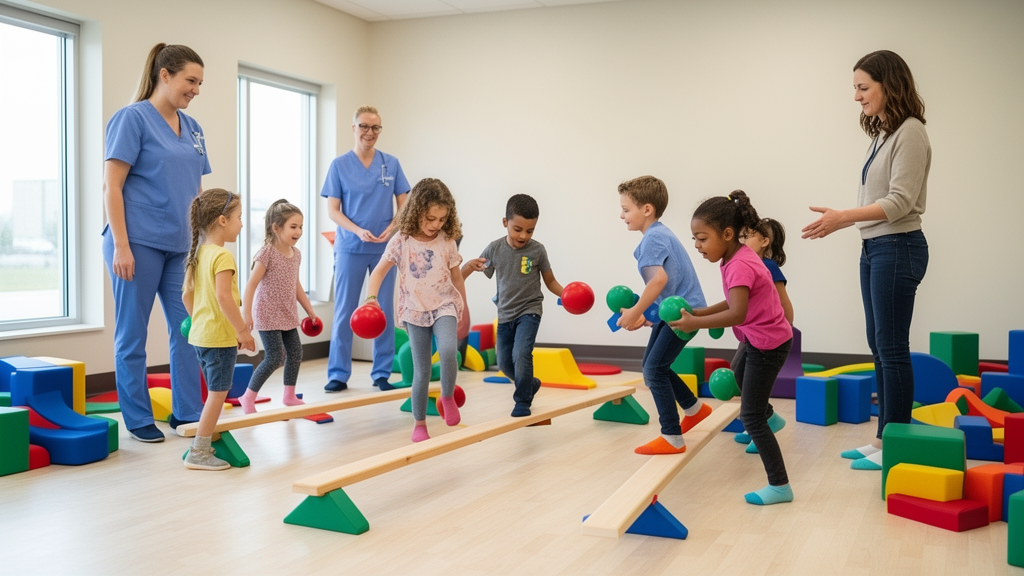
A six-month program coordinating physical-literacy activities across homes, schools and community settings was associated with higher measured motor competence among children in one Saskatchewan community, according to a quasi-experimental study. The researchers analyzed 686 pupils in grades 4–8 from seven schools, comparing 397 children in the intervention community with 289 children in two comparison communities. Mean motor-competence scores increased from 47.49 to 55.62 on a 0–100 scale in the intervention group, while scores declined from 50.87 to 47.07 in the comparison group. The group-by-time difference was statistically significant, p < 0.001. Because the design was not randomized and the study included only one intervention community, the difference cannot be attributed solely to the program or separated fully from community characteristics.
The project was built around “shared responsibility,” an approach in which education, recreation, sport, families and other community members collectively support children’s movement development rather than leaving it to one group. Saskatchewan in Motion selected the intervention community, while two comparison communities were chosen because of similarities in population, available services and socioeconomic status. The participating children had a mean age of 10.5 years with a standard deviation of 1.35. Researchers collected data at baseline and after the intervention, which ran from October through June. Questionnaire data were also available from 429 parents and 53 teachers, allowing researchers to examine motor performance alongside children’s own and adults’ perceptions of physical literacy.
Physical literacy was treated as a multidimensional construct comprising motivation, confidence, physical competence, knowledge and understanding, with the aim of valuing and taking responsibility for physical activity throughout life. The study used the Physical Literacy Assessment for Youth, or PLAY, battery to measure this broader construct from several perspectives. PLAY fun assessed motor competence through 18 tasks, while PLAY self captured children’s assessments of their own physical literacy. The PLAY parent and PLAY coach questionnaires measured parents’ and teachers’ perceptions of children’s physical literacy. The combination was important because an improvement in a child’s ability to perform movement skills does not necessarily indicate stronger confidence, motivation, knowledge or willingness to participate.
For the motor assessment, trained assessors scored each of the 18 PLAY fun skills on a visual scale from 0 to 100. The average score was calculated across all 18 skills, with subcategories covering locomotor abilities, object control and balance or stability. A skill was counted as acquired when its score exceeded 50, yielding a movement-vocabulary measure. Assessors completed four hours of training, followed a standardized playbook and were blinded to children’s baseline scores and group membership. Children were prevented from watching peers perform the tasks to reduce opportunities for observational learning. The same assessors and procedures were used at both measurement points, while a repeated-measures mixed model examined group and time effects, accounted for repeated observations within children and school-level clustering, and included sex and grade as covariates. Significance was set at p < 0.05.
The intervention combined information-sharing with practical opportunities to move. Families received newsletters and infographics explaining physical literacy, and the research team presented baseline findings to a School Community Council comprising parent representatives, administrators and school division leaders. Intervention schools received 20 physical-literacy-enriched lesson plans for each grade, access to professional-development sessions and teaching resources supplied by provincial sport organizations. Teachers and administrators met regularly with researchers to align the program with local needs. Community activities included a symposium involving students, parents, teachers and civic representatives, community action teams, information distributed through a webpage, newspaper and mail, an Activity Day with several sports and a revised recreation plan. A post-assessment “try-it” day gave pupils access to golf, rugby, tennis and other sports.
Group-level differences appeared across several parts of the motor assessment. Relative to the comparison group, the intervention group showed greater improvement in locomotor skills in grades 4, 5, 6 and 7, object control in grade 5 and balance in all grades. The number of skills classified as acquired also differed significantly between the groups in grades 4 through 7. Across all 18 skills, intervention pupils averaged 10 acquired skills at baseline and 12 at follow-up, whereas comparison pupils averaged 11 and nine, respectively. The overall motor score was higher in the intervention group in every grade, and the analysis found a significant grade interaction. Sex differences were limited, with boys scoring higher for locomotor skills in grades 6 and 8 in the intervention group and for acquired skills in grade 8. These averages do not establish that every child responded in the same way.
The intervention’s effects were not detected across the perception-based outcomes. Children’s self-perceived physical literacy showed no significant group-by-time effect, p = 0.784. Their mean PLAY self score changed from 58.18 to 58.28 in the intervention group and from 59.09 to 59.15 in the comparison group. Parents’ perceptions likewise did not differ significantly between groups over time, p = 0.173, although the analysis found an overall time effect, p < 0.001, which the researchers said appeared to reflect an increase in the intervention group. Teacher-reported physical literacy also showed no significant group-by-time effect, p = 0.987, even though mean PLAY coach scores increased in both groups. Possible explanations included the intervention’s stronger emphasis on motor development, variations in teachers’ familiarity with physical literacy, incomplete professional-development participation and possible effects of assessment participation on adult perceptions.
The divergence between observed motor change and perception measures is an important feature of the results. Children generally reported higher physical-literacy scores than their measured motor-competence scores, but the instruments assessed different constructs, and the study could not determine the reason for the discrepancy. The researchers suggested that confidence and motivation may develop more slowly than motor ability, while also noting that motor-skill instruction does not automatically build confidence or motivation. At baseline, the four PLAY measures were correlated only from rs = 0.27 to rs = 0.41, indicating low-to-moderate relationships among assessed performance, children’s self-perceptions and adults’ perceptions. The evidence for a differential intervention effect was therefore concentrated in motor competence rather than the children’s self-perceived physical literacy or teachers’ assessments.
Several limitations constrain what can be concluded from the study. The quasi-experimental design did not randomly assign communities or children, and only one community received the intervention. Community characteristics, including unmeasured ones, could therefore account for part of the observed difference. Implementation was uneven: one of the three intervention schools declined the offered professional-development session, and substantially more strategies occurred in schools than in homes or community settings. Teachers had varying levels of experience with physical literacy, and the activities were co-created according to community needs rather than delivered identically across sites. The six-month follow-up also could not establish whether changes persisted beyond one school year, and the study did not directly test downstream physical activity or health outcomes. Within those constraints, the measured results support the program as a promising multi-context strategy, particularly for motor competence, while the absence of significant group-by-time effects for children’s and teachers’ perceptions shows that the broader physical-literacy goals were not uniformly demonstrated.
Subject of Research: Evaluation of a shared-responsibility physical-literacy intervention for children across home, school and community settings
Article Title: Collective movement: reimagining children's physical literacy through shared responsibility
Article References: Houser, N. E., Humbert, M. L., Ferguson, L. J., Hellsten, L. M., Stoddart, A. L., & Erlandson, M. C. (2026). Collective movement: reimagining children's physical literacy through shared responsibility. Frontiers in Sports and Active Living, 8, Article 1922306. https://doi.org/10.3389/fspor.2026.1922306
Image Credits: AI Generated
DOI: 10.3389/fspor.2026.1922306
Keywords: physical literacy, motor competence, children, school intervention, community program, home-school-community, quasi-experimental study, Saskatchewan, physical activity, shared responsibility, Collective, movement
Cite Scienmag News
Faith Mcneil. (October 20, 2026). Shared-responsibility program linked to higher motor scores in Saskatchewan children. Scienmag. https://scienmag.com/shared-responsibility-program-linked-to-higher-motor-scores-in-saskatchewan-children/
Faith Mcneil. "Shared-responsibility program linked to higher motor scores in Saskatchewan children." Scienmag, 20 October 2026, https://scienmag.com/shared-responsibility-program-linked-to-higher-motor-scores-in-saskatchewan-children/. Accessed 20 October 2026.
Faith Mcneil. "Shared-responsibility program linked to higher motor scores in Saskatchewan children." Scienmag. October 20, 2026. https://scienmag.com/shared-responsibility-program-linked-to-higher-motor-scores-in-saskatchewan-children/


