


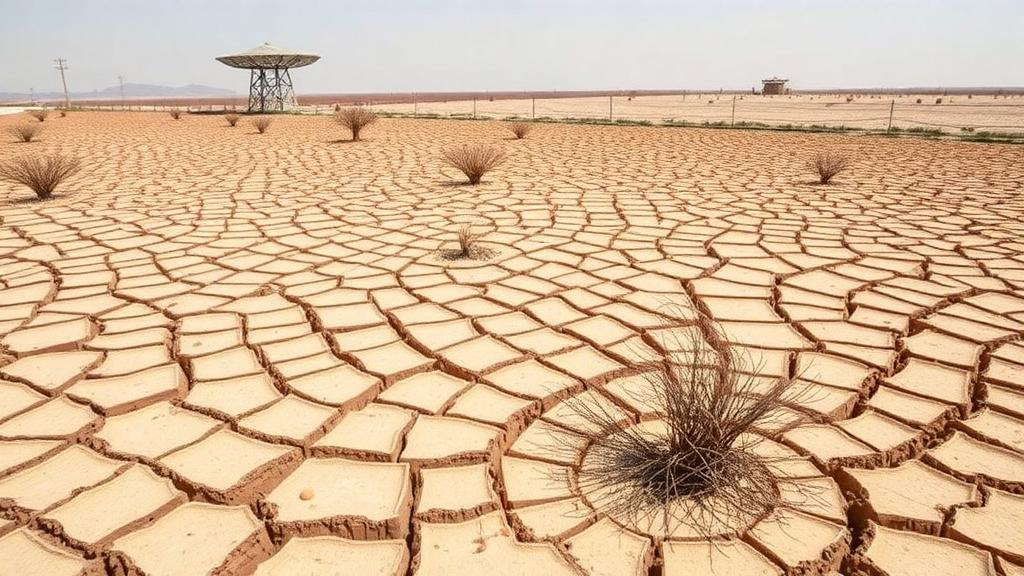
Across the vast drylands of northern China, vegetation has long walked a delicate tightrope between surviving drought and bouncing back from it. A new study published in Forest Ecosystems suggests that this tightrope becomes far more precarious as droughts intensify, with severe water stress fundamentally reshaping the relationship between two of the most important traits governing ecosystem stability: drought resistance and post-drought recovery. The findings carry significant implications for the future of some of the world’s most water-limited landscapes, including the region covered by the Three-North Shelterbelt Program, the largest ecological restoration project on Earth.
Drylands occupy a special and vulnerable place in the global carbon cycle. Although they are defined by scarcity of water, they are extensive enough that their vegetation exerts considerable influence on terrestrial carbon uptake from year to year. Because their ecosystems sit close to physiological limits imposed by aridity, even modest shifts in precipitation and evaporative demand can ripple through plant communities, altering growth, survival, and the capacity of the land to store carbon. Under climate change, droughts in these regions are expected to become more frequent and more severe, making it essential to understand how dryland vegetation copes when water becomes scarce.
The research team focused on the drylands of northern China, a region that spans pronounced gradients of aridity and includes vast areas of restored and semi-natural vegetation. To track how plants responded to drought over more than two decades, the researchers turned to satellite observations covering the period from 2001 to 2022. Rather than relying on ground measurements alone, which are sparse across such an enormous territory, they used satellite-derived estimates of net primary productivity, or NPP, as an indicator of vegetation productivity and carbon uptake. NPP captures the amount of carbon that plants fix through photosynthesis and retain as growth, making it a widely used proxy for ecosystem health and function.
To characterize drought conditions, the team employed the Standardized Precipitation Evapotranspiration Index, known as SPEI, which integrates both water supply through precipitation and atmospheric water demand through evapotranspiration. This index allowed the researchers to identify drought years of varying intensity across the study period. They combined the satellite productivity data with SPEI, land-cover classifications, and meteorological observations, then applied machine learning and statistical approaches to disentangle how vegetation behaved during drought years and in the years that followed.
At the heart of the analysis were two complementary abilities. The first is resistance, which describes how well vegetation maintains its productivity during drought years; a highly resistant ecosystem loses little carbon uptake even when water is scarce. The second is recovery, which reflects how quickly and completely vegetation regains its productivity once drought stress has passed. Together, these two traits determine whether an ecosystem’s carbon uptake remains stable over the long term, and ecologists have increasingly recognized that the balance between them may shift depending on the severity of the disturbance.
The study’s first major finding was encouraging: dryland vegetation with stronger resistance tended to show greater stability in carbon uptake over the long term. In other words, the ability to keep functioning during dry years is a cornerstone of stable ecosystem productivity in these water-limited environments. This result underscores why drought resistance has long been a central concern for ecologists and land managers working in arid regions, and it suggests that maintaining or enhancing resistance could help buffer dryland carbon cycling against the growing variability of the climate.
But the relationship between resistance and recovery proved to be far from fixed. Under moderate drought, the two traits moved in harmony: vegetation that resisted drought well also tended to recover well afterward. This positive association implies that, under less extreme water stress, the underlying physiological and structural attributes that help plants endure drought, such as deep roots or efficient water use, also position them to rebound quickly once conditions improve. Resistance and recovery, in this regime, are two faces of the same adaptive capacity.
Under severe drought, however, that harmony broke down. The positive relationship between resistance and recovery shifted into a tradeoff: vegetation that resisted drought better often recovered more slowly, while vegetation that rebounded faster tended to be less resistant during the drought years themselves. This reversal suggests that the strategies plants use to survive intense water stress may come at the cost of a slower return to full productivity, and vice versa. For ecosystems, such a tradeoff means that no single strategy guarantees stability, and that severe drought can expose vulnerabilities that moderate drought does not. Intriguingly, under extreme drought the tradeoff itself disappeared, which the researchers interpret as a sign that extreme water stress may disrupt the usual coordination between resistance and recovery altogether, potentially signaling increased vulnerability to drought across the system.
The study also revealed important differences across aridity zones. Arid ecosystems appeared more fragile as drought intensified, suggesting that the driest parts of the region have the least capacity to absorb escalating water stress. Semi-arid areas, by contrast, relied more heavily on recovery, meaning that their stability depends more on how quickly vegetation can regain productivity after drought than on how well it resists during the event. This distinction matters because it implies that the same drought can destabilize different landscapes through different mechanisms, and that assessments of ecosystem vulnerability must account for regional aridity rather than treating drylands as a uniform category.
The practical implications extend well beyond academic understanding. Because looking at only resistance or only recovery may miss important signs of vulnerability, the researchers argue that both abilities should be considered together when assessing the future of dryland ecosystems under climate change. For ecological restoration, the message is equally clear: strategies in water-limited regions should be matched to local drought conditions. Potential approaches include selecting drought-tolerant species, optimizing planting density to reduce competition for scarce soil water, improving soil moisture retention, and avoiding restoration schemes with excessive water demand. In a region that hosts the Three-North Shelterbelt Program, where decades of effort and enormous resources have been invested in reforesting and stabilizing dry landscapes, ensuring that restored vegetation can both withstand drought and recover from it may prove decisive for the long-term success of one of the planet’s most ambitious ecological experiments.
Subject of Research: Drought resistance and recovery dynamics of dryland vegetation in northern China
Article Title: Severe drought disrupts the balance between vegetation’s resistance and recovery in dryland
Article References: Severe drought disrupts the balance between vegetation’s resistance and recovery in dryland. (n.d.). Original publication
Image Credits: AI Generated
DOI: Not provided
Keywords: drylands, drought, vegetation stability, drought resistance, post-drought recovery, net primary productivity, SPEI, carbon uptake, northern China, Three-North Shelterbelt Program, aridity, ecological restoration
Cite Scienmag News
Gavin Prescott. (October 1, 2026). Severe Drought Flips the Balance Between Resistance and Recovery in China’s Drylands. Scienmag. https://scienmag.com/severe-drought-flips-the-balance-between-resistance-and-recovery-in-chinas-drylands/
Gavin Prescott. "Severe Drought Flips the Balance Between Resistance and Recovery in China’s Drylands." Scienmag, 1 October 2026, https://scienmag.com/severe-drought-flips-the-balance-between-resistance-and-recovery-in-chinas-drylands/. Accessed 4 October 2026.
Gavin Prescott. "Severe Drought Flips the Balance Between Resistance and Recovery in China’s Drylands." Scienmag. October 1, 2026. https://scienmag.com/severe-drought-flips-the-balance-between-resistance-and-recovery-in-chinas-drylands/


