


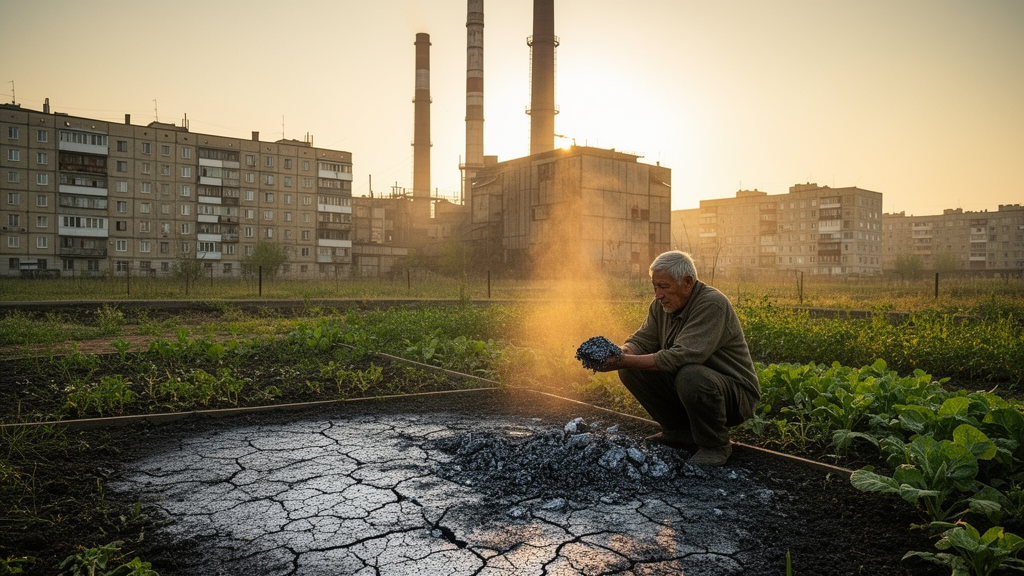
In the industrial heart of Ust-Kamenogorsk, a city in eastern Kazakhstan that has processed polymetallic ores for more than seven decades, the ground itself has become a chemical record of industrial history. A new study published in Frontiers in Soil Science shows that the soils beneath this major non-ferrous metallurgical center are not merely contaminated but geochemically transformed, carrying concentrations of zinc, cadmium, copper, and lead that in places exceed regulatory thresholds by tens to nearly a hundred times. The research, led by Dias Daurov and colleagues at the Institute of Plant Biology and Biotechnology in Almaty, offers one of the most comprehensive portraits yet of how legacy metallurgy reshapes the urban subsurface long after smokestacks are cleaned up.
The team collected surface soil samples from 29 sites spanning industrial, urban, and background functional zones, analyzing them for the four metals most closely tied to the city’s ore processing legacy. The results are striking. Zinc concentrations ranged from 5.2 to 1,675 milligrams per kilogram, with a mean of roughly 420 milligrams per kilogram, approximately 23 times higher than the value recorded at a local reference site 20 kilometers southwest of the city. Cadmium, though present at far lower absolute concentrations, averaged 10.4 milligrams per kilogram, about 13 times the reference level. Copper and lead reached maximum values of 57.8 and 59.5 milligrams per kilogram respectively, with coefficients of variation exceeding 110 percent for all four metals, indicating extreme spatial heterogeneity across the urban landscape.
What makes these numbers alarming is not just their magnitude but their distribution. Median concentrations in industrial soils were 704.5 milligrams per kilogram for zinc, 15.8 for cadmium, 11.5 for copper, and 22.1 for lead, roughly one order of magnitude above the medians measured in urban soils. The highest values clustered at sites S16 through S25, within the central industrial sector where the Kazzinc metallurgical complex, the Ust-Kamenogorsk Titanium and Magnesium Plant, and the Ulba Metallurgical Plant operate in close proximity to residential districts and transportation corridors. Site S19 recorded the maximum zinc and lead concentrations, while cadmium peaked at S20 and copper at S25.
To translate raw concentrations into environmental meaning, the researchers applied a battery of pollution indices. The contamination factor, geoaccumulation index, Nemerow pollution index, and potential ecological risk index each quantify different aspects of soil degradation, and their combined application revealed a coherent picture. The Nemerow index, which simultaneously considers average contamination and the worst single-metal exceedance, reached values above 50 at several industrial sites, far beyond the threshold of 3 that defines heavy pollution. The potential ecological risk index, which weights each metal by its toxicity, ranged from 41 to 2,188.9, with roughly one-third of sampling sites exceeding the threshold for very high ecological risk.
Perhaps the most consequential finding concerns cadmium. Although zinc dominated in concentration and spatial extent, cadmium contributed overwhelmingly to total ecological risk because of its high toxic-response coefficient in the Hakanson framework, which assigns cadmium a weighting of 30 compared with 5 for copper and lead and just 1 for zinc. Ecological risk factors for cadmium reached 1,462.5 at individual sites, often surpassing the threshold of 320 that marks very high risk. This means that remediation priorities based solely on total metal concentrations would miss the element posing the greatest environmental threat, a paradox the authors argue should fundamentally reshape how legacy metallurgical cities are monitored and managed.
The geochemical signature of the contamination points unambiguously to its source. Zinc and cadmium showed an exceptionally strong correlation, with a Spearman rank coefficient of 0.90, reflecting the fact that cadmium commonly substitutes for zinc within the mineral sphalerite and is released simultaneously during smelting of sulphide ores. Their spatial distributions were nearly identical in the interpolation maps, forming a coupled enrichment pattern recognized as a characteristic fingerprint of non-ferrous metallurgy worldwide. Copper and lead, by contrast, displayed more localized anomalies, consistent with coarser particles that settle rapidly after emission rather than remaining suspended for long-range atmospheric transport.
Soil properties themselves modulated the accumulation pattern. The investigated soils were predominantly neutral to slightly alkaline, with pH ranging from 5.73 to 7.48, conditions generally favourable for reducing metal mobility through adsorption onto clay minerals and organic matter. Yet even under these relatively buffering conditions, industrial sites remained heavily contaminated, demonstrating that soil chemistry regulates retention rather than the primary source of contamination. Particle-size composition exerted a particularly strong influence: sand content was negatively correlated with all four metals, while silt showed significant positive relationships, indicating that fine-textured soils act as efficient sinks for airborne industrial particulates thanks to their greater specific surface area and cation-exchange capacity.
Multivariate statistics reinforced the anthropogenic interpretation. Principal component analysis separated industrial sites, which clustered along a gradient defined by elevated metals and pollution indices, from urban and reference sites associated with higher pH, finer fractions, and exchangeable base cations. Non-metric multidimensional scaling, with a stress value of just 0.028, confirmed highly significant differences among ecological risk groups, while spatial interpolation using inverse distance weighting identified contamination hotspots surrounding the major metallurgical facilities, with zinc and cadmium showing the broadest footprints and copper and lead more restricted anomalies.
The persistence of these elevated concentrations decades after emission controls improved underscores that contaminated urban soils function as long-term reservoirs, capable of secondary redistribution through dust resuspension, erosion, and surface runoff. The authors argue that environmental management in cities like Ust-Kamenogorsk must address both ongoing emissions and the contaminants already locked in surface horizons, prioritizing cadmium-enriched hotspots for risk-based remediation while considering stabilization approaches using mineral amendments, organic sorbents, or phytostabilization. The study also acknowledges limitations, including reliance on a single local reference site and the measurement of total rather than speciated metal concentrations, leaving questions about bioavailability and human health risk for future investigation.
For a city that has smelted zinc, lead, copper, titanium, and uranium-related materials since the mid-twentieth century, the findings provide a scientific foundation for monitoring, risk-based land management, and sustainable remediation in one of Central Asia’s most intensively industrialized urban environments. They also carry a broader message: in long-established metallurgical cities worldwide, from Poland to China to Spain, the ground beneath our feet retains a geochemical memory of industrial activity that outlasts the factories themselves, and understanding that memory is the first step toward managing it.
Subject of Research: Legacy of non-ferrous metallurgy driving heavy metal-induced geochemical transformation of urban soils
Article Title: Legacy of non-ferrous metallurgy driving heavy metal-induced geochemical transformation of urban soils
Article References: Daurov, D., Abilda, Z., Zhambakin, K., Daurova, A., Sapakhova, Z., Toishimanov, M., Isgandarov, I., Mukhametov, A., Kanat, R., Otynshiev, M., Volkov, D., & Shamekova, M. (2026). Legacy of non-ferrous metallurgy driving heavy metal-induced geochemical transformation of urban soils. Frontiers in Soil Science, 6, Article 1949558. https://doi.org/10.3389/fsoil.2026.1949558
Image Credits: AI Generated
DOI: 10.3389/fsoil.2026.1949558
Keywords: heavy metals, soil pollution, legacy contamination, ecological risk, urban soils, metallurgy, Legacy, non-ferrous, driving, heavy, metal-induced, geochemical
Cite Scienmag News
Violet Maxwell. (October 16, 2026). Seven Decades of Smelting Left Kazakhstan’s Urban Soils Chemically Transformed. Scienmag. https://scienmag.com/seven-decades-of-smelting-left-kazakhstans-urban-soils-chemically-transformed/
Violet Maxwell. "Seven Decades of Smelting Left Kazakhstan’s Urban Soils Chemically Transformed." Scienmag, 16 October 2026, https://scienmag.com/seven-decades-of-smelting-left-kazakhstans-urban-soils-chemically-transformed/. Accessed 16 October 2026.
Violet Maxwell. "Seven Decades of Smelting Left Kazakhstan’s Urban Soils Chemically Transformed." Scienmag. October 16, 2026. https://scienmag.com/seven-decades-of-smelting-left-kazakhstans-urban-soils-chemically-transformed/


