

“The findings of the present study reveal that aging is linked to a decline in serine racemase protein levels across various brain regions […]”

Credit: 2024 Bean et al.
“The findings of the present study reveal that aging is linked to a decline in serine racemase protein levels across various brain regions […]”
BUFFALO, NY- June 5, 2024 – A new research paper was published in Aging (listed by MEDLINE/PubMed as “Aging (Albany NY)” and “Aging-US” by Web of Science) Volume 16, Issue 10, entitled, “Serine racemase expression profile in the prefrontal cortex and hippocampal subregions during aging in male and female rats.”
Aging is associated with a decrease in N-methyl-D-aspartate (NMDA) receptor function, which is critical for maintaining synaptic plasticity, learning, and memory. Activation of the NMDA receptor requires binding of the neurotransmitter glutamate and also the presence of co-agonist D-serine at the glycine site. The enzymatic conversion of L-serine to D-serine is facilitated by the enzyme serine racemase (SR).
Subsequently, SR plays a pivotal role in regulating NMDA receptor activity, thereby impacting synaptic plasticity and memory processes in the central nervous system. As such, age-related changes in the expression of SR could contribute to decreased NMDA receptor function. However, age-associated changes in SR expression levels in the medial and lateral prefrontal cortex (mPFC, lPFC), and in the dorsal hippocampal subfields, CA1, CA3, and dentate gyrus (DG), have not been thoroughly elucidated.
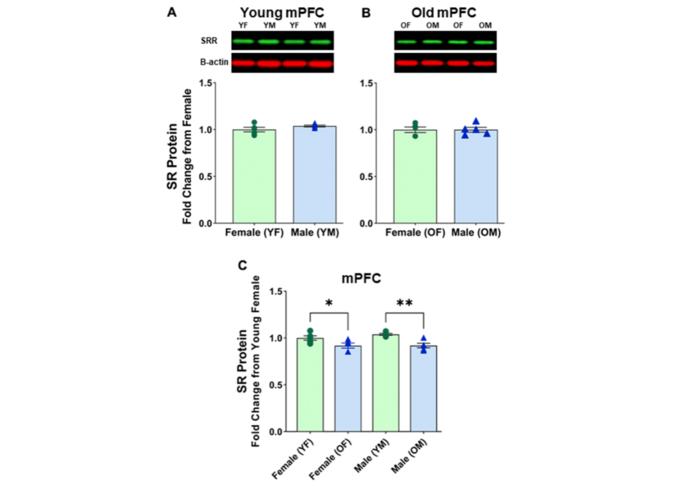
In this new study, researchers Linda Bean, Prodip K. Bose, Asha Rani, and Ashok Kumar from Indiana University School of Medicine, North Florida/South Georgia Veterans Health System, and the University of Florida aimed to determine the SR expression profile, including protein levels and mRNA, for these regions in aged and young male and female Fischer-344 rats. Their results demonstrate a significant reduction in SR expression levels in the mPFC and all hippocampal subfields of aged rats compared to young rats. No sex differences were observed in the expression of SR.
“These findings suggest that the decrease in SR levels may play a role in the age-associated reduction of NMDA receptor function in brain regions crucial for cognitive function and synaptic plasticity.”
Read the full paper: DOI: https://doi.org/10.18632/aging.205841
Corresponding Author: Ashok Kumar
Corresponding Email: kash@ufl.edu
Keywords: aging, serine racemase, hippocampus, medial prefrontal cortex (mPFC), NMDA receptor
Click here to sign up for free Altmetric alerts about this article.
About Aging:
Aging publishes research papers in all fields of aging research including but not limited, aging from yeast to mammals, cellular senescence, age-related diseases such as cancer and Alzheimer’s diseases and their prevention and treatment, anti-aging strategies and drug development and especially the role of signal transduction pathways such as mTOR in aging and potential approaches to modulate these signaling pathways to extend lifespan. The journal aims to promote treatment of age-related diseases by slowing down aging, validation of anti-aging drugs by treating age-related diseases, prevention of cancer by inhibiting aging. Cancer and COVID-19 are age-related diseases.
Aging is indexed by PubMed/Medline (abbreviated as “Aging (Albany NY)”), PubMed Central, Web of Science: Science Citation Index Expanded (abbreviated as “Aging‐US” and listed in the Cell Biology and Geriatrics & Gerontology categories), Scopus (abbreviated as “Aging” and listed in the Cell Biology and Aging categories), Biological Abstracts, BIOSIS Previews, EMBASE, META (Chan Zuckerberg Initiative) (2018-2022), and Dimensions (Digital Science).
Please visit our website at www.Aging-US.com and connect with us:
- X, formerly Twitter
- YouTube
- Spotify, and available wherever you listen to podcasts
Click here to subscribe to Aging publication updates.
For media inquiries, please contact media@impactjournals.com.
Aging (Aging-US) Journal Office
6666 E. Quaker Str., Suite 1B
Orchard Park, NY 14127
Phone: 1-800-922-0957, option 1
###
Journal
Aging-US
Method of Research
Experimental study
Subject of Research
Animals
Article Title
Serine racemase expression profile in the prefrontal cortex and hippocampal subregions during aging in male and female rats
Article Publication Date
17-May-2024

