


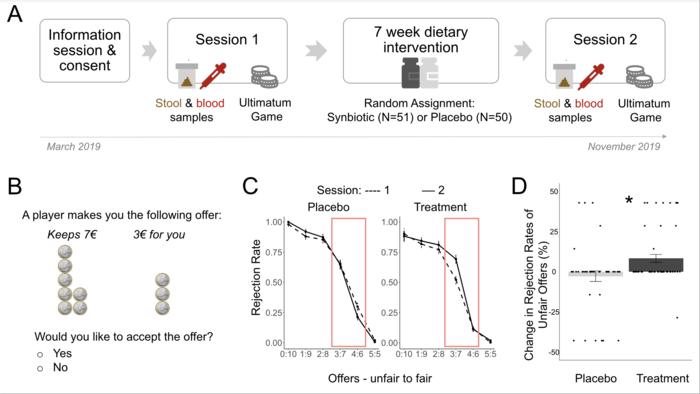
Taking pro- and prebiotics could make people more sensitive to fairness, even at the cost of earning less money, according to a study. The role of the human gut microbiome in shaping human behavior is only beginning to be explored. Hilke Plassmann and colleagues tested whether taking pro- and prebiotics could affect levels of altruistic punishment. Fifty-one participants took a supplement containing Lactobacillus and Bifidobacterium for seven weeks. Fifty additional participants acted as controls and took placebos. Before and after the seven-week intake of the dietary supplement, participants were asked to play the “ultimatum game,” in which one player controls a pot of money and can offer a share or “split” to a second player. The second player can accept the offer and take the money or can reject the offer—in which case neither player receives any money. Rejecting an unfair offer is interpreted as “altruistic punishment,” as the rejecter sacrifices whatever small share is on offer to punish the first player for being ungenerous. Players who had taken the dietary supplements were more likely to reject offers. In particular, players who had taken the dietary supplements were more likely to reject 30%–40% splits. (All players tended to reject very unequal splits.) Players who had a high ratio of Firmicutes to Bacteroidetes at the beginning of the study saw the greatest changes in both gut makeup and rates of altruistic punishment. The supplements reduced plasma levels of the dopamine precursor tyrosine in some participants, and players who experienced this reduction were the group who saw the most significant increase in altruistic punishment. According to the authors, people who changed their gut microbiome to a state regarded as healthier became less rational and more sensitive to social considerations.

Credit: Plassmann et al
Taking pro- and prebiotics could make people more sensitive to fairness, even at the cost of earning less money, according to a study. The role of the human gut microbiome in shaping human behavior is only beginning to be explored. Hilke Plassmann and colleagues tested whether taking pro- and prebiotics could affect levels of altruistic punishment. Fifty-one participants took a supplement containing Lactobacillus and Bifidobacterium for seven weeks. Fifty additional participants acted as controls and took placebos. Before and after the seven-week intake of the dietary supplement, participants were asked to play the “ultimatum game,” in which one player controls a pot of money and can offer a share or “split” to a second player. The second player can accept the offer and take the money or can reject the offer—in which case neither player receives any money. Rejecting an unfair offer is interpreted as “altruistic punishment,” as the rejecter sacrifices whatever small share is on offer to punish the first player for being ungenerous. Players who had taken the dietary supplements were more likely to reject offers. In particular, players who had taken the dietary supplements were more likely to reject 30%–40% splits. (All players tended to reject very unequal splits.) Players who had a high ratio of Firmicutes to Bacteroidetes at the beginning of the study saw the greatest changes in both gut makeup and rates of altruistic punishment. The supplements reduced plasma levels of the dopamine precursor tyrosine in some participants, and players who experienced this reduction were the group who saw the most significant increase in altruistic punishment. According to the authors, people who changed their gut microbiome to a state regarded as healthier became less rational and more sensitive to social considerations.
Journal
PNAS Nexus
Article Title
Impact of the gut microbiome composition on social decision-making
Article Publication Date
14-May-2024
COI Statement
The nutrition manufacturer MensSana AG provided the authors with the dietary supplement and the identical-looking placebo consisting of microcrystalline cellulose that does not have an effect on the microbiome composition. MensSana AG did not have an additional role in this study.
Cite Scienmag News
Morgan Morrow. (May 14, 2024). Sensitivity to fairness and the gut microbiome. Scienmag. https://scienmag.com/sensitivity-to-fairness-and-the-gut-microbiome/
Morgan Morrow. "Sensitivity to fairness and the gut microbiome." Scienmag, 14 May 2024, https://scienmag.com/sensitivity-to-fairness-and-the-gut-microbiome/. Accessed 4 September 2026.
Morgan Morrow. "Sensitivity to fairness and the gut microbiome." Scienmag. May 14, 2024. https://scienmag.com/sensitivity-to-fairness-and-the-gut-microbiome/

