


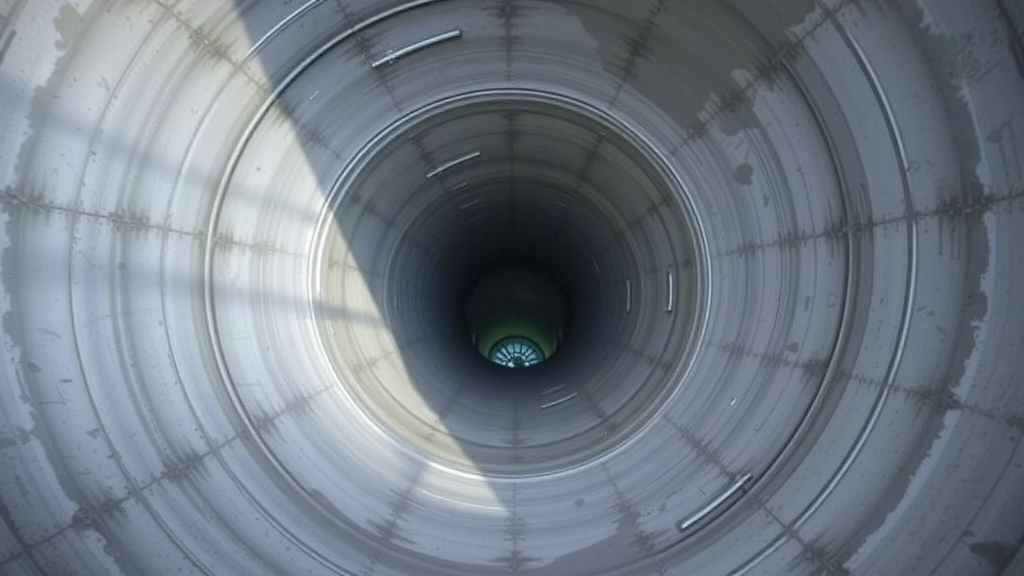
Deep beneath the surface of western China, mine shafts are being sunk through water-saturated, weakly cemented rock strata at depths approaching and exceeding one kilometer. The concrete linings that hold these shafts open face a punishing combination of forces: intense surrounding rock stress, high pore water pressure, heat released during cement hydration, temperature shrinkage, and constant construction disturbances. When this cocktail of stresses cracks the lining, the consequences are immediate and dangerous. Cracks become seepage channels for pressurized groundwater, the load-bearing capacity of the lining drops, and aggressive dissolved substances penetrate the structure, accelerating long-term durability degradation. A new study published in Case Studies in Construction Materials by Zongchuang Ding, Zhishu Yao, and colleagues at Anhui University of Science and Technology proposes an ambitious answer: a self-healing concrete that can simultaneously restore both its mechanical strength and its waterproofness after cracking, even under coupled stress and seepage conditions.
The team’s strategy rests on three complementary components engineered into C70 high-performance concrete, the grade commonly used for deep shaft linings because of its high strength and compact microstructure. The first component is a family of polyurea microcapsules filled with 1,3-xylylene diisocyanate, or 1,3-XDI, a healing agent selected for the first time in this application. The second is a dose of calcium sulfate whiskers, needle-like microfibers roughly 50 micrometers in diameter and 250 micrometers long, with a tensile strength of 25 gigapascals and an elastic modulus of 200 gigapascals. The third is triethylenediamine, a tertiary amine catalyst that accelerates the water-triggered reaction of the healing agent. Together these form what the authors call a synergistic intrinsic-whisker-microcapsule system, designed so that physical crack control and autonomous chemical repair reinforce each other.
The choice of 1,3-XDI as the healing core is central to the design. Unlike silane-based agents that rely on slow hydrolysis and condensation reactions, isocyanates react directly with water. When a propagating crack pierces a microcapsule, the released 1,3-XDI contacts moisture infiltrating the crack. Its isocyanate groups react with water to form an unstable intermediate that decomposes into amine groups while releasing carbon dioxide, and the amines then react with further isocyanate groups to build long-chain polyurea. This polymeric product fills and seals the crack. Because 1,3-XDI’s reactivity sits between that of aromatic and aliphatic isocyanates, it balances stability during encapsulation with responsiveness after rupture, and critically it needs no additional curing agent delivered from outside the crack.
The microcapsules themselves were synthesized by interfacial polymerization, with 4,4′-methylenediphenyl diisocyanate and diethylenetriamine forming the polyurea wall around the emulsified 1,3-XDI core. To toughen this wall, the researchers incorporated nano-silica particles whose surfaces had been modified with the silane coupling agent KH550. The amino groups on the modified nano-silica react with isocyanate groups of the shell-forming monomer, creating a cross-linked polyurea-silica composite network that densifies the wall and reduces surface defects. In controlled reaction tests, the catalyst proved dramatic: without triethylenediamine, the reaction of 1,3-XDI with water took more than 18 days to reach completion, releasing 2.34 grams of carbon dioxide, while the catalyzed group reached the identical release in under 11 days and formed dense reaction products rather than loose precipitates.
Optimizing the nano-silica dosage revealed a classic Goldilocks effect. At 2 percent of the core mass, the modified microcapsules achieved a core content of 89.88 percent and an encapsulation efficiency of 87.61 percent, both higher than unmodified capsules, and showed the narrowest particle size distribution with the best sphericity under electron microscopy. Scanning electron micrographs showed the silica particles embedded in smoother, fuller capsule walls. At 3 percent, however, excess nanoparticles agglomerated, destabilized the emulsion, and degraded both encapsulation and morphology. Waterproof performance followed the same pattern: after 30 days of immersion, the 2 percent capsules absorbed only 11.03 percent water by mass, the lowest of all groups, compared with 20.45 percent for unmodified capsules. This matters because premature water absorption could deactivate the healing agent before it is ever needed in service.
The researchers then mixed the three components into C70 concrete using an orthogonal experimental design varying whisker content from 1 to 5 percent, microcapsules from 3 to 6 percent, and catalyst from 1 to 2 percent. Before any damage, moderate doses actually improved strength: whiskers at 3 percent boosted compressive, splitting tensile, and flexural strengths by 6.55, 9.22, and 8.91 percent respectively over the reference concrete, thanks to their pore-filling and crack-bridging effects. The optimal combined formulation, designated MWC-05 with 3 percent whiskers, 4.5 percent microcapsules, and 1.5 percent catalyst, increased splitting tensile strength by 13.20 percent and flexural strength by 11.01 percent while raising compressive strength by 4.93 percent, demonstrating that self-healing ingredients need not sacrifice baseline performance.
The healing trials were deliberately harsh. Cubic and prismatic specimens were pre-damaged to 60 percent of their initial strengths to generate reproducible microcracks, then cured for 28 days at 20 degrees Celsius and 50 percent relative humidity. The reference concrete recovered only 25.08 percent of its crack width, sealing a 311-micrometer crack down to 233 micrometers through intrinsic hydration alone. Whisker-containing concrete reached 48.49 percent healing by bridging the crack and providing deposition sites. The microcapsule-only mix achieved complete crack closure at 28 days, but the full synergistic system closed its crack entirely within just 14 days. Strength recovery was equally striking: MWC-05 regained 97.2 percent of its compressive strength, 93.9 percent of its splitting tensile strength, and 96.0 percent of its flexural strength. Range analysis showed microcapsules dominated compressive recovery while whiskers governed tensile and flexural restoration, confirming the division of labor between active chemical filling and mechanical bridging.
The most demanding test simulated actual shaft-lining service conditions. Cylindrical cores of reference and self-healing concrete were pre-damaged, allowed to heal, then loaded in a TAW-2000 rock triaxial apparatus capable of 2000 kilonewtons of axial force, 100 megapascals of confining pressure, and 60 megapascals of pore water pressure. The team applied three coupled confining pressure-water pressure combinations of 8/6, 9/7, and 10/8 megapascals, calibrated against the in-situ stress and confined water environments of approximately 1000-meter-deep shafts in western China. Steady-state permeability measurements based on Darcy’s law tracked how seepage evolved through pore compaction, elastic deformation, crack development, and failure. Higher confining pressure compacted pores and closed seepage channels, reducing initial permeability by up to 12.21 percent, while higher water pressure drove crack propagation and interconnection, raising permeability.
Against this background, the self-healing concrete’s advantage became clear. The key metric, peak permeability growth rate, measures how much more water a pre-damaged-healed specimen transmits at failure compared with an intact one. Pre-damaged MWC-05 beat the reference concrete on this measure by 1.01, 3.32, and 2.06 percent across the three stress conditions, maintaining low permeability even after damage. In the reference specimens, failure evolved from cracks along the weak interfacial transition zones between aggregate and paste into trans-aggregate fractures and through-going failure networks. In the self-healing concrete, cracks stayed localized and never formed connected pathways. Infrared spectroscopy confirmed the product sealing the healed cracks was indeed polyurea, which absorbed little water and retained nearly all its mass through 60 days of immersion, demonstrating moisture stability of the repair chemistry.
The authors are candid about limitations before engineering-scale deployment. Healing was evaluated after a single damage event under controlled laboratory conditions; real shafts experience cyclic loading, sustained stress, mining disturbances, elevated temperatures from geothermal gradients, and mineralized groundwater containing sulfate and chloride species that could affect both matrix and healing products. Because ruptured microcapsules release their agent only once, the system offers limited repeated local healing, and long-term compatibility of the catalyst with the alkaline cementitious environment, including possible migration or leaching, remains unproven. Economically, the multi-step microcapsule preparation is expected to dominate the added cost, though this may be offset by reduced leakage maintenance. Still, the study establishes a compelling proof of concept: a concrete that, when the earth squeezes and the water pushes, can stitch itself back together and keep the water out. Field trials on representative lining segments are the necessary next step toward bringing this self-repairing material into the world’s deepest mines.
Subject of Research: Synergistic self-healing high-performance concrete for deep mine shaft linings under hydro-mechanical coupling
Article Title: Mechanical performance and impermeability of self-healing concrete for deep mine shaft linings under hydro-mechanical coupling
Article References: Ding, Z., Yao, Z., Liu, X., Huang, X., Shu, S., & Kong, Y. (2026). Mechanical performance and impermeability of self-healing concrete for deep mine shaft linings under hydro-mechanical coupling. Case Studies in Construction Materials, 25, Article e06555. https://doi.org/10.1016/j.cscm.2026.e06555
Image Credits: AI Generated
DOI: 10.1016/j.cscm.2026.e06555
Keywords: self-healing concrete, microcapsules, nano-silica, calcium sulfate whiskers, mine shaft lining, hydro-mechanical coupling, permeability, polyurea, C70 concrete, crack healing, 1,3-XDI, deep mining
Cite Scienmag News
Denise Maddox. (September 26, 2026). Self-Healing Concrete Recovers Strength and Blocks Water in Deep Mine Shafts. Scienmag. https://scienmag.com/self-healing-concrete-recovers-strength-and-blocks-water-in-deep-mine-shafts/
Denise Maddox. "Self-Healing Concrete Recovers Strength and Blocks Water in Deep Mine Shafts." Scienmag, 26 September 2026, https://scienmag.com/self-healing-concrete-recovers-strength-and-blocks-water-in-deep-mine-shafts/. Accessed 4 October 2026.
Denise Maddox. "Self-Healing Concrete Recovers Strength and Blocks Water in Deep Mine Shafts." Scienmag. September 26, 2026. https://scienmag.com/self-healing-concrete-recovers-strength-and-blocks-water-in-deep-mine-shafts/


