


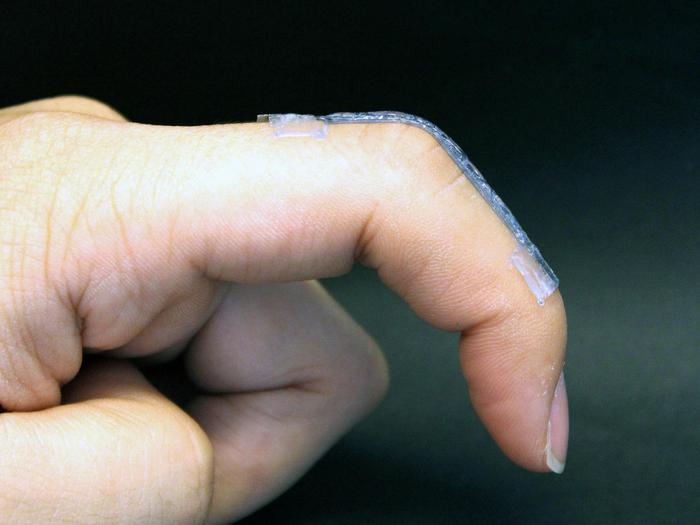
UNIVERSITY PARK, Pa. — To advance soft robotics, skin-integrated electronics and biomedical devices, researchers at Penn State have developed a 3D-printed material that is soft and stretchable — traits needed for matching the properties of tissues and organs — and that self-assembles. Their approach employs a process that eliminates many drawbacks of previous fabrication methods, such as less conductivity or device failure, the team said.

Credit: Marzia Momin
UNIVERSITY PARK, Pa. — To advance soft robotics, skin-integrated electronics and biomedical devices, researchers at Penn State have developed a 3D-printed material that is soft and stretchable — traits needed for matching the properties of tissues and organs — and that self-assembles. Their approach employs a process that eliminates many drawbacks of previous fabrication methods, such as less conductivity or device failure, the team said.
They published their results in Advanced Materials.
“People have been developing soft and stretchable conductors for almost a decade, but the conductivity is not usually very high,” said corresponding author Tao Zhou, Penn State assistant professor of engineering science and mechanics and of biomedical engineering in the College of Engineering and of materials science and engineering in the College of Earth and Mineral Sciences. “Researchers realized they could reach high conductivity with liquid metal-based conductors, but the significant limitation of that is that it requires a secondary method to activate the material before it can reach a high conductivity.”
Liquid metal-based stretchable conductors suffer from inherent complexity and challenges posed by the post-fabrication activation process, the researchers said. The secondary activation methods include stretching, compressing, shear friction, mechanical sintering and laser activation, all of which can lead to challenges in fabrication and can cause the liquid metal to leak, resulting in device failure.
“Our method does not require any secondary activation to make the material conductive,” said Zhou, who also has affiliations with the Huck Institutes of the Life Sciences and the Materials Research Institute. “The material can self-assemble to make its bottom surface be very conductive and its top surface self-insulated.”
In the new method, the researchers combine liquid metal, a conductive polymer mixture called PEDOT:PSS and hydrophilic polyurethane that enables the liquid metal to transform into particles. When the composite soft material is printed and heated, the liquid metal particles on its bottom surface self-assemble into a conductive pathway. The particles in the top layer are exposed to an oxygen-rich environment and oxidize, forming an insulated top layer. The conductive layer is critical for conveying information to the sensor — such as muscle activity recordings and strain sensing on the body — while the insulated layer helps prevent signal leakage that could lead to less accurate data collection.
“Our innovation here is a materials one,” Zhou said. “Normally, when liquid metal mixes with polymers, they are not conductive and require secondary activation to achieve conductivity. But these three components allow for the self-assembly that produces the high conductivity of soft and stretchable material without a secondary activation method.”
The material can also be 3D-printed, Zhou said, making it easier to fabricate wearable devices. The researchers are continuing to explore potential applications, with a focus on assistive technology for people with disabilities.
The papers other authors are Salahuddin Ahmed, Marzia Momin and Jiashu Ren, all doctoral students in the Penn State engineering science and mechanics department, and Hyunjin Lee, a doctoral student in the biomedical engineering department at Penn State. This work was supported by the National Taipei University of Technology-Penn State Collaborative Seed Grant Program and by the Department of Engineering Science and Mechanics, the Materials Research Institute and the Huck Institutes of the Life Sciences at Penn State.
Journal
Advanced Materials
Method of Research
Experimental study
Subject of Research
Not applicable
Article Title
Self-Assembly Enabled Printable Asymmetric Self-Insulated Stretchable Conductor for Human Interface
Article Publication Date
2-Apr-2024
Cite Scienmag News
Denise Maddox. (July 1, 2024). Self-assembling, highly conductive sensors could improve wearable devices. Scienmag. https://scienmag.com/self-assembling-highly-conductive-sensors-could-improve-wearable-devices/
Denise Maddox. "Self-assembling, highly conductive sensors could improve wearable devices." Scienmag, 1 July 2024, https://scienmag.com/self-assembling-highly-conductive-sensors-could-improve-wearable-devices/. Accessed 4 September 2026.
Denise Maddox. "Self-assembling, highly conductive sensors could improve wearable devices." Scienmag. July 1, 2024. https://scienmag.com/self-assembling-highly-conductive-sensors-could-improve-wearable-devices/

