


WASHINGTON, May 7, 2024 – As much as we might not want to think about it, mucus is everywhere in our bodies. It coats our airways and our digestive systems and serves as a first line of defense against pathogens, a habitat for our microbiomes, and a conveyor belt for our insides to keep everything moving smoothly.

Credit: Cai and Braunreuther et al.
WASHINGTON, May 7, 2024 – As much as we might not want to think about it, mucus is everywhere in our bodies. It coats our airways and our digestive systems and serves as a first line of defense against pathogens, a habitat for our microbiomes, and a conveyor belt for our insides to keep everything moving smoothly.
The front-line role of mucus means it is often the site of the first symptoms of infection or disease. Understanding how mucus changes, and what it changes in response to, can help diagnose illnesses and develop treatments. Designing a study to measure the physical properties of mucus, however, is nothing to sneeze at.
In APL Bioengineering, by AIP Publishing, researchers from Stanford University developed a system to grow mucus-producing intestinal cells and study the characteristics of the mucus in different conditions. Their platform can explore the effects of pathogens and help develop medications to combat them.
Currently, researchers looking to study intestinal mucus commonly use lab animals for their experiments. These animals would be given a pathogen or drug, and researchers would surgically remove the intestinal mucus to study the effects. This process is expensive, complex, and most importantly, deeply unpleasant for the animals.
In addition, the researchers say, the act of removing the mucus is likely to change how it behaves, making any obtained results unreliable.
“When people collect the mucus from the animal, they’ll pipette it off or scrape it off,” said author Margaret Braunreuther. “But what we found is that when we pipette the mucus layer from our cell culture, we see a very different behavior after that action. We think that the act of pipetting or scraping this very soft polymeric solution is resulting in more liquidlike behavior.”
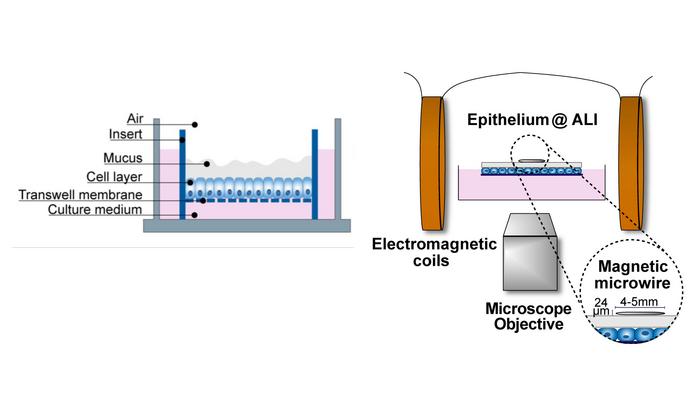
The alternative process developed by the Stanford team involves growing a layer of intestinal cells on a laboratory plate exposed to air. These cells produce a layer of mucus that the researchers can easily access for testing. Using a magnetic wire, they could measure the consistency of the mucus without affecting its properties.
“We put this wire on the mucus layer of the live cells, and then we applied a magnetic force to this probe and measured its displacement,” said Braunreuther. “From the relationship between the applied force and the magnetic wire displacement, we can then calculate the rheological properties of the material.”
Using this setup, the team simulated an infection by a parasitic worm to observe how the mucus responds. This study serves as both a practical demonstration of their platform and a glimpse into how these infections could be treated.
The group is now exploring even more ways to leverage their approach for better mucus health.
“We have a parallel effort to study airway mucus, looking at conditions such as cystic fibrosis and acute asthma,” said author Gerald Fuller. “We also started a collaboration with a group in Berlin to develop drugs to restore a healthy mucus response.”
###
The article “Air-liquid intestinal cell culture allows in situ rheological characterization of intestinal mucus” is authored by Pamela C. Cai, Margaret Braunreuther, Audrey Shih, Andrew J. Spakowitz, Gerald G. Fuller, and Sarah C. Heilshorn. It will appear in APL Bioengineering on May 7, 2024 (DOI: 10.1063/5.0187974). After that date, it can be accessed at https://doi.org/10.1063/5.0187974.
ABOUT THE JOURNAL
APL Bioengineering is an open access journal publishing significant discoveries specific to the understanding and advancement of physics and engineering of biological systems. See http://aip.scitation.org/journal/apb.
###
Journal
APL Bioengineering
Article Title
Air-liquid intestinal cell culture allows in situ rheological characterization of intestinal mucus
Article Publication Date
7-May-2024
Cite Scienmag News
Katie Riggs. (May 7, 2024). Seeking medical insights in the physics of mucus. Scienmag. https://scienmag.com/seeking-medical-insights-in-the-physics-of-mucus/
Katie Riggs. "Seeking medical insights in the physics of mucus." Scienmag, 7 May 2024, https://scienmag.com/seeking-medical-insights-in-the-physics-of-mucus/. Accessed 4 September 2026.
Katie Riggs. "Seeking medical insights in the physics of mucus." Scienmag. May 7, 2024. https://scienmag.com/seeking-medical-insights-in-the-physics-of-mucus/

