

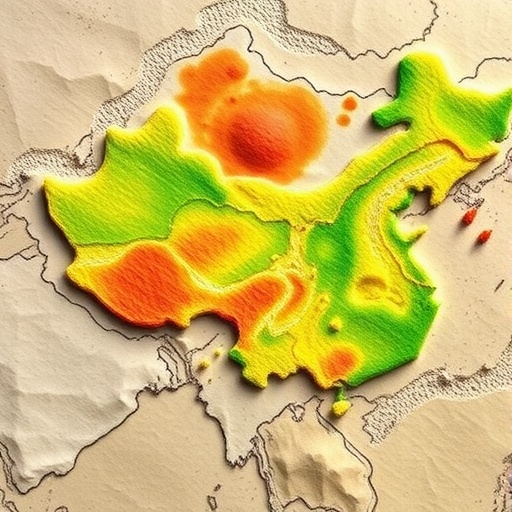
In a groundbreaking study poised to reshape our understanding of nitrogen cycling in terrestrial ecosystems, a team of researchers from Northern China has unveiled contrasting sedimentary nitrogen isotope responses to atmospheric nitrogen deposition. This revelation, published in the prestigious journal Environmental Earth Sciences, provides an unprecedented glimpse into how nitrogen pollutants interact with sedimentary records, shedding light on both historical and ongoing environmental transformations in one of the world’s most rapidly changing regions.
Nitrogen, a fundamental element essential for life, is increasingly influenced by human activities that alter its natural cycles on a global scale. Atmospheric nitrogen deposition, primarily driven by industrial emissions, fossil fuel combustion, and agricultural fertilizers, has surged over recent decades, leaving an indelible mark on ecosystems. Yet, the manner in which these atmospheric inputs are recorded and reflected in sedimentary nitrogen isotopes has remained enigmatic. The study led by Zhou, Wei, Sheng, and colleagues confronts this knowledge gap by exploring spatially divergent isotope patterns in sediments across Northern China, a hotspot of anthropogenic nitrogen input.
Harnessing advanced isotope geochemistry techniques, the research team analyzed sediment cores collected from multiple sites spanning varied environmental settings within Northern China. These analyses focused on the ratio of nitrogen-15 to nitrogen-14 isotopes, a well-established proxy for tracing nitrogen sources and cycling processes. Remarkably, the isotope data revealed two contrasting patterns of nitrogen isotope responses to atmospheric deposition, underscoring the complex interplay between environmental variables, nitrogen sources, and sedimentary processes.
One of the most compelling findings is the identification of sedimentary nitrogen isotope enrichment in regions characterized by intensive agricultural activity. Here, enriched nitrogen-15 signatures suggest a dominance of nitrogen inputs derived from synthetic fertilizers and manure, highlighting the substantial influence of human-driven agricultural practices on sediment chemistry. This isotope enrichment reflects not only the origin of nitrogen but also its transformation pathways through microbial processes such as nitrification and denitrification, processes deeply affected by soil type, moisture, and organic content.
Conversely, areas dominated by urban and industrial emissions displayed a contrasting pattern—sediments exhibiting depleted nitrogen-15 isotope values. This depletion implies that atmospheric nitrogen deposition in these zones is more heavily influenced by combustion-derived nitrogen oxides, which possess distinct isotopic characteristics compared to agricultural sources. The findings suggest that urban-industrial landscapes impose a different nitrogen signature on sediments, reflecting a complex mosaic of deposition sources and biogeochemical cycling mechanisms.
The spatial heterogeneity in sedimentary nitrogen isotopes not only elucidates contemporary nitrogen dynamics but also offers insights into the historical trajectories of nitrogen deposition. Through high-resolution sediment dating, the authors demonstrated temporal shifts in nitrogen isotope ratios that parallel the intensification of industrial and agricultural activities over the past century. This temporal dimension provides a vital framework for reconstructing the evolution of nitrogen pollution and its ecological consequences in Northern China’s rapidly transforming landscapes.
Underlying these isotope variations are intricate biogeochemical processes modulated by environmental conditions such as hydrology, vegetation cover, and soil microbial communities. The study emphasizes that sedimentary nitrogen isotope records are shaped by a confluence of nitrogen source inputs and in-situ microbial processing, which in turn can be influenced by climate variables and land use changes. This complexity calls for integrated approaches that couple isotope geochemistry with ecological and atmospheric monitoring to fully decipher nitrogen cycling mechanisms.
Beyond advancing fundamental science, the research carries profound implications for environmental management and policy formulation. Accurate interpretation of sedimentary nitrogen isotope signals can serve as a powerful tool for assessing the impacts of pollution control measures and tracking the efficacy of nitrogen emission reduction strategies. In a region grappling with air quality challenges and ecosystem degradation, such monitoring capabilities are indispensable for safeguarding environmental health and sustainable development.
Moreover, the methodologies employed open new avenues for cross-disciplinary investigations bridging atmospheric chemistry, soil science, and sedimentology. By linking isotope signatures to specific nitrogen sources and transformations, researchers can refine models predicting nitrogen movement and fate under different land use and climate scenarios. This predictive capacity is crucial for anticipating future environmental changes and designing adaptive management frameworks that mitigate nitrogen pollution risks.
The study also prompts a reevaluation of current assumptions regarding nitrogen isotope behavior in sediments, as the observed contrasting responses underscore the necessity of context-specific interpretations. Blanket applications of nitrogen isotope proxies without accounting for local environmental heterogeneity may lead to erroneous conclusions about nitrogen source attribution and cycling dynamics. Hence, this research advocates for tailored analytical approaches that incorporate multiple lines of evidence to unravel complex biogeochemical interactions.
Furthermore, the research highlights Northern China as an exemplar region for studying anthropogenic nitrogen impacts due to its mixture of intensive agriculture, burgeoning urbanization, and diverse climatic zones. Insights gleaned here can inform regional and global understanding of nitrogen pollution, particularly in rapidly developing areas undergoing similar environmental pressures. The study’s integrative framework offers a template for comparable investigations elsewhere, enhancing our collective capacity to address nitrogen-related environmental challenges.
The nuances revealed by this investigation extend into ecological concerns, as shifts in nitrogen deposition patterns and sedimentary signatures can influence nutrient availability, primary productivity, and ecosystem resilience. Altered nitrogen inputs have cascading effects on soil chemistry, water quality, and biotic communities, with potential feedbacks on carbon cycling and greenhouse gas emissions. Understanding these linkages through isotope-based studies is essential for developing holistic environmental stewardship strategies.
In sum, the research by Zhou and colleagues constitutes a milestone in environmental earth sciences, providing a sophisticated lens through which to view nitrogen’s complex sedimentary imprint amidst human-induced changes. By unraveling the contrasting isotope responses to atmospheric nitrogen deposition, the study enriches our grasp of nitrogen biogeochemistry and its environmental ramifications. This knowledge is poised to catalyze further scientific inquiry, guiding effective interventions to restore and protect vital ecosystems vulnerable to nitrogen pollution.
As humanity navigates the Anthropocene, where human activities increasingly sculpt the planet’s chemical landscape, such rigorous scientific endeavors are critical. They illuminate the subtle signatures of human influence imprinted within natural archives, enabling us to trace, understand, and ultimately mitigate the far-reaching impacts of nitrogen contamination. Through this pioneering research, the intricate story of nitrogen’s journey from atmosphere to sediment unfolds with clarity, offering hope for informed environmental stewardship in Northern China and beyond.
In conclusion, this compelling exploration into nitrogen isotope dynamics not only transforms the scientific narrative around nitrogen deposition but also serves as a clarion call for heightened awareness and proactive environmental governance. Its innovative approach, meticulous data analysis, and profound ecological insights render it a cornerstone contribution to the ongoing effort to unravel the complexities of Earth’s nitrogen cycle under the sway of human development.
Subject of Research: Sedimentary nitrogen isotope responses to atmospheric nitrogen deposition in Northern China.
Article Title: Contrasting sedimentary nitrogen isotope responses to atmospheric nitrogen deposition in Northern China.
Article References:
Zhou, K., Wei, Y., Sheng, E. et al. Contrasting sedimentary nitrogen isotope responses to atmospheric nitrogen deposition in Northern China. Environ Earth Sci 85, 50 (2026). https://doi.org/10.1007/s12665-025-12774-4
Image Credits: AI Generated


