

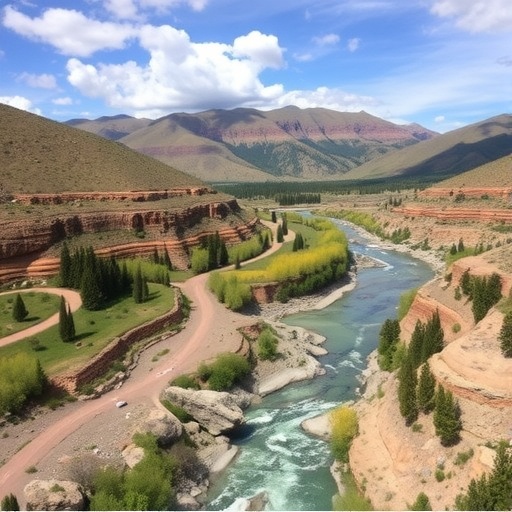
In a groundbreaking study that connects the intricate dynamics of land use with sediment production and transport, researchers Rodrigues, Spagnol, and Rabello have devised various scenarios for the Doce River basin’s future. This research, published in the journal Environmental Monitoring and Assessment, brings to light the critical interrelations between land cover changes and sediment dynamics, which have profound implications for ecological health and water quality.
The study is particularly significant in the context of ongoing environmental challenges, where understanding how land management practices affect sediment movement can inform better policies for conservation and sustainable land use. The Doce River basin, spanning extensive regions imbued with rich biodiversity, serves as an ideal experimental site for observing these complex interactions. The researchers delve deep into how agricultural practices, urban development, and deforestation could alter sediment fluxes within this vital watershed.
Sediments play a crucial role in aquatic ecosystems, influencing water clarity, nutrient transport, and habitat structure for numerous flora and fauna. However, increased sediment production not only compromises these natural settings but also poses threats to human infrastructure and health. Unregulated land use can dramatically elevate sediment yield, leading to adverse effects such as river degradation and increased flooding risks. Through their scenarios, the researchers provide a lucid framework that predicts how different land use decisions will reverberate throughout the ecological landscape.
Utilizing sophisticated modeling techniques, the authors construct various land use scenarios, envisioning pathways ranging from extensive agricultural expansion to the implementation of sustainable agronomic practices. The data reveals that while agriculture is a significant contributor to sediment yield, implementing soil conservation methods could markedly decrease sediment transport to the river. Such alternatives present a compelling case for the necessity of integrating sustainable farming techniques within land use policies to curb the detrimental effects of sediment overproduction.
Moreover, urbanization presents its unique challenges. The study indicates that increased impervious surfaces resulting from urban sprawl heightens runoff and subsequently, sediment transport into the river system. This aligns with broader trends observed globally, where unchecked urban development has led to significant environmental degradation. The researchers call for a renaissance in urban planning, advocating for green infrastructure that minimizes runoff and enhances sediment control mechanisms.
The implications of these findings extend to public health and safety as well. High sediment loads can exacerbate water treatment costs and impair drinking water quality. Consequently, improper management of land resources can infringe upon the very fabric of community health. By investigating the sediment dynamics in the Doce River basin, the study raises crucial questions about responsibility and accountability in land use management.
The research emphasizes the pivotal role of policy-making in shaping land use outcomes. It highlights how informed decisions can mitigate the negative impacts of human activity on sediment transport. The authors argue that robust environmental policies could create a balanced approach that integrates economic, social, and environmental considerations, ensuring a sustainable future for the entire region.
Furthermore, the authors make a compelling argument for why interdisciplinary collaboration is vital in addressing the challenges posed by sediment dynamics. Harmonizing the expertise of ecologists, urban planners, and agricultural specialists can lead to innovative strategies that maximize land use efficiency while minimizing adverse environmental impacts. The potential for collaborative efforts in research and governance shines brightly within this context.
In conclusion, this study serves as a lucid reminder of the interconnectedness of our environmental systems. The intricate relationship between land use, sediment production, and ecology is not merely an academic pursuit but a pressing concern for communities, policymakers, and environmentalists alike. The comprehensive scenarios devised by Rodrigues, Spagnol, and Rabello equip stakeholders with the knowledge needed to navigate these challenges proactively.
As we look toward the future of the Doce River basin, their insights pave the way for transformative approaches to land use management. With proactive measures grounded in scientific understanding, there exists the potential not only to protect the river’s ecological integrity but also to enhance community resilience against environmental stresses. The findings advocate for a reevaluation of land use priorities that could fundamentally alter the trajectory of the Doce River basin for generations to come.
Ultimately, by bridging scientific research with practical applications in land management, the work of these researchers offers a roadmap for navigating the complexities of sediment dynamics. Their research encourages a collaborative and proactive spirit in addressing the environmental challenges that face not only the Doce River basin but ecosystems worldwide.
The call to action is clear: we must prioritize sustainable land use practices that champion ecological health and community well-being. The flourishing of our rivers depends upon the choices we make today concerning our lands. The study lays the groundwork for a renewed commitment to safeguarding these vital waterways amid the ever-changing landscape of human intervention.
Subject of Research: Interrelations between land use scenarios and sediment production and transport in the Doce River basin.
Article Title: Land use and land cover scenarios and their interrelations with sediment production and transport—Doce River basin.
Article References:
Rodrigues, M.B., Spagnol, I.T., Rabello, L.L. et al. Land use and land cover scenarios and their interrelations with sediment production and transport—Doce River basin.
Environ Monit Assess 198, 61 (2026). https://doi.org/10.1007/s10661-025-14912-8
Image Credits: AI Generated
DOI: https://doi.org/10.1007/s10661-025-14912-8
Keywords: Sediment production, land use, environmental assessment, Doce River basin, sustainable practices, ecological health.


