


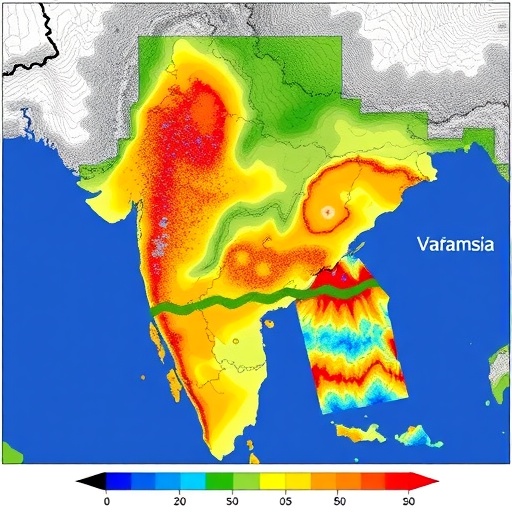
A groundbreaking study conducted by Tiwari, Mishra, and Tripathi has brought to light the intricate relationship between seasonal land surface temperature (LST) and various land use indices in Varanasi, India. The research, set to be published in the journal Discover Cities, offers a compelling examination of how spatio-temporal variations in LST correlate with spectral land use indices, revealing critical insights into urban climate dynamics.
The primary focus of the study is to assess how LST changes seasonally in relation to urban development and land use patterns. Varanasi, a historical city known for its cultural significance, is also facing significant urban expansion and associated environmental challenges. The researchers utilized satellite imagery and advanced statistical models to conduct their analysis over multiple seasons, providing a comprehensive overview of how urban land use influences temperature variations.
By employing remote sensing techniques, the team carefully analyzed data gathered from various seasons to understand how different land use types—such as residential, agricultural, and industrial—affect LST. Their methodology involves a sophisticated approach that integrates spectral indices, which measure different properties of the Earth’s surface, with temperature readings. This intersection of technology and environmental science sheds light on the complexities of urban heat islands and their development in rapidly urbanizing regions like Varanasi.
The findings reveal that seasonal variations in LST are heavily influenced by the type of land cover present in an area. For instance, urbanized regions with high levels of impervious surfaces showed markedly higher temperatures compared to areas with more vegetation or water bodies. This denotes a significant urban heat island effect, where cities experience higher temperatures than their rural counterparts, leading to various ecological and health-related implications. The relationship between spatio-temporal LST and land use indices necessitates urgent attention as cities continue to expand.
Moreover, the research underscores the global relevance of urban heat management strategies. As city populations grow, the increased demand on infrastructure and resources exacerbates temperature fluctuations. Understanding these dynamics not only assists in urban planning and development but also informs policy decisions aimed at mitigating the adverse effects of climate change in urban environments.
The researchers emphasized the importance of integrating LST data into urban planning processes. By recognizing variations in temperature across different land use types, city planners can adopt targeted measures to enhance green spaces within urban areas. Parks, community gardens, and rooftop greenery not only improve local climate conditions but also enhance the overall quality of life for residents, thereby fortifying the city’s resilience against climate change.
Importantly, the study highlights how these temperature variations are not just limited to Varanasi but are applicable to urban areas worldwide, especially in developing countries facing similar rapid urbanization. As cities grapple with the repercussions of climate change, understanding these intricate relationships between land surface temperatures and urban configurations becomes crucial for sustainable development.
Furthermore, the research indicates that long-term monitoring of LST and land use will pave the way for adaptive strategies that can effectively respond to the ever-changing urban landscape. This ongoing assessment is vital for generating effective urban heat management strategies that have the potential to minimize the impact of extreme temperatures on vulnerable populations.
In addition to environmental benefits, incorporating this knowledge into urban design can yield economic benefits as well. Investments in sustainable infrastructure, such as green roofs and reflective pavements, can result in reduced energy consumption, lower cooling costs, and increased property values. The interrelationship between urban form and climate underscores the necessity for a holistic approach to city planning that acknowledges the vital connections between environment and human well-being.
The researchers also called for collaboration between governmental agencies, urban planners, and environmental scientists. This multi-faceted approach can ensure that climate considerations are integrated into every level of urban decision-making, fostering communities that are not only more sustainable but also more adaptable to the challenges posed by climate change.
As urban centers like Varanasi continue to transform, this important research provides a timely reminder of the significant role that informed urban design can play in addressing climate change. The findings serve as an essential resource for stakeholders worldwide looking to implement effective strategies to mitigate the urban heat island effect and promote greener, healthier environments for their residents.
In conclusion, this groundbreaking research by Tiwari, Mishra, and Tripathi establishes a foundational understanding of how seasonal land surface temperatures interact with land use indices in urban areas. By illuminating these relationships, the study paves the way for innovative approaches to urban planning that prioritize sustainability and resilience in the face of multiple environmental challenges.
Tiwari, N., Mishra, P.K. & Tripathi, V.K. Assessment of spatio-temporal variation in seasonal land surface temperature and its relationship with spectral land use indices in Varanasi.
Discov Cities 2, 74 (2025). https://doi.org/10.1007/s44327-025-00120-z
Cite Scienmag News
Courtney Benton. (November 16, 2025). Seasonal Land Surface Temperature Variations in Varanasi. Scienmag. https://scienmag.com/seasonal-land-surface-temperature-variations-in-varanasi/
Courtney Benton. "Seasonal Land Surface Temperature Variations in Varanasi." Scienmag, 16 November 2025, https://scienmag.com/seasonal-land-surface-temperature-variations-in-varanasi/. Accessed 4 September 2026.
Courtney Benton. "Seasonal Land Surface Temperature Variations in Varanasi." Scienmag. November 16, 2025. https://scienmag.com/seasonal-land-surface-temperature-variations-in-varanasi/


