

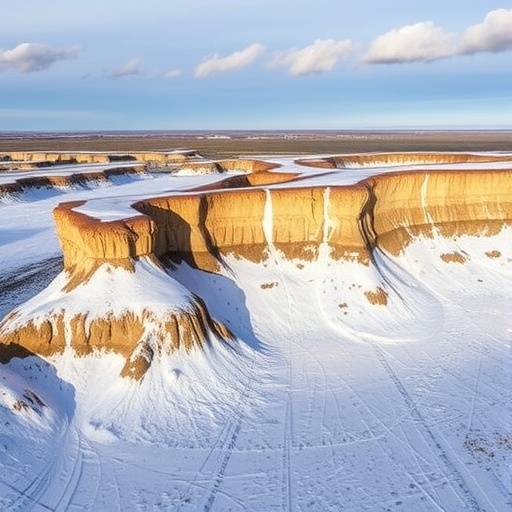
In a groundbreaking study poised to reshape our understanding of polar landscapes, researchers have unveiled compelling evidence that seasonal freezing processes significantly amplify erosion in the High Arctic, fundamentally altering how these fragile environments respond to the intensifying extremes of climate change. This investigation, spearheaded by Eschenfelder, Chartrand, Jellinek, and colleagues, sheds new light on the dynamic interplay between temperature fluctuations and geomorphological change in one of the most sensitive regions on Earth. Their findings, published in Communications Earth & Environment, challenge existing paradigms about Arctic landscape stability and underscore the urgency of re-evaluating climate impact models to incorporate the newly recognized effects of freeze-thaw cycles.
The High Arctic, defined by its perennially frigid conditions and expansive ice coverage, has long been perceived as a relatively static environment, where slow geological processes govern terrain evolution. However, Eschenfelder et al. reveal that this longstanding assumption underestimates the dramatic role that seasonal freeze-thaw oscillations play in intensifying erosional forces. As winter temperatures plummet and the landscape succumbs to deep freezing, the physical structure of surface materials is altered profoundly. When spring arrives and the ice thaws, soils and sediment become highly destabilized, primed for rapid mobilization. This cyclical pattern, exacerbated year after year, supercharges erosional mechanisms, leading to unexpected landscape degradation.
At the heart of this research lies an intricate analysis of both in situ observations and remote sensing data, combined with sophisticated climate and erosion models. The authors mapped seasonal freeze depth and duration across multiple High Arctic sites, correlating these parameters with sediment displacement rates measured over recent decades. Their results demonstrate a direct link: longer, deeper seasonal freezes correspond with exponentially higher erosion rates once thaw commences. This reveals a feedback loop where intensified freeze-thaw cycles, driven by climate variability, accelerate landscape change beyond what melting ice alone would predict.
One of the most striking revelations pertains to the timing and intensity of climate extremes such as winter cold spells followed by abrupt spring warming events. These conditions produce what researchers describe as “thermal shock” to surface materials, fracturing rocks, and loosening sediment. This phenomenon, historically overlooked in Arctic geomorphology, emerges as a pivotal driver of erosion. The resultant sediment mobilization not only reshapes landforms but also impacts downstream ecological systems through increased turbidity and altered nutrient flows in Arctic rivers and coastal zones.
The implications of these findings reach far beyond geology, intersecting with the fields of ecology, hydrology, and climate science. As landscapes erode more rapidly, permafrost—already vulnerable due to rising global temperatures—experiences accelerated thawing in adjacent zones through exposed subsurface heat transfer. This process releases trapped greenhouse gases like methane and carbon dioxide, contributing to a feedback cycle that amplifies global warming. The research by Eschenfelder and colleagues thus situates the Arctic landscape not merely as a passive victim of climate change but as an active agent in accelerating planetary warming.
Furthermore, the study identifies distinct geomorphological responses dependent on local landscape features such as slope, soil composition, and vegetation cover. Areas with loose, silty sediments are particularly susceptible to freeze-driven erosion, whereas rocky, well-vegetated terrains display more resilience. This heterogeneity suggests that predictive models must incorporate detailed spatial variability rather than global averages to accurately forecast future Arctic landscape dynamics. The authors advocate for the integration of these localized erosion patterns into climate adaptation policies and conservation efforts aimed at preserving Arctic ecosystems.
Technically, the research employs advanced ground-penetrating radar (GPR) and thermal imaging to monitor subsurface ice formation and thaw during freeze-thaw cycles in real time. These cutting-edge methods allow the team to capture the microphysical alterations in permafrost layers as seasonal freezing progresses. Coupling these observations with satellite data enables comprehensive monitoring of erosion fronts and sediment transport pathways. The multifaceted methodological approach represents a significant advance in polar geoscience, offering the potential to track rapid environmental changes with unprecedented precision.
Intriguingly, the study also highlights the impact of episodic extreme weather events—such as polar vortex disruptions and unseasonal warm spells—on the erosion process. Such events amplify the freeze-thaw erosional feedback, producing episodic bursts of sediment displacement far exceeding the gradual baseline rates. This non-linear response of the Arctic landscape to climate extremes presents new challenges for scientists attempting to model and project future terrain stability under increasingly volatile weather regimes.
The research team contextualizes these observations within the broader framework of cryosphere change, emphasizing that seasonal freezing, traditionally viewed as a stabilizing process that locks sediment in place during winter, paradoxically acts as a catalyst for accelerated erosion under current climate trends. This nuanced perspective reframes the debate around Arctic landscape vulnerability and calls for more integrative research approaches that consider multiple interacting physical processes rather than isolated environmental factors.
The study’s revelations carry profound implications for indigenous communities and wildlife dependent on Arctic landforms. Accelerated erosion alters habitat distribution and accessibility, threatening subsistence hunting grounds and migratory corridors. Moreover, changes in sediment flux influence nutrient availability and aquatic habitats, disrupting entire food webs that sustain Arctic biodiversity. Recognizing these socio-ecological linkages is vital for developing sustainable management strategies underpinned by robust scientific understanding.
Looking forward, Eschenfelder and colleagues propose intensified monitoring efforts leveraging emerging technologies like autonomous drones and high-resolution satellite constellations to track seasonal freeze-thaw dynamics continuously. Integrating machine learning algorithms with these datasets could enable predictive modeling at unprecedented temporal and spatial scales, offering early warnings of geomorphological shifts with societal and ecological ramifications. Such proactive monitoring is critical to mitigate risks posed by rapid Arctic environmental transformations.
This pioneering work unequivocally establishes seasonal freezing—not just thawing—as a principal orchestrator of High Arctic landscape evolution in the context of climate extremes. It challenges traditional assumptions in polar science and invites a paradigm shift in how researchers, policymakers, and the global community understand and respond to Arctic environmental change. The study underscores the complexity and interconnectedness of cryospheric processes, calling for urgent, coordinated responses to preserve the integrity of this vital planet zone.
In essence, as climate change relentlessly reshapes the Arctic, the dualistic nature of seasonal freezing cycles emerges as both a physical agent of erosion and a climatic amplifier. The knowledge illuminated by Eschenfelder, Chartrand, Jellinek, and their team not only advances scientific frontiers but also highlights the precarious balance sustaining Earth’s coldest frontiers. Their work stands as a clarion call for intensified research investments and novel cross-disciplinary collaborations aimed at decoding and safeguarding the future of the High Arctic landscapes.
The depth of insight afforded by this research promises to recalibrate environmental models and inform international climate policy frameworks with granular precision. It encourages a reevaluation of engineering and conservation methodologies currently employed in Arctic infrastructure planning. Incorporating seasonal freeze-thaw induced erosion into risk assessments will prove essential to anticipate infrastructure instability, guide resilient construction, and foster sustainable community development under rapidly evolving environmental conditions.
Ultimately, this study reveals that the High Arctic’s response to climate extremes is far more dynamic and complex than previously understood. The accentuated erosional processes driven by seasonal freezing not only reshape terrestrial landscapes but also reverberate through global climate systems. As the planet warms, understanding and addressing these interconnected processes will be critical to forecasting future environmental scenarios and implementing effective mitigation strategies worldwide.
Article References:
Eschenfelder, J.A., Chartrand, S.M., Jellinek, A.M., et al. Seasonal freezing increases High Arctic erosion and landscape response to climate extremes. Commun Earth Environ (2026). https://doi.org/10.1038/s43247-026-03468-1
Image Credits: AI Generated


