


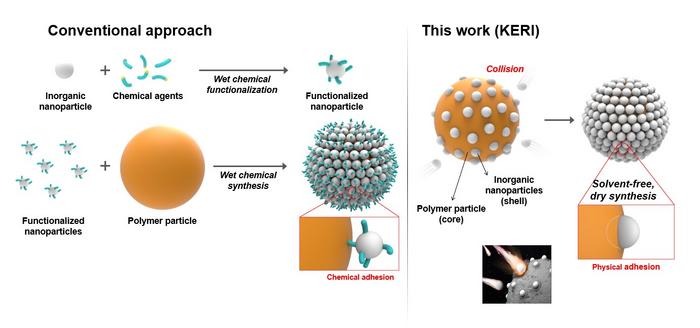
In an innovative leap for materials science, Dr. Seunggun Yu and his team at the Korea Electrotechnology Research Institute (KERI) have unveiled a transformative technology called ‘Hybrid Supraparticle Synthesis Technology’. This groundbreaking method represents a significant departure from conventional fabrication techniques, allowing the attachment of inorganic nanoparticles to polymer microparticles through a process of mechanical collision. By eliminating the complexities and environmental hazards associated with traditional wet-chemical methods, this new synthesis approach may well industry-wide applications, from batteries to biotechnology.
Traditionally, in the manufacturing of composite materials, combining functional inorganic nanoparticles with polymer microparticles has been achieved through wet chemical processes. These established methodologies are fraught with difficulties, including elaborate multi-step procedures, increased costs, and significant environmental impacts due to solvent usage. Moreover, existing surface functionalization technologies are often limited in their ability to establish reliable chemical bonding between disparate materials. The introduction of the hybrid synthesis method fundamentally changes this dynamic, significantly addressing these challenges and paving the way for cleaner and more efficient production methods.
Inspired by lunar geology, specifically the impact craters created by asteroids, Dr. Yu’s research draws a parallel to the mechanics of particle collision in their innovative technique. The method is predicated on the physical and mechanical collisions of particles, whereby inorganic nanoparticles are strategically attached one at a time to the surfaces of larger polymer microparticles. This creates a novel core-shell structure, where the nanoparticles constitute a protective and functional outer layer enveloping the polymer core.
Although the principles underlying this synthesis may appear deceptively simple, the practical implementation is marked by a multitude of complex factors that must be meticulously balanced. These include the size ratios of the two types of particles, the speed and angles at which they collide, and the energy involved in their rotation. Furthermore, variations in surface energy and roughness also play crucial roles in the efficacy of the synthesis. Dr. Yu’s research team spent considerable time establishing the optimal parameters for this process, ultimately making it feasible to combine a wide variety of inorganic nanoparticles with polymer microparticles that exhibit diverse properties.
One of the major breakthroughs of this research has been the development of technology aimed at quantitively analyzing key metrics like the degree of nanoparticle attachment, resulting surface coverage, and the stability of the interface bonding. This analytical capability has allowed the team to assess thermal, mechanical, and chemical durability, culminating in the synthesis of highly reliable and multifunctional composite particles adept at withstanding various environmental challenges. Beyond just durability, these composite particles also exhibit impressive features such as magnetic properties, photocatalytic activity, and high adsorption capabilities.
The recognition of their work is underscored by the publication of their findings in the prestigious journal Advanced Materials, a leading platform in the realm of materials science research. This accolade is further emphasized by the journal’s formidable impact factor of 27.4, which positions it among the top 1.9% of scientific journals in the field. Such a high impact factor is an indicator of the exceptional quality and relevance of the research, ensuring that it gains the attention of industry leaders and researchers alike.
Dr. Yu articulated the far-reaching implications of their eco-friendly, solvent-free synthesis approach, noting that it allows for the easy combination of essential materials in a process reminiscent of assembling toy blocks. Not only does this innovation facilitate mass production and commercialization, but it also makes the technology attractive due to its broad applicability across various industries. The method’s inherent simplicity coupled with high reproducibility presents a low barrier for industrial entry, ensuring that this innovation can be readily adopted in diverse manufacturing environments.
In pursuit of continued advancements in this field, KERI is focused on further optimizing the synthesis processes through ongoing research initiatives. The institute is proactively seeking industry partners who are interested in collaborating on this technology, highlighting their commitment to driving technology transfer and real-world application of their research findings. Empowered by strong collaborative ties with universities and other research entities, KERI is poised to spearhead the commercialization of this revolutionary synthesis method.
This research endeavor was made possible through collaborations with esteemed researchers from various institutions, including Professor Dong Woog Lee’s team at UNIST, Dr. Seung-Yeol Jeon’s team at the Korea Institute of Science and Technology (KIST), and Professor Shu Yang’s team at the University of Pennsylvania. Such interdisciplinary teamwork underscores the importance of collective expertise in enhancing the scope and impact of scientific research in the field of materials science.
The implications of KERI’s ‘Hybrid Supraparticle Synthesis Technology’ extend well beyond the immediate results of their research. As the margins between traditional and innovative synthesis techniques blur, industry sectors ranging from electronics to energy storage can benefit significantly from advancements in composite materials. The team’s findings herald a new age of potential applications, which could include improved battery performance, innovative drug delivery systems in pharmaceuticals, and advanced materials for semiconductor manufacturing.
Moreover, the future of materials synthesis may witness a paradigm shift thanks to the insights derived from this influential research. By embracing an environmentally conscious and technologically advanced synthesis methodology, industries can hope to streamline their production processes while reducing their ecological footprints. As sustainability continues to ascend the hierarchy of global manufacturing priorities, KERI’s approach offers a compelling blueprint for how materials science can adapt to meet these challenges head-on.
The impact of KERI’s discoveries may well expand to foster a new generation of materials characterized by versatility and resilience, capable of meeting the escalating demands of contemporary technological landscapes. In an era of increasing complexity and innovation, advancements in hybrid synthetic pathways could very well redefine how materials integrate functionality and durability in an eco-friendly manner.
Cite Scienmag News
Denise Maddox. (June 17, 2025). Seamlessly Connect Nanoparticles Like Building Blocks for Industrial Applications! Scienmag. https://scienmag.com/seamlessly-connect-nanoparticles-like-building-blocks-for-industrial-applications/
Denise Maddox. "Seamlessly Connect Nanoparticles Like Building Blocks for Industrial Applications!" Scienmag, 17 June 2025, https://scienmag.com/seamlessly-connect-nanoparticles-like-building-blocks-for-industrial-applications/. Accessed 6 September 2026.
Denise Maddox. "Seamlessly Connect Nanoparticles Like Building Blocks for Industrial Applications!" Scienmag. June 17, 2025. https://scienmag.com/seamlessly-connect-nanoparticles-like-building-blocks-for-industrial-applications/


