


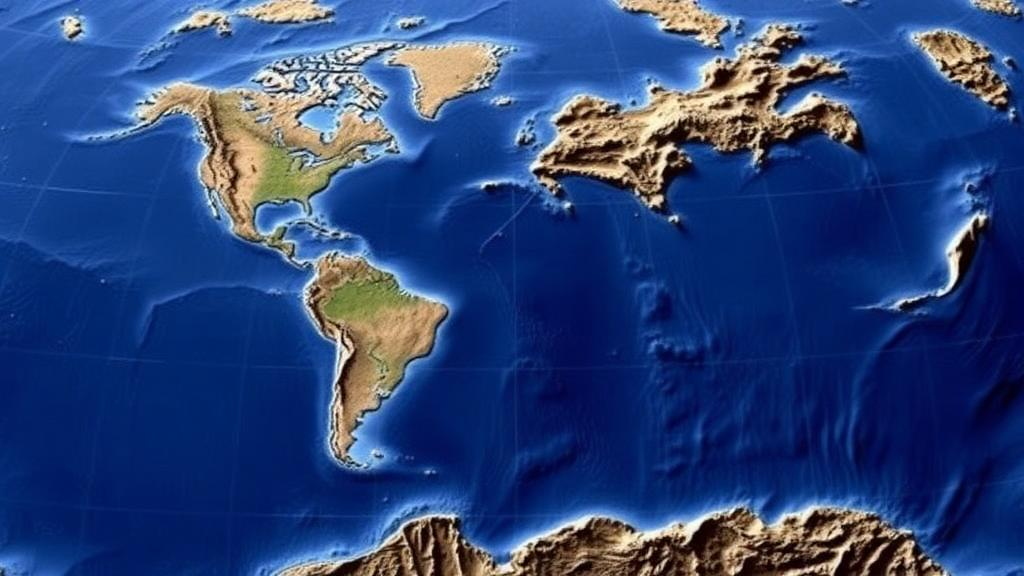
What really drives Earth’s climate? For decades, scientists have pointed to the familiar cast of characters: the Sun, greenhouse gases, the layout of continents, and the great mountain ranges that deflect winds and storms. But a new modeling study published in the journal Ocean-Land-Atmosphere Research on August 25, 2026, adds a less visible protagonist to that list—the shape of the seafloor itself. Researchers led by Peixi Wang, a postdoctoral researcher at Sun Yat-sen University, used a fully coupled climate model to ask a deceptively simple question: if you erase every continent on Earth but keep the ocean’s real bathymetry, does the climate system still look like the one we know? The answer, strikingly, is that much of it does.
The team’s approach was built on a class of idealized experiments known as aquaplanet simulations. In a standard aquaplanet, the planet is reduced to a featureless global ocean: no land, no mountains, no sea ice, and a uniform seafloor. Such experiments have long been used to isolate the behavior of atmospheric general circulation models, or AGCMs, and to test how the atmosphere responds when the complicating influence of geography is stripped away. But Wang and his colleagues inverted the logic. Instead of removing everything, they removed only the continents and the land surface, while preserving the actual three-dimensional topography of the ocean floor—its ridges, basins, and sills—in a configuration they called BATHY.
The experiments were run with the Community Earth System Model version 1.2.2, a fully coupled model in which ocean, atmosphere, sea ice, and land interact dynamically. The researchers performed two simulations. The first, named REAL, used present-day Earth geography and served as the control. The second, BATHY, replaced all land with a shallow 10-meter-deep ocean while retaining the original ocean bathymetry beneath. By comparing the two worlds, the team could isolate the influence of seafloor topography from that of continental geometry and land-surface processes, a separation that is impossible to achieve with observations of the real Earth alone.
The results were remarkable. Compared with the real Earth, the BATHY planet retained a broadly similar large-scale ocean circulation, though with an overall strengthening of key current systems. Most notably, a realistic Atlantic Meridional Overturning Circulation, or AMOC—the great conveyor of deep water formation and northward heat transport that operates in the Atlantic basin—persisted even without an Atlantic basin bounded by continents. In addition, a Pacific Meridional Overturning Circulation, a PMOC, emerged in the model, a feature that is absent or weak in the present-day ocean. These overturning cells are among the most consequential structures in the climate system, because they govern how heat is carried from the tropics toward the poles and how carbon and nutrients are exchanged between the surface and the deep ocean.
The consequences rippled through the entire coupled system. As ocean currents shifted and wind systems redistributed heat, the model’s Antarctic region warmed while the Arctic cooled. The Antarctic Circumpolar Current, the mighty eastward flow that rings Antarctica and isolates the southern continent from warmer subtropical waters, weakened in the BATHY configuration. Meridional heat transport—the poleward movement of energy by ocean and atmosphere—was substantially reorganized. The atmosphere responded in kind: the Hadley circulation, the vast tropical overturning cell that shapes the trade winds and the position of the Intertropical Convergence Zone, adjusted measurably, westerly wind belts shifted, and the ITCZ migrated southward. Sea-ice changes and their associated feedbacks amplified the hemispheric temperature contrasts.
Perhaps the most philosophically intriguing finding concerns hemispheric asymmetry. In the real world, the Northern and Southern Hemispheres differ profoundly: one is dominated by continents, the other by ocean, and the AMOC contributes to a persistent interhemispheric temperature contrast. The researchers found that even on a continent-free planet, this asymmetry survived—sustained by the existence of an AMOC-like overturning—although it was substantially reduced compared with the REAL configuration. In other words, bathymetry alone can imprint a north-south asymmetry on the climate, but the full magnitude of Earth’s hemispheric contrast requires the combined action of seafloor shape and continental geometry. As Wang explained, the result highlights the combined roles of ocean bathymetry and continental geometry in shaping Earth’s climate.
The broader significance of the study lies in how it reframes the role of the ocean floor. In most climate thinking, bathymetry is treated as a passive boundary condition—a static floor beneath the water. The BATHY experiments demonstrate that it is anything but passive. By steering the pathways of deep currents, controlling where dense water can form and spread, and setting the geometry of basin-scale overturning, the seafloor actively regulates coupled ocean-atmosphere dynamics. Because the ocean carries a substantial fraction of the planet’s poleward heat transport, particularly in the tropics and Southern Hemisphere, any reorganization of large-scale circulation driven by bathymetry translates directly into changes in surface temperature, precipitation patterns, and sea-ice extent.
The study also clarifies the division of labor among the three kinds of topography that shape climate. Continental topography, such as the Tibetan Plateau and the Rocky Mountains, is well known to anchor atmospheric stationary waves and monsoon systems. Land-sea distribution controls where continents heat and cool faster than water, driving monsoons and continental climates. Bathymetry, the third member of the trio, has been the least explored in coupled models, partly because idealized frameworks often flatten it. By retaining realistic bathymetry in an otherwise ocean-covered world, Wang and colleagues have shown that it is a first-order player, capable of sustaining and reshaping the key features of the climate system on its own.
The implications extend beyond the modern Earth. Understanding how bathymetry regulates circulation and heat transport offers a tool for interpreting past climates, epochs in which seafloor geometry, gateways, and basin configurations differed from today’s, reshaping ocean currents and global temperatures in the process. It may also inform thinking about other planetary environments, where the topography beneath a global ocean could similarly organize circulation and climate. The research team sees the next step as quantifying how individual components of ocean bathymetry and continental geometry regulate circulation and climate. Ultimately, as Wang put it, the goal is to better understand how ocean bathymetry interacts with the other components of the Earth system to shape the global climate.
The research team included Peixi Wang, Yihan Zhang, Song Yang, and Xiaoming Hu from Sun Yat-sen University, Zhenning Li from the Hong Kong University of Science and Technology, and Qianyi Yu from Fudan University. The work was funded by the National Natural Science Foundation of China and published in Ocean-Land-Atmosphere Research. For a field that has long treated the seafloor as scenery, the message of the Bathyplanet experiments is clear: the hidden landscape beneath the waves is an active architect of the climate we live in, and any complete account of Earth’s climate system must look down, not just around.
Subject of Research: The role of ocean bathymetry in shaping large-scale ocean circulation and global climate, investigated through aquaplanet simulations
Article Title: Ocean topography’s important role in Earth’s climate
Article References: Ocean topography’s important role in Earth’s climate. (n.d.). Original publication
Image Credits: AI Generated
DOI: Not provided
Keywords: ocean bathymetry, aquaplanet simulation, AMOC, PMOC, ocean circulation, climate modeling, heat transport, Antarctic Circumpolar Current, ITCZ, Hadley circulation, sea ice, hemispheric asymmetry
Cite Scienmag News
Violet Maxwell. (October 1, 2026). Seafloor Shapes Alone Can Steer Earth’s Climate, Even Without Continents. Scienmag. https://scienmag.com/seafloor-shapes-alone-can-steer-earths-climate-even-without-continents/
Violet Maxwell. "Seafloor Shapes Alone Can Steer Earth’s Climate, Even Without Continents." Scienmag, 1 October 2026, https://scienmag.com/seafloor-shapes-alone-can-steer-earths-climate-even-without-continents/. Accessed 4 October 2026.
Violet Maxwell. "Seafloor Shapes Alone Can Steer Earth’s Climate, Even Without Continents." Scienmag. October 1, 2026. https://scienmag.com/seafloor-shapes-alone-can-steer-earths-climate-even-without-continents/


