

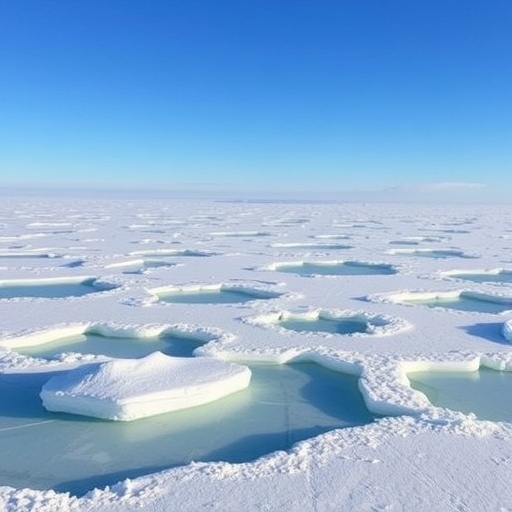
In the rapidly warming Arctic, the transformation of sea ice exerts profound influence far beyond the ocean’s frozen surface, extending into the fragile snowpack above it. A groundbreaking study led by Macfarlane, Mellat, Dadic, and their colleagues, published in Nature Communications in 2026, has revealed a previously underappreciated mechanism shaping the Arctic snowpack: sea-ice recrystallization. This intricate physical process, occurring within the crystalline matrix of sea ice, not only alters the microstructure of the ice itself but significantly impacts the thermal and mechanical properties of the overlying snow layers, thus playing a critical role in the Arctic climate system.
Recrystallization is a well-documented phenomenon in materials science and geophysics, involving the reorganization of crystal grains without melting, typically driven by temperature gradients, mechanical stresses, or impurities. In the Arctic context, as sea ice undergoes seasonal cycling of freezing and partial melting, microscopic ice crystals merge, reorganize, and grow in size, a process that subtly but powerfully changes the sea ice’s microtexture. This microstructural evolution directly modifies how sea ice insulates the ocean from the atmosphere and alters the snowpack that accumulates on top. Until now, the extent to which these changes in sea ice influenced snowpack properties remained elusive.
The new research employs state-of-the-art imaging techniques, including X-ray computed tomography and advanced electron microscopy, to visualize the grain evolution inside recrystallizing sea ice samples collected across various Arctic sites. By analyzing crystal orientations and boundaries, the researchers uncovered a dynamic cycle of grain boundary migration and grain coalescence, which results in larger and fewer crystalline grains over time. This recrystallization process impacts the porosity and permeability of the ice, altering how heat and moisture transfer occurs between the ocean and the atmosphere.
One of the most striking revelations from this study is how changes in the sea ice texture due to recrystallization influence the accumulation and metamorphism of the Arctic snowpack. Snow, which consists of loosely bound ice crystals, is highly sensitive to the underlying substrate’s temperature and moisture regime. The modified thermal conductivity of recrystallized sea ice alters the snow temperature gradients, driving enhanced vapor transport within the snowpack. This enhanced vapor flux promotes complex snow metamorphic processes, including sublimation and recrystallization of snow grains, which reshape the snow’s microstructure and density distribution.
This feedback loop between sea-ice crystal evolution and snowpack metamorphism has far-reaching climate implications. Snowpack properties such as density, grain size, and layering determine its albedo—the amount of solar radiation reflected back into space. Altered albedo modifies how much solar energy the Arctic surface absorbs, which in turn affects regional warming patterns and the timing of snow and ice melt. Sea-ice recrystallization thus indirectly modulates Arctic energy budgets through its influence on snowpack radiation processes, highlighting a crucial and previously underexplored climate feedback mechanism.
The interdisciplinary nature of this discovery stems from combining cryospheric physics, high-resolution imaging, and climate modeling. The team integrated microstructural data from sea-ice samples into snow and ice thermodynamic models, revealing that even subtle recrystallization-induced changes in sea ice can measurably influence the thickness and persistence of Arctic snow until spring melt. This finding challenges traditional views that largely considered the snowpack and sea ice as physically separate entities in climate simulations, underscoring the need to model their coupled evolution explicitly.
Beyond theoretical insights, these results have practical implications for understanding the future trajectory of the Arctic system under accelerated warming. As Arctic sea ice thickness declines and seasonal cycling becomes more pronounced, recrystallization processes are expected to intensify, leading to altered snowpack properties that may exacerbate or mitigate warming in complex ways. Incorporating recrystallization dynamics into Earth system models could improve projections of Arctic snow and ice extent, ecosystem responses, and even global sea-level rise via feedbacks influencing ice sheet stability.
Interestingly, the study also sheds light on the microscopic fingerprints of environmental stressors on sea ice. Variations in salinity, impurity content such as black carbon, and mechanical deformation caused by winds and currents all influence recrystallization pathways. These factors modify the kinetics of grain growth and texture development, thereby altering how sea ice interacts thermodynamically with its environment. This nuanced understanding helps link microscopic processes to large-scale climatic and ecological phenomena, representing a significant advance in cryospheric science.
The researchers emphasize that this discovery opens new avenues for remote sensing of Arctic snow and ice properties. Satellite sensors that capture spectral signatures related to snow grain size and ice texture could potentially detect the imprint of recrystallization indirectly, offering a novel diagnostic tool for monitoring sea-ice health and dynamic evolution in real time. Advances in this domain could enhance early warning systems for shipping, resource extraction, and indigenous community activities disrupted by shifting ice conditions.
Furthermore, the interplay between recrystallizing sea ice and snowpack evolution has implications for Arctic wildlife, especially species dependent on the stability and timing of snow and ice cover. Changes in thermal insulation and surface albedo influence vegetation cycles, prey availability, and habitat conditions for animals such as polar bears, seals, and migratory birds. By resolving these microphysical climate linkages, the study contributes critical knowledge needed to anticipate ecological tipping points in a rapidly changing Arctic environment.
The work by Macfarlane and colleagues marks a significant step in comprehending the complex cryo-environmental interactions that govern Earth’s polar regions. By unveiling the critical role of sea-ice recrystallization in modifying snowpack structure and behavior, they have introduced a fundamental piece of the Arctic climate puzzle. As the polar regions continue to experience unprecedented warming and ice loss, understanding such microscale processes and their macroscale consequences will be pivotal for predicting future climate trajectories with greater precision and credibility.
In sum, this research underscores the intricate interdependence of physical processes at the ice-ocean-atmosphere interface. It reminds us that the Arctic system’s fate depends not only on large-scale patterns of temperature and ice extent but also on subtle, microscopic transformations occurring within the ice itself. As climate change accelerates, such refined insights will be indispensable for scientists, policymakers, and communities striving to navigate the uncertain future of the planet’s northernmost frontier.
Subject of Research: The physical process of sea-ice recrystallization and its impact on the structure and metamorphism of the Arctic snowpack.
Article Title: The contribution of sea-ice recrystallization to the Arctic snowpack.
Article References:
Macfarlane, A.R., Mellat, M., Dadic, R. et al. The contribution of sea-ice recrystallization to the Arctic snowpack. Nat Commun (2026). https://doi.org/10.1038/s41467-026-68762-0
Image Credits: AI Generated


